



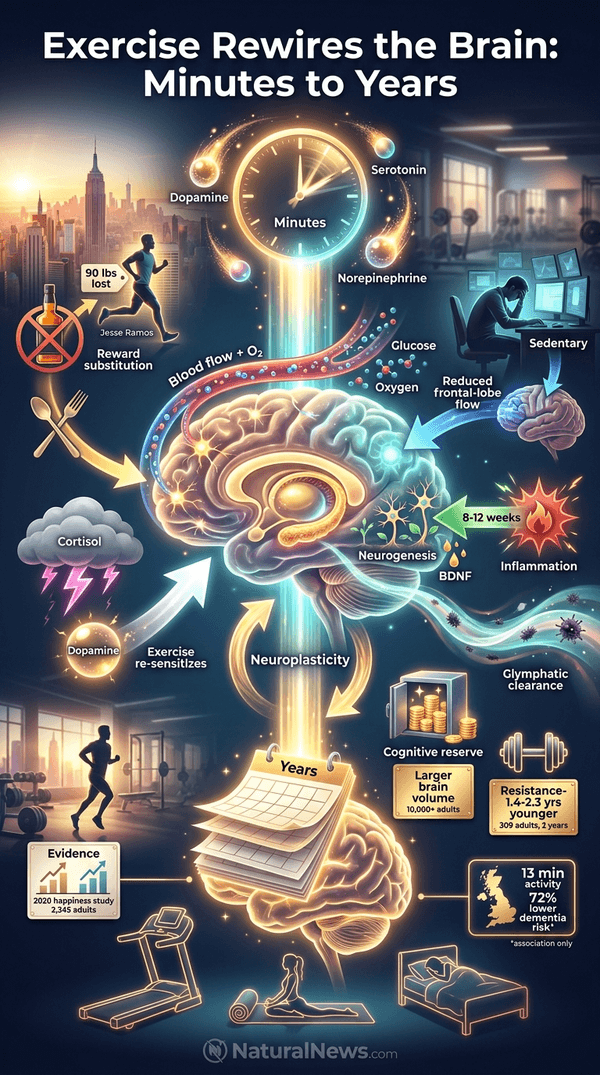
Neuroscientists and physicians say exercise changes brain chemistry within minutes and brain structure over months and years, according to interviews published by the Epoch Times. [1]
The report published Oct. 12, 2026 describes benefits that unfold on overlapping timelines, from immediate shifts in mood and mental performance to long-term adaptations that may help preserve brain health with age. [1] One case cited in the report is Jesse Ramos, who quit drinking in 2023 after nearly two decades of alcohol use and later lost 90 pounds.
Ramos – now a fitness trainer in New York City – said he did not understand the neuroscience when he began. "I didn't know the science – I just knew it made me feel amazing," he told the publication. [1]
The First Few Minutes
Patrick Porter, a neuroscientist and founder of BrainTap Technologies in New Bern, North Carolina, told the Epoch Times that brain chemistry begins to change and electrical activity increases within minutes of exercise. Porter said increased blood flow and oxygen fuel neurons, and the brain releases dopamine, serotonin and norepinephrine for motivation, mood regulation and focus.
Dr. Mill Etienne, vice chancellor and professor of neurology and medicine at New York Medical College, said the dopamine response is the same chemical boost people with addiction often seek, according to the report. A 2020 study of 2,345 healthy adults found those with moderate or high physical activity reported greater life satisfaction and happiness than those with low activity, even after demographic factors were accounted for, according to the report.
Ramos described his earlier pattern in stark terms. "I would eat to feel good and drink to feel numb," he said. "I didn't have the framework to understand what I was doing to my body."
Porter added that stress can dampen the brain's dopamine response, and that exercise may help restore it. Separately, research has linked physical activity to improved mood and reduced anxiety and depression symptoms, according to a systematic review cited in NaturalNews.com reporting. [2]
Months In: Structural Change
Porter said regular exercise appears to stimulate neurogenesis, the growth of new neurons. He said sedentary brains show reduced blood flow to the frontal lobe, which governs decision-making, emotional control and memory.
"Our modern lifestyle – sitting, screens and less movement – doesn't challenge the brain the way it used to," Porter remarked. In his book on exercise and the brain, John J. Ratey describes how chronic stress can shrink the hippocampus and disrupt neurogenesis, while exercise works in the opposite direction.
One review cited in the report found eight to 12 weeks of consistent exercise lowered certain inflammatory markers linked to depressive symptoms. A 2024 study of more than 10,000 adults found those who exercised more often tended to have slightly larger brain volumes, according to the report. Etienne said: "If you have higher brain volumes, you're preserving more brain cells."
Mark Kovacs, an exercise physiologist in Atlanta, told the Epoch Times via email that repeated nervous system stimulation drives lasting change. "It's better to be consistently good than occasionally great," he said. Separately, research has shown that aerobic exercise can increase the volume of the hippocampus, the brain region involved in learning and memory, according to the American Psychological Association. [3]
Years In: Cognitive Reserve and Dementia Risk
Kovacs said exercise supports proteins such as BDNF, which helps brain cells grow and communicate, resulting in improved learning, faster skill acquisition and better adaptability. A review reported by NaturalNews.com similarly concluded that cardio and strength training may support the brain in different ways, with BDNF supporting healthy brain cells and playing an important role in learning and memory. [4]
Etienne compared cognitive reserve to a bank account. "If you have nothing saved and something happens, you're in trouble," he said, according to the report.
The report also stated that exercise supports the glymphatic system, which may help clear abnormal proteins such as amyloid, and that physically active adults tend to have a lower risk of dementia. A February randomized controlled trial followed 309 adults for two years and found moderate and heavy resistance training was linked to a brain appearing about 1.4 to 2.3 years younger than expected, according to the report.
On the observational end, a September 2026 analysis of UK Biobank data covering 66,483 adults linked 13 continuous minutes of moderate-to-vigorous activity to a 72% lower dementia risk, though researchers cautioned the design shows an association and cannot prove causation. [5]
What Kind of Exercise Works Best
Kovacs said low-intensity activity such as a 10 to 20 minute walk can improve mental clarity and idea generation, while moderate and high-intensity exercise may produce stronger effects on neuroplasticity. "It's not either-or. It's about combining both strategically," he said, recommending consistent movement through the week with two to three higher-intensity workouts.
Etienne advised caution. "Do not start with extreme workouts," he said. "Find something you enjoy and build gradually. And if you haven't exercised in a while, consult your doctor first."
Research continues to show that even brief movement can sharpen the brain, with one September 2026 report finding that as little as five minutes of brisk walking produced measurable changes in brain function, particularly in older adults. [6]
References
- How Exercise Changes Your Brain, From Minutes to Years. https://www.theepochtimes.com/health/how-exercise-changes-your-brain-from-minutes-to-years-6053237
- The "Good Stress" That Rewires Your Brain: How Exercise Builds Mental Resilience - NaturalNews.com, July 29, 2026.
- Working out boosts brain health. https://www.apa.org/topics/exercise-fitness/stress
- Exercise May Support Brain Health Through Two Key Molecules, Review Finds. https://www.naturalnews.com/2026-10-02-exercise-supports-brain-health-two-key-molecules.html
- Study Links 13 Continuous Minutes of Moderate-to-Vigorous Activity to 72% Lower Dementia Risk. https://www.naturalnews.com/2026-09-21-continuous-physical-activity-linked-lower-dementia-risk.html
- Just 5 minutes of brisk walking can sharpen your brain, study finds. https://www.naturalnews.com/2026-09-07-study-5-minutes-brisk-walking-sharpen-brain.html
Explainer Infographic











Please contact us for more information.