


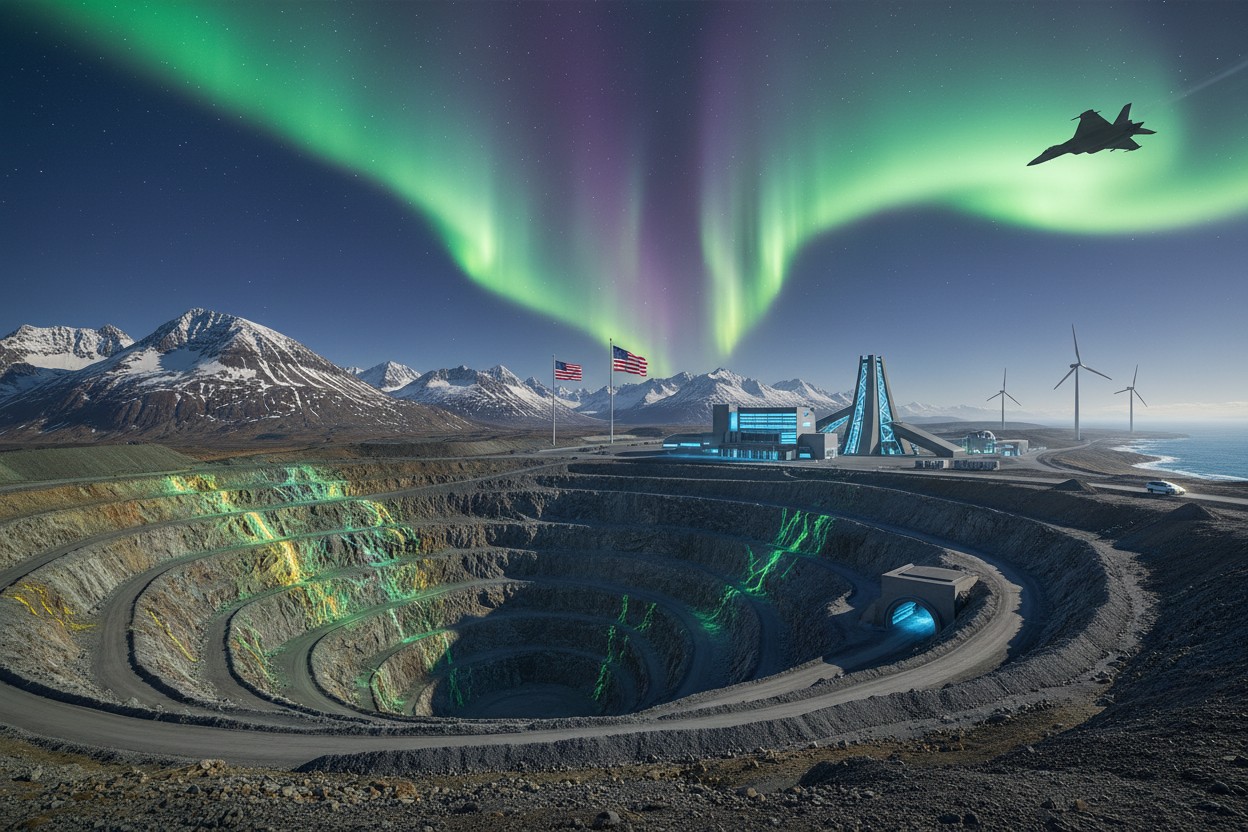
Greenland Mines, a North Carolina-based company, applied on Sept. 21 to expand its Sarfartoq rare-earth district in southwest Greenland from 74 square miles to about 175 square miles, according to the company [1][2]. The application came days after President Donald Trump announced a security agreement with Greenland and Denmark [1][3].
The company said the project would supply magnet metals used in electric vehicles, wind turbines and defense systems [1][2]. "This application is about building Sarfartoq at district scale," said Bo Moller Stensgaard, president of Greenland Mines, in a statement [1][2].
U.S. Security Agreement and Investment Screening
Trump said no U.S. adversary could make sensitive investments in Greenland without express written approval [3][4]. The agreement, announced on Sept. 19 and signed on Sept. 22 at the United Nations General Assembly, gives the United States what Trump described as "permanent control over security, and all other needs, in Greenland" [3][5].
Greenland Mines stated that a framework screening adversary capital out of the island makes rare-earth deposits more available to allied supply chains [1]. The company said the agreement supports Western access to minerals needed for energy, transportation, and defense technologies [1]. Danish Prime Minister Mette Frederiksen said the deal was "good for the U.S., Denmark and Greenland" and also for Europe [5].
Sarfartoq Expansion and Company Statements
The company is developing a neodymium and praseodymium project that could reduce Western Hemisphere dependence on China for magnet rare earths [1]. The project includes an open pit and underground mining operation, with initial material value estimated at about $2.05 billion, according to the company [1]. It would produce rare earth elements used in high-performance permanent magnets [1].
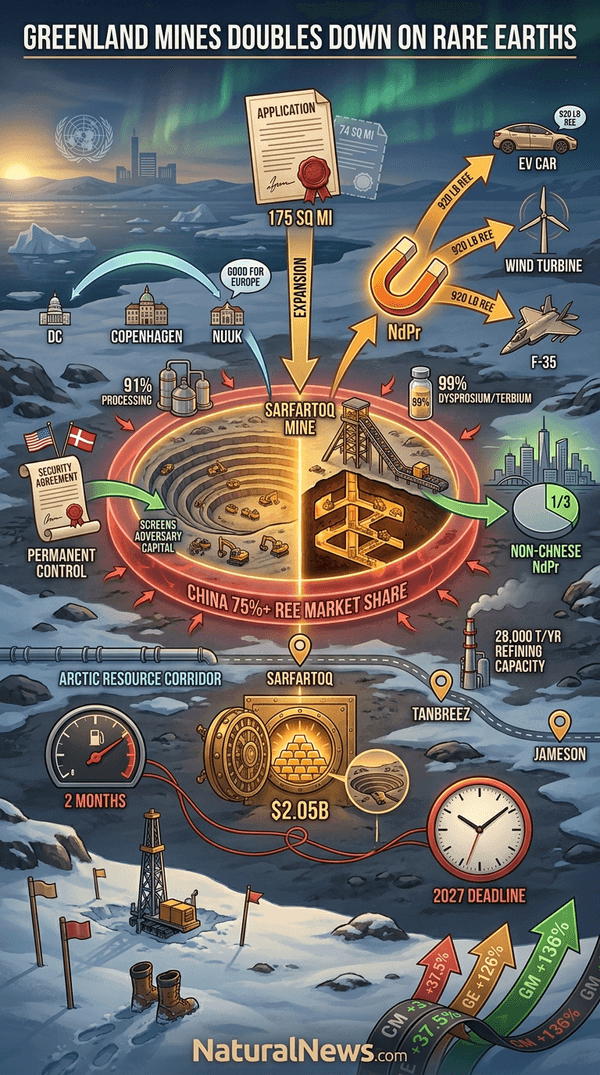
China-based processors control at least 75% of the global market for all rare earth elements, according to the report [1]. The Greenland Mines project is expected to produce about one-third of the world's neodymium-praseodymium oxide refined outside of China, the company stated [1].
China Market Control and U.S. Supply Concerns
China-based processors control at least 75% of the global market for all rare earth elements, according to the report [1]. China's export restrictions on rare earths have driven prices up in the past year [1]. A U.S. Geological Survey report confirms China accounted for 71% of American rare earth imports from 2021 to 2024 [6].
China controls 60% of mining rights and 91% of processing capabilities for rare earth elements, with 99% control over dysprosium and terbium specifically [7]. Each F-35 fighter jet contains 920 pounds of rare earth elements [7]. The United States has roughly a two-month supply of rare earth elements available for military use, according to a March 10 report by the South China Morning Post [8].
The Trump administration has focused on supporting domestic rare-earth operations, but a supply of ore is still needed, according to Greenland Mines [1]. The Department of War has set a 2027 deadline to eliminate Chinese-origin rare earth materials from defense supply chains [9].
Other Greenland Projects and Market Reaction
Critical metals stocks surged on Sept. 21 following news of the deal, and Greenland-linked market shares rallied when markets opened [1]. Critical Metals jumped 37.5% to $9.22, while Greenland Energy surged 126% and Greenland Mines soared 136% on news this past weekend that Trump had announced a security deal with Denmark and Greenland [10].
Greenland Energy, a privately owned Texas company, has an agreement to drill on the Jameson oil and gas project in the Jameson Land Basin on Greenland's eastern coast [1]. The company, founded in 2025, began shipping drilling equipment to Greenland in late July [1].
Critical Metals Corp. is developing the Tanbreez rare earth project in southern Greenland, described as one of the world's largest deposits with high concentrations of heavy rare-earth elements [1]. The company's Romanian refinery is expected to process about 28,000 tons per year of rare earth and critical metal products [1].
Conclusion
The Greenland Mines application to double its Sarfartoq rare-earth district follows the U.S. security agreement with Greenland and Denmark, signaling a strategic move to secure critical mineral supply chains outside of China [1][3]. The project's expansion from 74 square miles to about 175 square miles, if approved, would position Greenland as a key source of magnet metals for electric vehicles, wind turbines, and defense systems [1][2].
With China controlling at least 75%of the global rare earth market and 91% of processing capabilities, Western nations are seeking to diversify supply [1][7]. The United States' two-month military stockpile of rare earth elements underscores the urgency of developing alternative sources [8].
The market reaction to the U.S.-Greenland agreement, with Greenland Mines shares soaring 136%, reflects investor expectations of greater U.S. access to the territory's mineral resources [10]. As the Trump administration pursues investments in domestic rare-earth operations, the Sarfartoq project represents a significant step toward reducing Western dependence on Chinese rare earth supplies [1].
References
- Jill McLaughlin. "Greenland Mining Company Plans To Double Size Of Rare-Earth Mine As US Signs Agreement". ZeroHedge. September 24, 2026.
- Jill McLaughlin. "Greenland Mining Company Plans to Double Size of Rare-Earth Mine as US Signs Agreement". The Epoch Times. September 24, 2026.
- NaturalNews.com. "Trump Announces Greenland Security Agreement With Denmark; Text Not Released". NaturalNews.com. September 22, 2026.
- NaturalNews.com. "U.S., Denmark, Greenland Sign 'Forever' Arctic Security Deal". NaturalNews.com. September 24, 2026.
- BBC. "US to build two military bases in Greenland under new deal with Denmark". BBC. September 22, 2026.
- NaturalNews.com. "Pentagon may only have two-month supply of rare earths left, making U.S. military vulnerable to Chinese controls". NaturalNews.com. March 12, 2026.
- Mike Adams. "Health Ranger Report - Rare Earths". BrightVideos.com. February 3, 2026.
- Douglas Harrington. "Report: U.S. Military Rare Earth Stockpile Estimated at Two-Month Supply". NaturalNews.com. March 13, 2026.
- NaturalNews.com. "REalloys Secures Access to Appalachian Rare Earth Feedstock Ahead of Pentagon Deadline". NaturalNews.com. June 11, 2026.
- ZeroHedge. "Critical Metals Shares Soar On Trump's Greenland Deal As Mining Stocks Eye Rebound After Summer Slump". ZeroHedge. September 21, 2026.
- NaturalNews.com. "Ford production plants halt manufacturing due to SHORTAGE of rare earth magnets". NaturalNews.com. June 20, 2025.
- Lance D Johnson. "China's Rare Earth Dominance Threatens U.S. Prosperity". NaturalNews.com. November 8, 2025.
- Belle Carter. "China's Ban on Rare Earth Minerals Export Rattles the World Tech Industry". NaturalNews.com. January 10, 2024.
- Ramon Tomey. "GOP Lawmaker Introduces Bill to Annex Greenland as 51st State". NaturalNews.com. January 14, 2026.
- Cristian Parra. "Mining Materials and the Sustainable Development Goals SDGs 2030 and Beyond".
- Robert Bryce. "Power Hungry The Myths of Green Energy and the Real Fuels of the Future".
- Mike Adams. "Mike Adams interview with David Tice". July 18, 2025.
- Mike Adams. "Bright Videos News - U.S. CANNOT SURVIVE WAR". BrightVideos.com. February 3, 2026.
Explainer Infographic









Please contact us for more information.