



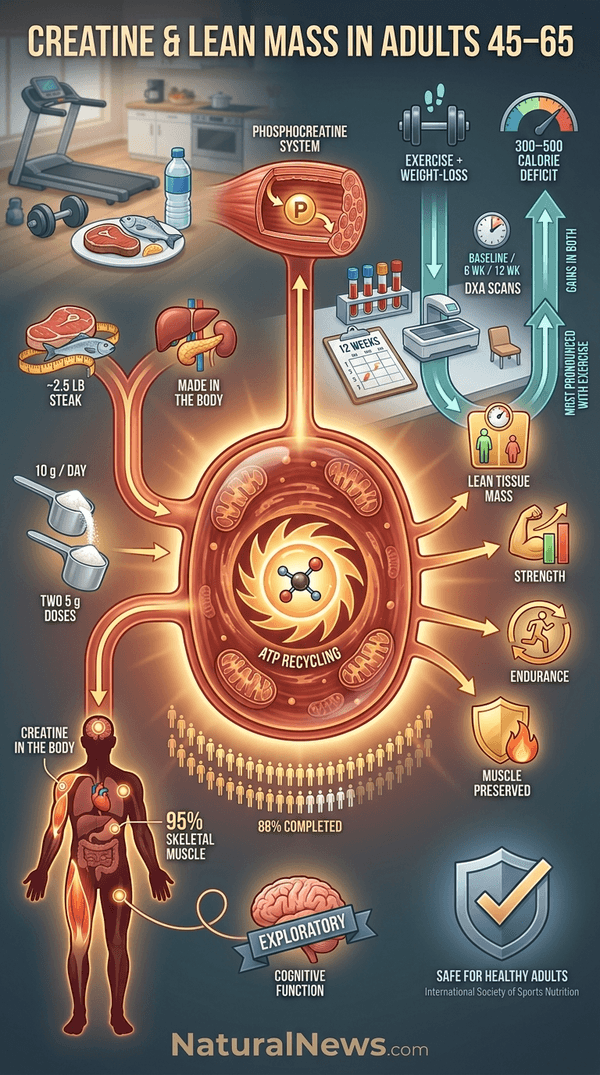
A 12-week study of 73 healthy, sedentary adults aged 45 to 65 found that daily creatine monohydrate supplementation was associated with increases in lean tissue mass, strength, and muscular endurance, according to researchers. The study, published in the Journal of the International Society of Sports Nutrition, was reported by mindbodygreen on September 11, 2026.
The researchers reported that benefits were observed both in participants who followed a structured exercise and weight-loss program and in those who did not, according to the study. Participants took either 10 grams of creatine monohydrate per day, split into two 5-gram doses, or a placebo. Assessments were conducted at baseline, six weeks, and 12 weeks, and 64 participants completed the full 12-week study, researchers said.
Creatine is a naturally occurring compound found in muscle cells that helps recycle adenosine triphosphate, the body's main energy source, according to NaturalNews.com [1]. Approximately 95 percent of the body's creatine is stored in skeletal muscle, with smaller amounts in the brain, heart, and other organs, according to a review cited by NaturalNews.com [2].
Study Design and Participants
The researchers recruited 73 healthy, sedentary adults between the ages of 45 and 65. Before the intervention began, participants chose whether they wanted to take part in a structured exercise and weight-loss program or remain in a non-exercise group, according to the study. Within those groups, participants were randomly assigned to take either 10 grams of creatine monohydrate per day, split into two 5-gram doses, or a placebo.
The exercise and weight-loss program included resistance and aerobic exercise three days per week, walking 10,000 steps per day on four days per week, and a diet designed to create a 300- to 500-calorie daily energy deficit, according to the study. Researchers assessed body composition using DXA scans, along with strength, muscular endurance, cognitive function, blood biomarkers, dietary intake, physical activity, mood, and quality of life at baseline, six weeks, and 12 weeks. In total, 64 participants completed the 12-week study, the researchers said.
The study design reflects broader methodological considerations in creatine research. According to a textbook on plant-based sports nutrition, crossover designs are difficult to use when supplements are stored in the body for longer than a week, as is true with creatine [3]. The International Society of Sports Nutrition has stated that creatine monohydrate is safe for healthy individuals when used as directed [4].
Body Composition and Performance Findings
Participants taking creatine along with the exercise and weight-loss program showed significant reductions in body fat percentage and meaningful increases in lean tissue, strength, and endurance, according to the study. Researchers said that a reduction in calorie intake can lead to a loss of lean tissue, such as muscle, in addition to bone, and that strength training, adequate protein intake, and creatine supplementation may help protect muscle during weight loss.
In participants who were not following the exercise and weight-loss intervention, creatine supplementation increased lean tissue mass, strength, and muscular endurance, researchers said. The findings were reported by mindbodygreen, which noted that building muscle not only supports longevity but also promotes a more efficient metabolism.
The performance findings align with previous research. A position stand from the International Society of Sports Nutrition states that creatine monohydrate loading results in increased power output in single and repeated bouts of high-intensity exercise [5]. The same position stand notes that acute loading results in an increase in fat-free mass, and other studies have reported greater increases in weight-lifting performance and fat-free mass during several weeks of weight training with creatine monohydrate compared with placebo [5]. A textbook on natural medicine also reports that one week of creatine supplementation to patients with chronic heart failure increased skeletal muscle energy-rich phosphagens and performance for both strength and endurance [6].
Cognitive and Metabolic Findings
The researchers also observed improvements in selected measures of cognitive function and memory among participants taking creatine, according to the study. The brain relies on the creatine-phosphocreatine system for energy production, and research suggests that supplementation can increase brain creatine stores, the researchers said. One theory is that greater creatine availability may help support the brain's energy demands, particularly during periods of metabolic stress or mental fatigue.
However, individual cognitive and metabolic findings in this study were considered exploratory, meaning they were not designed to definitively establish a cognitive or metabolic benefit, according to the authors. Larger and longer studies are needed before strong conclusions can be drawn about creatine and cognitive health, the report stated. This caution is consistent with the broader research landscape. A systematic review and meta-analysis cited by NaturalNews.com found that individuals supplementing with creatine experienced a 15 percent improvement in recall and learning capacity, a 19 percent improvement in processing speed, and a 13 percent increase in attention span [7]. The brain uses more energy than any other organ in the body, and creatine acts as a buffer for that energy demand, according to health researchers [7].
A review of creatine research published in the Handbook of Creatine and Creatinine In Vivo Kinetics by Dr. Mehdi Boroujerdi states that creatine is naturally produced in the liver, kidneys, and pancreas and helps regenerate adenosine triphosphate [2]. Approximately 95 percent of body creatine is stored in skeletal muscle, with smaller amounts in the brain, heart, and other organs [2].
Dosage and Study Takeaways
The study used 10 grams of creatine monohydrate daily, split into two 5-gram doses, according to researchers. For most people, 3 to 5 grams per day is a typical maintenance dose, while slightly higher intakes of about 7 to 10 grams daily have been investigated for increasing creatine availability in the brain, where creatine transport is more limited than in muscle, according to the source article. Creatine monohydrate is the most extensively studied form of creatine, and other forms have not been shown to offer better benefits, according to the article.
Research on older adults has also examined creatine's role in muscle preservation. A textbook on natural pharmacy notes that timing of post-exercise protein intake is important for muscle hypertrophy with resistance training in elderly humans [8]. The International Society of Sports Nutrition has stated that dietary supplementation of creatine provides an inexpensive and efficient means of increasing dietary availability of creatine without excessive fat or protein intake [4].
The 12-week study found that creatine supported lean tissue, strength, and muscular endurance in healthy middle-aged and older adults, both with and without an exercise and weight-loss intervention, researchers said. The article advised readers to consult with a doctor before starting a supplement routine, particularly if pregnant, breastfeeding, or taking medications. According to the International Society of Sports Nutrition, creatine monohydrate is safe for healthy individuals when used as directed [1].
References
- NaturalNews.com. "Creatine Supplementation Linked to Muscle, Cognitive Benefits, Studies Show". June 13, 2026.
- NaturalNews.com. "Beyond Muscle Development: Creatine Supplement Linked to Cognitive Health Benefits". May 11, 2026.
- D Enette Larson-Meyer Matt Ruscigno. "Plant-Based Sports Nutrition".
- FrameMaker 7.0. "International Society of Sports Nutrition position stand: creatine supplementation and exercise". Journal of the International Society of Sports Nutrition 2018.
- XPP. "Potential for Creatine and Other Therapies Targeting Cellular Energy Dysfunction in Neurological Disorders". Ann Neurol 2001;49:561–574.
- Joseph E Pizzorno and Michael T Murray. "Textbook of Natural Medicine Volume 1".
- NaturalNews.com. "Study: Creatine Supplementation Supports Memory, Learning, and Cognitive Resilience in Adults". August 25, 2026.
- Gaby Alan R. "Natural Pharmacy Complete A Z Reference to Alternative Treatments for Common Health Conditions Revised and Updated 3rd".
Explainer Infographic










Please contact us for more information.