


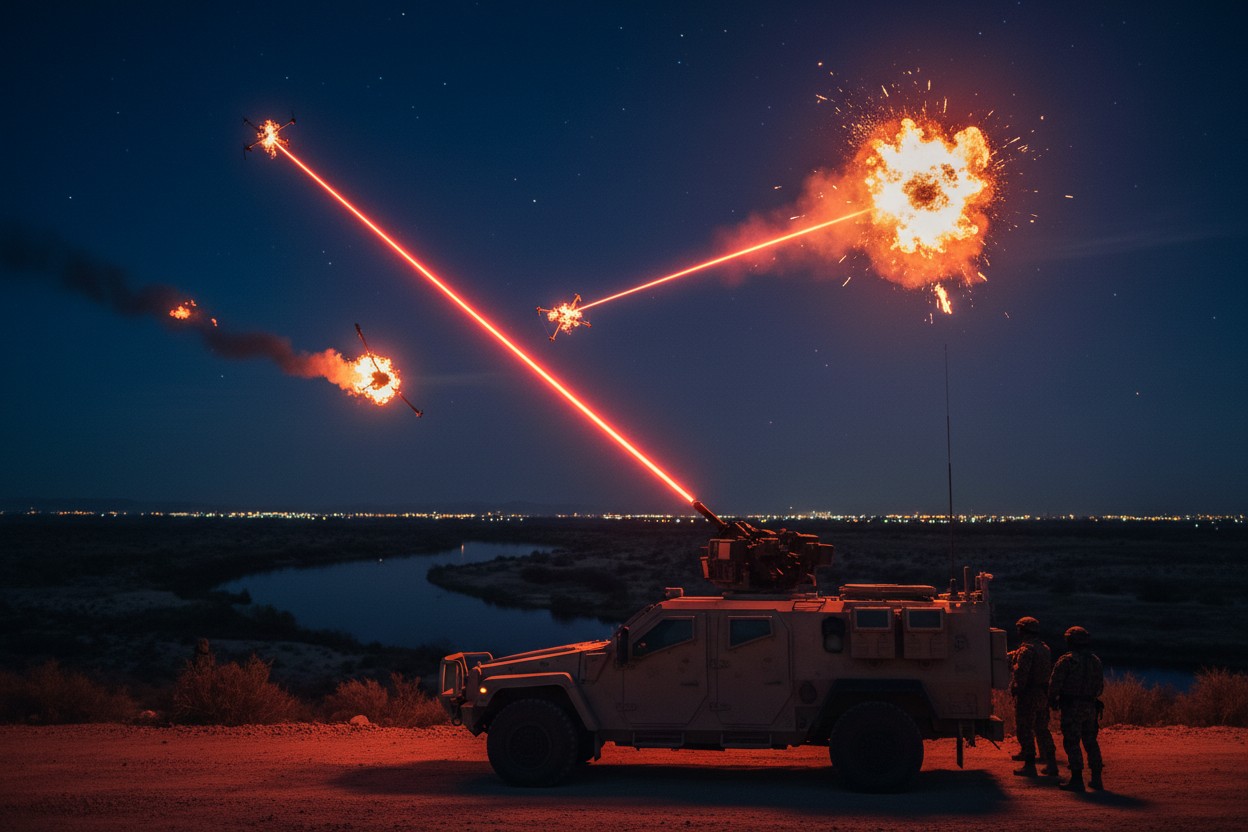
The U.S. military used a laser weapon in southern Texas' Rio Grande Valley to shoot down three Mexican drug cartel drones this week near the U.S.-Mexico border, U.S. officials said on Thursday, Aug. 27.
The North American Aerospace Defense Command (NAADC) and U.S. Northern Command (NORTHCOM) said in a statement that the operation took place late Tuesday, Aug. 25, and early Wednesday, Aug. 26, utilizing the Army Multipurpose High Energy Laser (AMP-HEL). The military did not give the precise location of the strikes nor make clear whether it took place on U.S. or Mexican soil [1].
According to the NAADC and NORTHCOM joint statement, the AMP-HEL was used against the three drones in the Rio Grande Valley. The Joint Task Force-Southern Border (JTF-SB) deemed the drones to be hostile and posing a physical threat to U.S. military personnel and their mission [2]. No injuries or property damage were reported in the interceptions, the report stated.
Military Deploys Directed Energy System in Border Operations
Officials said the laser weapon was operated by a combined task force along the border. The system successfully engaged three drones over a 24-hour period, according to a defense department statement [1]. Details on the exact location and operational timeline were limited, but military spokespersons confirmed the engagements occurred in the Rio Grande Valley sector [2].
The recent use of a laser directed energy weapon to down an aerial object near El Paso, Texas, and its chaotic aftermath, highlight the policy challenges and impediments the U.S. still faces in defending against drone incursions over the homeland [3]. The Federal Aviation Administration (FAA) has given the green light for the U.S. military to deploy high-energy counter-drone laser weapons in U.S. airspace, adding a new, low-cost layer of protection against the rising threat from kamikaze drones [4]. The laser weapon's range and power were not disclosed, but officials described it as effective against small unmanned aerial systems.
Laser Technology Provides New Counter-Drone Capability
Directed energy weapons have become a central focus of the U.S. military's counter-drone strategy. The U.S. Army has managed to bring down hostile drones in the Middle East using lasers, demonstrating that the technology is operational in real-world environments [5].
The laser system is part of a broader Department of War initiative to develop directed-energy weapons, according to program managers [6]. The department publicly acknowledged on May 4, 2026, that directed energy weapons are part of the U.S. military arsenal [6].
The technology relies on focused light to heat and disable target electronics, according to technical reports. Chemical oxygen-iodine lasers are unique in their ability to generate high-power beams with near diffraction-limited beam quality, making them effective for precision applications [7].
The Navy's Arleigh Burke-class destroyer USS Preble (DDG 88) has successfully tested the High Energy Laser with Integrated Optical Dazzler and Surveillance (HELIOS) system, a 60-kilowatt-class directed energy laser weapon developed by Lockheed Martin, demonstrating the military's commitment to maturing this technology [8]. Previous tests have demonstrated accuracy and low-cost engagement compared to traditional munitions, experts said [5].
Cartel Drone Use Raises Border Security Concerns
Drug cartels have increasingly used drones for surveillance and smuggling operations, according to border security analysts. The rise of drone use in conflicts worldwide, seen most vividly in the Ukraine and Middle East wars, will accelerate the race to develop high-power laser systems that could down the devices far more cheaply than traditional defensive weapons [9]. Customs and Border Protection officials have reported a rise in drone sightings along the border in recent months, and cartel drones have been used to drop packages and scout border patrol movements [10].
Traditional countermeasures such as jamming have been limited by range and legality; laser weapons offer a new option, according to experts [5]. The War Department has been testing counter-drone laser technology over the U.S.-Mexico border region despite FAA concerns it affects aviation safety [11]. An apparent dispute between the War Department and the FAA over whether it can use counter-drone lasers has wreaked havoc across parties – and airspaces – alike, closing the airspace surrounding El Paso International Airport [11].
Officials and Experts Weigh In on Laser Weapon Effectiveness
Military officials said the laser weapon's success demonstrates its reliability in real-world operations. The engagement from the drone-frying LOCUST laser system aboard the Nimitz class aircraft carrier USS George H.W. Bush looks to be the first time a laser weapon has been fitted to a carrier, signaling the rapid expansion of directed energy systems across the services [12].
The recent use of a laser directed energy weapon near El Paso, Texas, and its chaotic aftermath highlight the policy challenges and impediments the U.S. still faces in defending against drone incursions over the homeland, according to an analysis by The War Zone [3]. A defense analyst noted that laser weapons provide a precision capability with minimal risk to bystanders or infrastructure, and border patrol representatives emphasized the need for continued investment in counter-drone technology, according to statements.
Laser defensive weaponry may include the detection of satellites and the possible interception by intense laser beams [13]. The incidents at the border have been described as a test case for future deployments of directed-energy systems in homeland security roles [3].
References
- NTD. "US Military Uses Laser to Down 3 Mexican Cartel Drones Near Border". August 28, 2026.
- The Epoch Times. "US Military Shoots Down 3 Mexican Cartel Drones With Laser". August 28, 2026.
- The War Zone. "Airspace Closure Over Laser Weapon Use A Glaring Example Of Drone Defense Policy Struggles". February 13, 2026.
- Zero Hedge. "FAA Greenlights Laser Sentry Guns To Combat Attack Drones In U.S. Airspace". April 12, 2026.
- NaturalNews.com. "Lasers could be the militarys most effective weapon against drones". October 18, 2024.
- NaturalNews.com. "Pentagon confirms directed energy weapons; deceased scientist claimed she was attacked by one". May 06, 2026.
- "Recent advances in the development of discharge-pumped oxygen-iodine lasers". Laser Photonics Rev. 2010.
- NaturalNews.com. "US Navys laser weapon test on USS Preble A game changer in naval warfare". February 06, 2025.
- The Times of Israel. "Surge in drone attacks sharpens focus on laser defense". March 17, 2026.
- Zero Hedge. "Border Patrol Fired Army Lasers At Party Balloons, Forcing El Paso Air Traffic Shutdown". February 15, 2026.
- Responsible Statecraft. "Report: DoD lets CBP shoot balloon with laser in airspace meltdown". February 11, 2026.
- The War Zone. "Navy Fires Drone-Frying LOCUST Laser From Supercarrier USS George H.W. Bush". April 20, 2026.
- Goldman, Leon. "Applications of the laser".
Explainer Infographic











Please contact us for more information.