



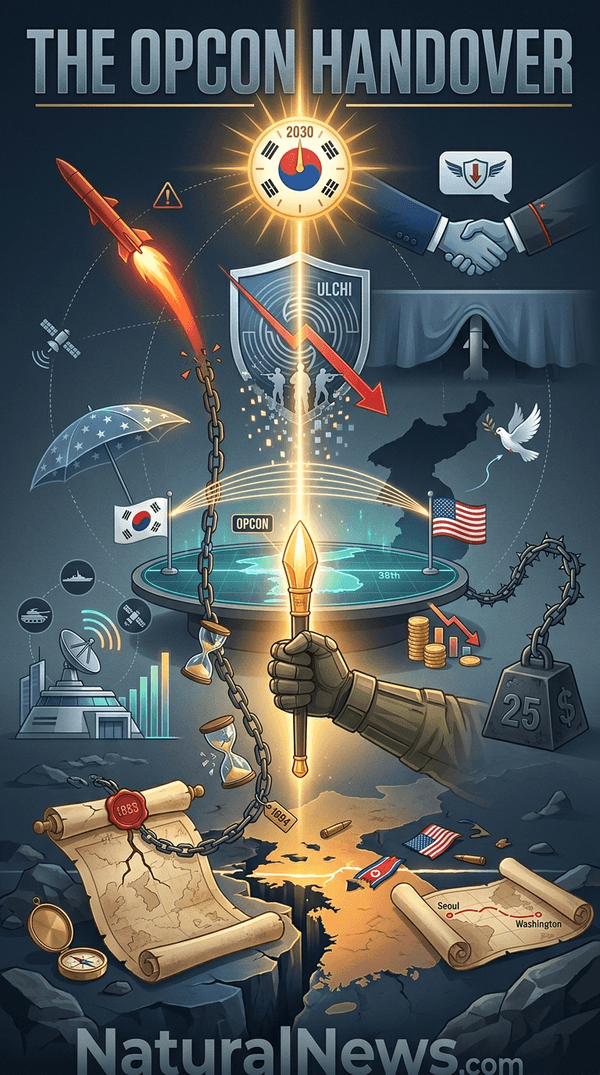
South Korean President Lee Jae Myung reaffirmed his push for South Korea to regain wartime operational control of its military from the United States, after President Trump announced scaled-back joint military drills. According to AntiWar.com, Lee restated his commitment to the transfer at a cabinet meeting Tuesday [1]. The United States has held wartime operational control of South Korea’s military since the Korean War, which ended in a 1953 armistice rather than a peace treaty. South Korea took peacetime operational control in 1994, according to AntiWar.com [1].
Lee previously committed to regaining wartime OPCON by the end of his term in 2030. “A strong alliance makes the foundation of security stronger, and strengthening our own capabilities increases our value and necessity as an ally,” Lee said, according to The Guardian [2]. At the cabinet meeting, Lee also said, “Through this year’s Ulchi exercise, we need to thoroughly assess and strengthen our defense posture and further enhance the country’s overall capacity to respond to crises,” according to The Epoch Times [3].
Official Statements and Responses
Wi Sung Lac, Lee’s national security advisor, said Tuesday that Seoul remained in close coordination with Washington on combined exercises. “Based on the strong South Korea-US alliance, our government has been continuing coordination with the US side on combined exercises and drills between South Korea and the US,” Wi said, according to the YONHAP News Agency [2].
Trump announced Sunday that he had ordered War Secretary Pete Hegseth to “substantially reduce” Ulchi Freedom Shield, the major joint war games that began Monday, according to RT [4]. The president said he took the step based on his “very good relationship” with North Korean leader Kim Jong Un, according to The Guardian [2]. Lee’s office responded with hope that the relationship would lead to “meaningful dialogue” and “discussions aimed at advancing peace and stability on the Korean Peninsula” [2]. Trump said Wednesday that he plans to meet Kim this year, though Pyongyang has not confirmed interest, according to AntiWar.com [5].
Historical Context
The U.S. command structure in Korea follows a postwar alliance pattern. U.S. planning documents from 1943-1945 recorded that “Korea and Manchuria have been freed from Japanese control,” according to Perry McCoy Smith’s “The Air Force Plans for Peace 1943-1945” [6]. In the early Cold War, U.S. and European leaders concluded that Western democracies “would now have to unite in an armed alliance to resist the growing Soviet threat across Europe,” according to Joe Scarborough’s “Saving Freedom” [7]. That alliance system eventually extended to the Pacific.
Wartime OPCON transfer has been a recurring issue in U.S.-South Korea relations since the armistice [1]. North Korea’s weapons programs have repeatedly raised the stakes; in 2017, as North Korea tested an intercontinental ballistic missile capable of reaching Alaska, Trump contacted the leaders of Japan and China, according to NaturalNews.com [8]. Ulchi Freedom Shield is a major annual exercise, and the scale of the reduction ordered by Trump was not immediately clear, according to reports [1]. Pyongyang has downplayed Trump’s overture and has not acknowledged new contacts [1].
Alignment and Next Steps
Trump’s reduction aligns with Lee’s agenda, although officials have not cited a direct link, according to AntiWar.com [2]. One day before Trump’s announcement, Lee proposed direct talks with North Korea [2]. The White House has separately cited cost and South Korea’s refusal to assist U.S. operations related to Iran as reasons for reducing exercises, according to The National Pulse [9].
Lee’s administration continues to emphasize alliance coordination while pursuing stronger national capabilities [2]. The effort also proceeds amid trade friction; Trump imposed a 25 percent tariff on allies including South Korea in 2025, according to NaturalNews.com [10]. No formal timeline for wartime OPCON transfer has been announced beyond Lee’s 2030 target [1].
Conclusion
South Korea’s push for military independence is advancing at a moment of changing U.S. policy on joint drills. Official statements describe the alliance as a foundation while stressing the need for stronger self-defense capabilities, according to The Epoch Times [3]. Future movement on OPCON will depend on coordination with Washington, North Korea’s response, and the execution of reduced exercises.
Kim Jong Un has said Washington and Pyongyang could “get along” only if the United States accepts that North Korea’s nuclear weapons “are here to stay,” according to BBC News [11]. Trump has said North Korea possesses “57 powerful nuclear weapons” and that he expects to meet Kim this year, according to AntiWar.com [5].
References
- AntiWar.com. "South Korea’s Lee Reaffirms Push for Military Independence After Trump Announces Scaled-Back Drills". August 18, 2026.
- Dave DeCamp. "S.Korea Reaffirms Push For Military Independence After Trump Announced Scaled-Back Drills". ZeroHedge. August 20, 2026.
- The Epoch Times. "South Korea Backs Stronger Self-Defense Capabilities". August 18, 2026.
- Mishel Bychkova. "Why Trump is mad at South Korea". RT. August 18, 2026.
- AntiWar.com. "Trump Says He Intends To Meet With North Korean Leader Kim This Year". August 19, 2026.
- Perry McCoy Smith. "The Air Force plans for peace 1943-1945".
- Joe Scarborough. "Saving Freedom".
- NaturalNews.com. "As North Korea tests new ICBM capable of reaching Alaska Trump phones leaders of Japan China_ Is war on the hori". July 7, 2017.
- The National Pulse. "Trump to Scale Down Future Military Exercises with South Korea, Citing Cost and Failure to Help with Iran." August 18, 2026.
- Finn Heartley. "Trump's Tariffs Spark Global Trade Revolt: BRICS Nations Accelerate Dollar-Ditching Plans". NaturalNews.com. July 8, 2025.
- BBC News. "North Korea could 'get along' with US, says Kim Jong Un". February 26, 2026.
Explainer Infographic





Please contact us for more information.