


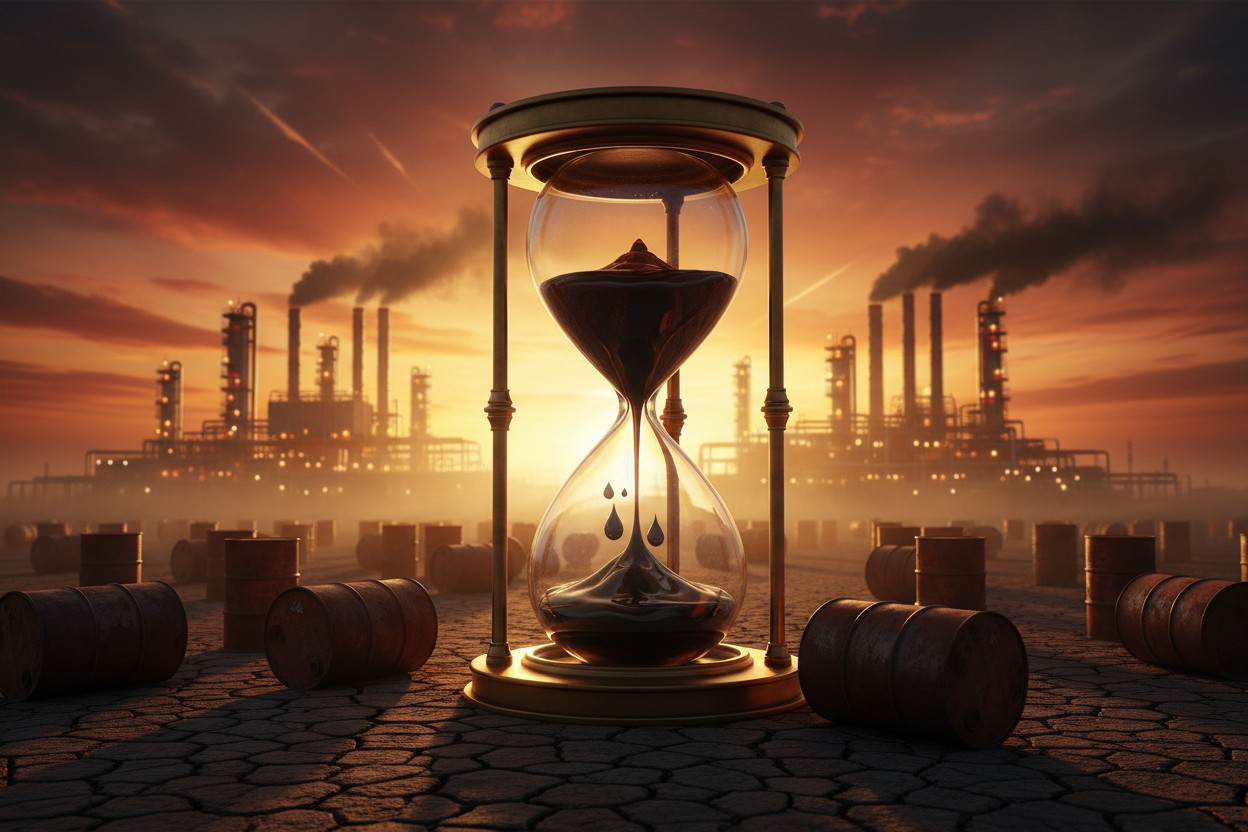
The United States is playing a dangerous game of roulette with its national security. The Strategic Petroleum Reserve - once a formidable hedge against global disruption - has fallen to its lowest levels since the early 1980s, and the consequences are not just numerical. With inventories hovering at roughly 304.8 million barrels, the government risks hitting the critical 300-million-barrel threshold that experts warn could precipitate irreversible geological damage to the very caverns that house the oil.
This reserve is the circulatory system of the American economy, and its current anemia is a self-inflicted wound - a wound that, if left untreated, could render the nation paralyzed and exposed at the very moment it can least afford vulnerability.
For years, successive administrations have wielded the reserve as a political cudgel, draining its strength for short-term gain while leaving the American taxpayer to foot the bill for a multibillion-dollar restoration. And as the cycle of hasty drawdowns and frantic refills accelerates, the structural integrity of the salt caverns themselves erodes with each violent swing.
Key points:
- The SPR has fallen below 300 million barrels for the first time since the early 1980s, nearing a critical operational floor.
- Experts warn that rapid drawdowns risk severe damage to the salt caverns, including potential collapse.
- The current administration plans to purchase 1 million barrels, a minuscule amount compared to the billions needed for a full refill.
- The reserve has been used for non-emergency purposes, raising concerns about political manipulation.
- The Government Accountability Office warns that repeated drawdowns are reducing the long-term viability of the storage caverns.
The Strategic Petroleum Reserve is being used a geopolitical lever
The reserve, a vast network of 60 underground salt caverns located in Texas and Louisiana, was designed as a shield against supply disruptions, a buffer for natural disasters, and a geopolitical lever. The strategy was simple: hold enough crude to weather a storm. But that shield has been battered. The 2022 release of 180 million barrels under the Biden administration, intended to quell gasoline prices following Russia’s invasion of Ukraine, set a precedent for using the reserve as a price-control mechanism rather than an emergency stockpile. Now, with the Iran war prompting another massive 172 million barrel release, the SPR is heading toward a stunning 243 million barrels once the drawdown concludes.
The physical danger is real. Petroleum engineering experts, such as Siddharth Misra of Texas A&M University, paint a grim picture of what happens when the crude level drops below 300 million barrels. To extract oil, operators pump water into the caverns to displace the crude to the surface. But this process is not without consequence. The fresh water dissolves the salt walls, creating unstable roofs and thinning the salt pillars that separate adjacent caverns. This "greatly increases the geological risk of a structural cave-in," Misra warns. The system was designed for five full drawdowns over its lifetime, yet it has been subjected to dozens of cycles over the past four decades. The result is an aging, stressed infrastructure held together with metaphorical "Band-Aids," as Energy Department officials admitted to the Government Accountability Office.
Furthermore, the operational capability of the reserve is compromised at these low levels. The ability to pump oil at rapid speeds is lost, and the equipment itself risks damage as sludge rises toward the extraction intake.
A history of misuse
The current administration's plan to purchase 1 million barrels is a proverbial drop in the bucket, a gesture that highlights the severe financial limitations facing the refill effort. Congressional appropriations are insufficient to cover the multi-billion-dollar cost of refilling a reserve that is only about 42.7 percent full. The situation is tangled in a political web where the SPR is viewed as a piggy bank to be raided when gas prices rise, with the promise that equivalent oil production on federal lands will make up the difference. Representative Porter has decried this as a "double dip" that allows oil companies to profit from American taxpayers twice.
The question is not whether the reserve will be refilled, but whether it can survive the process. If the trend of losing oil continues, the country faces a future where the SPR is a hollow shell, a symbol of past strength with no practical utility. The prospect of a hurricane hitting the Gulf Coast, a scenario Hochstein warns could put the nation in a tough position, becomes even more terrifying when the emergency response system is fragile. The bureaucracy in Washington treats the SPR as an abstract number on a ledger, but the physical reality is that these are massive geological structures under immense pressure.
Sources include:






Please contact us for more information.