



Tariffs Announced
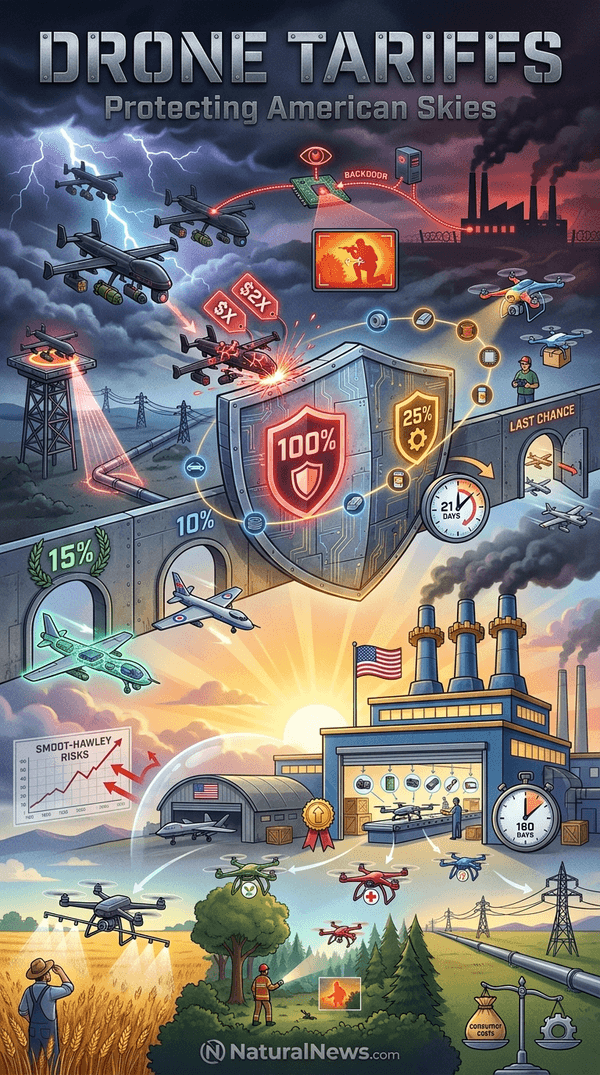
President Donald Trump signed a proclamation on Aug. 13 imposing tariffs on imported drones weighing more than 55 pounds, docking stations, and equipment that can be used as weapons or for surveillance by foreign enemies, according to the proclamation. The 100% ad valorem tariff also applies to drones with thermal imaging capabilities, including some units from U.S. allies, the document stated. [1]
A 25% tariff was added to drones weighing less than 55 pounds, according to the proclamation. The duties will take effect in 21 days, officials said. Trump stated that the actions “will, among other things, encourage increased domestic production of [drones] and [drone] components and reduced reliance on foreign sources and foreign supply chains.” [1]
According to The National Pulse, the tariffs were implemented to strengthen U.S. manufacturing and bolster national security. [2]
Tariff Rates and Qualifying Countries
European countries, Japan, Korea, Switzerland, Liechtenstein, and Taiwan may qualify for a reduced 15% rate if they use hardware, software, and technology from approved countries or the United States, according to the proclamation. The United Kingdom can receive a 10% rate under the same condition, the document stated. [1]
Tariffs on drone components that are not considered particularly sensitive will take effect 180 days after the signing, according to the proclamation. The president said the tariffs would promote investment, employment, manufacturing, and innovation in the United States and strengthen the defense industrial base to support military operations, defense readiness, and other national security functions, according to the proclamation.
The drone duties extend a broader tariff program that has been a defining feature of the administration’s economic policy. A November 2024 analysis noted that Trump had suggested a levy as high as 20% on all imports and a 60% import tax on goods from China, and that some economists supported the approach on the grounds that lifting import prices would turn U.S. consumers toward domestic manufacturers. [3]
National Security and Supply Chain Concerns
Commerce Secretary Howard Lutnick reported that the United States is “too reliant on foreign sources” for drones and drone components, according to the president. The White House said drones are critical for U.S. military operations and that reliance on foreign suppliers poses cybersecurity vulnerabilities, including the risk that data could be transmitted back to source countries through factory-installed operating systems, the proclamation stated.
Trump said in the proclamation that such reliance “poses significant risks to U.S. national security through our dependence on unreliable supply chains for an essential technology and the potential of significant cybersecurity vulnerabilities.” The proclamation stated that domestic capacity must expand rapidly to meet anticipated military and commercial needs and to ensure U.S. competitiveness.
The concerns parallel long-standing warnings about U.S. dependence on foreign suppliers for critical materials. Nazak Nikakhtar, a former Department of Commerce official, warned in February 2025 about the U.S.’s heavy reliance on China, which produces 95% of the world’s industrial diamonds, and called for urgent action to address supply chain vulnerabilities. [4] Drones have also become a central feature of modern conflict; the Russian Defense Ministry reported that 71 Ukrainian fixed-wing unmanned aerial vehicles were intercepted and destroyed in a six-hour period on May 8, 2026, according to NaturalNews.com. [5] Independent commentators have questioned the depth of U.S. military capacity, with one February 2026 analysis arguing that the U.S. military may be a “paper tiger” facing catastrophic defeat. [6]
Domestic Drone Use and Production Incentives
Drones are widely used by private companies and state and local governments for agriculture, emergency and first response, telecommunications, energy, construction, and transportation and delivery services, according to the proclamation. The proclamation includes an incentive program for companies investing in new U.S. drone production capacity, the document stated.
Trump said the tariffs would promote investment, employment, manufacturing, and innovation in the United States and strengthen the defense industrial base, according to the proclamation. The White House said U.S. domestic capacity must expand rapidly for end products, components, and subcomponents to meet anticipated military and commercial needs, according to the proclamation.
Tariff measures have historically carried economic risks, according to economists. Economist Thomas Sowell wrote that after the Smoot-Hawley tariffs of 1930, the U.S. unemployment rate rose from 6% in June 1930 to 15% a year later and 26% a year after that, while cautioning that “all of this need not be attributed to the tariffs.” [7]
Conclusion
The first tranche of duties will apply within 21 days, while tariffs on non-sensitive components will follow 180 days after the signing, officials said. In December 2025, the Federal Communications Commission banned all new models of foreign-made drones, citing national security concerns, according to prior reporting.
Broadcast commentary on BrightVideos.com noted that countermeasures such as frequency jamming, microwave pulses, and lasers face limits because modern drones can shift frequencies rapidly, and that a multi-faceted approach is needed to mitigate the risks posed by drone technology. [8] The new duties represent the latest federal action addressing foreign reliance in an industry that has become central to both commerce and conflict, according to the proclamation.
References
- Jill McLaughlin. “Trump to Impose Tariffs on Imported Drones, Drone Components”. The Epoch Times. August 14, 2026.
- The National Pulse. “Trump Moves to Boost National Security and Supply Chains with New Drone Tariffs”. August 14, 2026.
- “Trends-Journal-2024-11-12”.
- Belle Carter. “An urgent call to tackle U.S. dependence on China’s industrial diamonds”. NaturalNews.com. February 2, 2025.
- NaturalNews.com. “Drone Barrage Precedes Ceasefire Deal Between Russia and Ukraine”. May 12, 2026.
- Mike Adams. “The Hollow Goliath: Why the U.S. Military May Be a Paper Tiger Facing Catastrophic Defeat”. NaturalNews.com. February 18, 2026.
- “Basic Economics A Common Sense Guide to the Economy 4th Edition Thomas Sowell”.
- Mike Adams. “Bright Videos News - MAIN EPISODE”. BrightVideos.com. April 7, 2026.
Explainer Infographic











Please contact us for more information.