


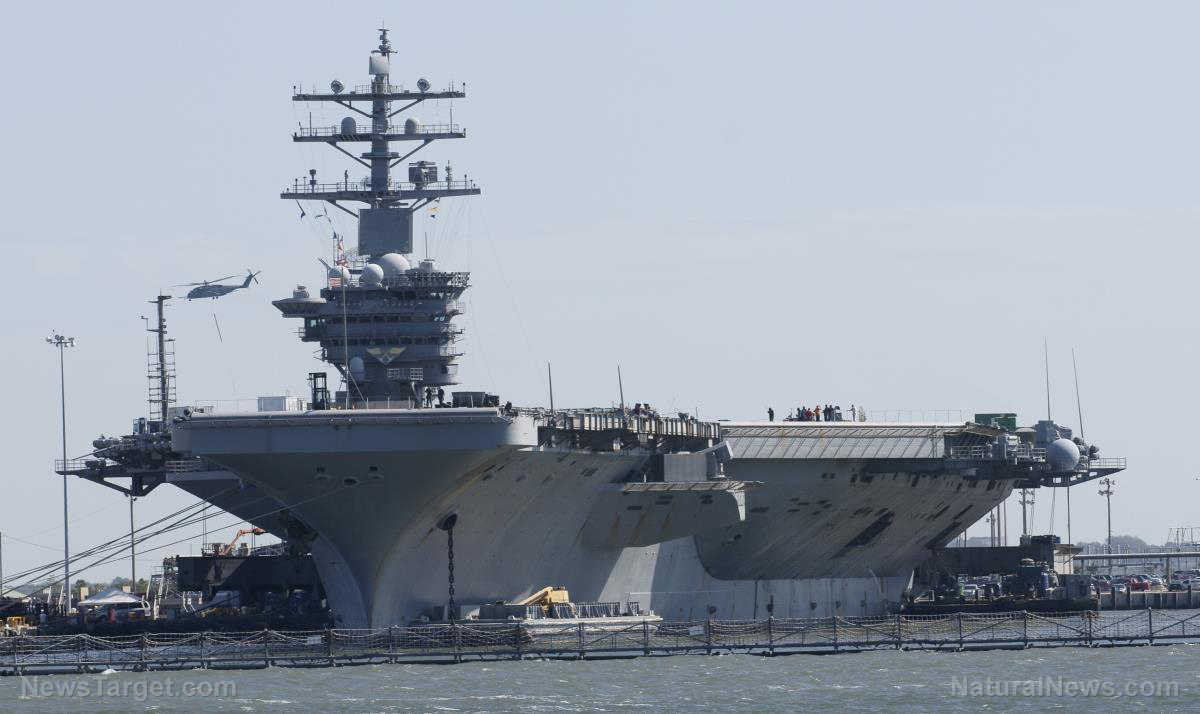
- outrSailors aboard the USS Abraham Lincoln have reportedly attempted suicide by jumping overboard as the carrier enters its ninth month at sea.
- The deployment, tied to the ongoing US-Israel war with Iran, has been extended indefinitely, with the crew spending a record 250 consecutive days without making land.
- Families report severe shortages of basic supplies, including toothpaste, soap and deodorant, alongside issues with moldy showers, broken toilets and rationed food.
- Acting Navy Secretary Hung Cao acknowledged the strain but offered no timeline for relief, citing operational security.
- Lawmakers and military families are demanding accountability, with some questioning the strategic purpose of the prolonged conflict.
A Navy under siege
The mental and physical toll of America’s longest-running carrier deployment since the Vietnam War has reached a critical breaking point. Reports from military families and service members indicate that sailors aboard the USS Abraham Lincoln, operating near Iran, have attempted to jump overboard amid exhaustion, low morale and deteriorating living conditions. The carrier, deployed since November 2025, has been extended indefinitely as part of Operation Epic Fury, the US-Israel campaign against Tehran. With the crew having spent 250 consecutive days at sea, the Navy faces a humanitarian crisis that threatens both operational readiness and the lives of its 5,000 sailors and Marines.
Record deployment exacts heavy toll
The USS Abraham Lincoln departed San Diego on November 21, 2025, originally destined for the Pacific before being redirected to the Middle East. Since then, the crew has had only two days of shore leave—one in Guam in December and a brief stop in Oman in July. The deployment was slated to end in May but has been extended twice as the war with Iran grinds on.
According to the Navy Times and Stars and Stripes, the prolonged deployment has led to multiple suicide attempts. Annabelle Loma, wife of a sailor, told the Navy Times that her husband attempted to jump overboard, fearing his 13-year career would end in dishonor due to burnout. Another sailor’s wife recounted an incident where her husband physically restrained a fellow crew member from going over the side.
The crew’s resilience is eroding under the strain of relentless combat operations. Over the past eight months, the carrier has launched more than 10,000 aircraft sorties, supporting strikes on Iranian missile facilities, air defense systems and drone infrastructure. The flight deck, described by one Navy veteran as “the most dangerous place in the world,” is now a source of added risk as exhausted sailors manage high-speed aircraft and live ordnance in extreme conditions.
Families and lawmakers sound the alarm
At a town hall meeting in San Diego last week, attended by roughly 200 family members, Acting Navy Secretary Hung Cao faced emotional pleas for action. One spouse told officials that her husband had texted her, saying “he hopes he doesn’t wake up tomorrow.” Another accused Navy leadership of having “broken trust between us and the leadership.”
Democratic lawmakers have amplified these concerns. Rep. Mike Levin of California described the conditions on board as “moldy showers, broken toilets, laundry down for weeks, long stretches with no hot water, a meal that came down to half a cup of rice and two tortillas. No soap, deodorant, or toothpaste.” Rep. Jason Crow of Colorado, a former Army Ranger, warned that the strain is “building week by week.”
The Navy has pushed back against the harshest criticisms. Cmdr. Joseph Hontz, a 5th Fleet spokesperson, acknowledged that “more than 250 days on deployment is challenging for the crew and their equipment” but insisted the ship remains “fully capable of meeting all mission tasking.” However, the Navy’s official statement, noting that it had not identified an increase in suicidal ideation, stands in stark contrast to the accounts provided by families and service members.
A strategic miscalculation?
This crisis raises profound questions about the Biden-Trump administration’s conduct of the Iran war. Polls indicate the conflict is deeply unpopular, with President Donald Trump’s approval rating falling to 33 percent, its lowest since his return to office. The war has also exposed severe logistical deficiencies. The Navy has struggled to supply the fleet, with fresh food and basic hygiene products running short.
Beyond the immediate humanitarian concern lies a broader strategic calculus. The United States is demonstrating that its military might is not limitless. The Lincoln’s prolonged deployment risks not only the mental health of its crew but also the safety of its operations. As fatigue sets in, the likelihood of a catastrophic accident increases—an outcome that would undermine America’s credibility and embolden its adversaries.
The Navy’s decision to keep the Lincoln in theater without relief reflects a force stretched thin. The USS Theodore Roosevelt is reportedly preparing to relieve the Lincoln, but no timeline has been provided. Meanwhile, the war shows no signs of ending, with peace talks stalled and the Strait of Hormuz closed to most shipping.
The human cost of endless conflict
The USS Abraham Lincoln has become a symbol of the costs of a war without an exit strategy. The reports of suicide attempts and deplorable conditions are not merely a failure of logistics; they are a failure of leadership. The United States is asking its sailors to shoulder an unsustainable burden in a conflict that many, including members of the military’s own families, openly question.
As the Navy scrambles to address the immediate crisis, it must confront a larger truth: a military stretched to its breaking point is not a deterrent; it is a vulnerability. The country must reevaluate its strategic commitments in the Middle East and ensure that those who serve are not sacrificed on the altar of an open-ended war. The sailors of the Lincoln have done their duty. It is time for Washington to do its own.
Sources for this article include:









Please contact us for more information.