



Study Overview and Key Findings
Decades of nutritional research have converged on a consistent finding: what people eat is directly tied to how long they live. According to a large body of evidence, strong adherence to any of several healthy dietary patterns is associated with a longer lifespan and lower risk of chronic disease. A 2020 study from researchers at the Harvard T.H. Chan School of Public Health, for example, examined dietary scores for four healthy eating patterns and found they decreased heart disease risks in adults, as reported by NaturalNews.com [1]. Other research shows that maintaining a healthy diet over 17 to 32 years is linked to slower biological aging, according to a study published in The Journal of Nutrition [2].
Across these dietary approaches, common elements emerge: an emphasis on fruits, vegetables, legumes, whole grains, nuts, and seeds, combined with limited intake of ultra-processed foods, trans fats, and sugary drinks. A dietitian reviewing the accumulated evidence noted that the findings show consistent benefits across different eating approaches, with higher adherence linked to lower risk of cardiovascular disease, Type 2 diabetes, and mortality from all causes. The data suggest that no single diet is universally superior; rather, multiple patterns can achieve similar longevity benefits.
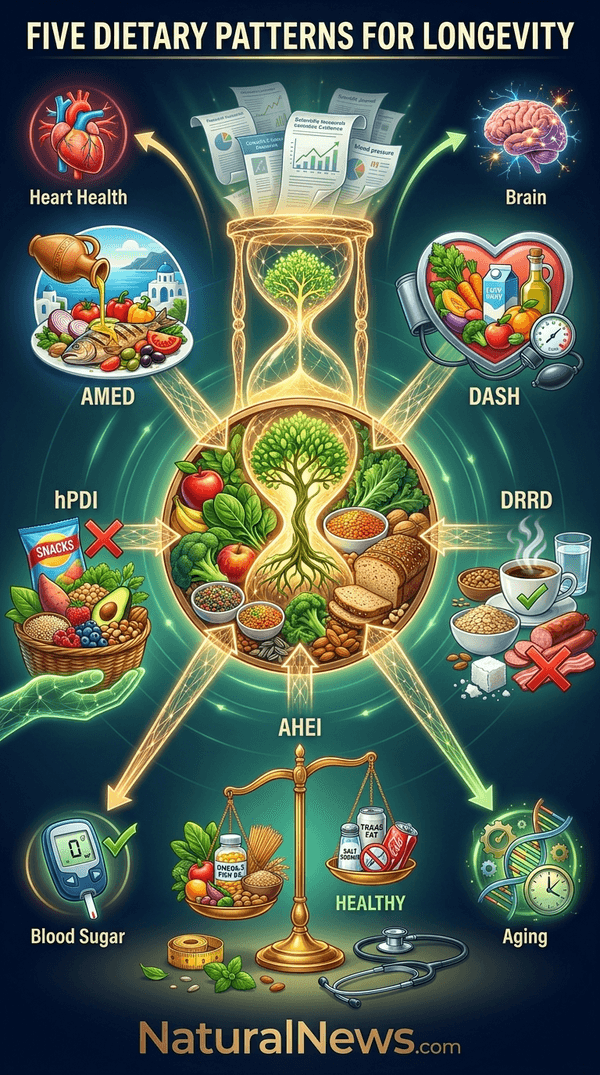
Alternate Mediterranean Diet (AMED)
The Alternate Mediterranean Diet (AMED) scores dietary adherence based on 10 components, including vegetables, legumes, fruit, nuts, whole grains, and fish, with a total score range of 10 to 50, according to the research framework. Higher AMED scores are associated with reduced risk of cardiovascular disease, Type 2 diabetes, cognitive decline, and all-cause mortality, researchers reported. Evidence from a 20-year study of 642 adults aged 65 and older found that greater adherence to the Mediterranean diet, as measured by dietary biomarkers, was associated with a lower risk of all-cause and cardiovascular mortality, according to findings published in BMC Medicine [3].
The diet places emphasis on moderate alcohol intake -- scored on a curve -- and minimizing red and processed meat, the study noted. Earlier work, such as a 2006 study published in Annals of Neurology, also linked the Mediterranean diet to a lower risk for Alzheimer’s disease [4]. The pattern’s protective mechanisms are thought to involve its abundant plant food content and healthy fats, as outlined in a 2007 review in Nutrition Research and Practice [5].
DASH Diet (Dietary Approaches to Stop Hypertension)
The DASH diet was designed to lower blood pressure without medication, according to study descriptions; adherence is scored from 8 to 40 based on eight food components. Components encouraged include fruits, vegetables, nuts and legumes, low-fat dairy, and whole grains; sodium, red and processed meats, and sugary drinks are limited, researchers said. The Harvard study that examined dietary scores for healthy eating patterns included the DASH diet score as one of the four patterns associated with lower heart disease risk [1].
Higher DASH scores correlate with lower risk of hypertension, cardiovascular disease, stroke, Type 2 diabetes, kidney disease, and all-cause mortality, the study stated. The diet’s focus on nutrient-dense, low-sodium foods aligns with recommendations from the Dietary Guidelines for Americans, according to health authorities.
Healthy Plant-Based Diet Index (hPDI)
The Healthy Plant-Based Diet Index (hPDI) scores diets across 17 food groups in three categories, with total scores from 17 to 85; higher scores indicate greater consumption of whole plant foods and fewer animal products and processed plant foods, according to the study. Researchers said a plant-based diet relying on packaged snacks does not offer the same health benefits as one based on minimally processed plants. A 2020 study from Pennsylvania State University, analyzing data from over 11,000 American adults, found that adopting a plant-based diet may lower the risk of heart disease, as reported by NaturalNews.com [6].
Higher hPDI scores are associated with lower risk of Type 2 diabetes, cardiovascular disease, certain cancers, and all-cause mortality, the study found. The Adventist Health Studies database has also shown that individuals who ate a plant-based diet performed better on cognitive tests, according to The Alzheimer's Solution by Dean Sherzai [7]. This reinforces the idea that whole-food, plant-forward eating supports long-term health.
Diabetes Risk Reduction Diet (DRRD)
The Diabetes Risk Reduction Diet (DRRD) scoring tool identifies dietary patterns most strongly linked to lower Type 2 diabetes risk, with scores ranging from 9 to 45 based on nine components, according to the study. Components associated with lower risk include cereal fiber, coffee, nuts, whole fruits, and legumes; higher risk foods include trans fats, red/processed meats, and sugary drinks, the researchers reported. Higher DRRD scores are tied to improved blood sugar regulation and lower inflammation, the study stated.
Protective mechanisms of such a pattern are detailed in research on the Mediterranean diet and obesity/Type 2 diabetes, which notes that a common characteristic of beneficial dietary patterns is their abundant plant food content [5]. The traditional Okinawan diet, which is low in refined starches and high in vegetables and legumes, mirrors many of these principles and is associated with slower aging, as noted in Calorie Restriction, Aging and Longevity [8].
Alternate Healthy Eating Index-2010 (AHEI)
The Alternate Healthy Eating Index-2010 (AHEI) was developed by Harvard researchers to assess diet quality for chronic disease prevention; foods and nutrients are scored 0 to 10 based on evidence, with higher totals indicating better quality, according to the study. Encouraged foods include fruits, vegetables, whole grains, nuts, legumes, polyunsaturated fats, and omega-3s; limited items include sodium, trans fats, sugary drinks, red/processed meats, and alcohol, the study noted. The Harvard study that examined the AHEI-2010, along with other dietary scores, found that adherence to such patterns decreased heart disease risks [1].
Higher AHEI-2010 scores are associated with lower risk of coronary heart disease, stroke, diabetes, and overall mortality, the researchers said. Long-term adherence to a high-quality diet like the AHEI has also been linked to decelerated epigenetic aging, according to a Finnish study published in The Journal of Nutrition [2]. This suggests that the benefits of such eating patterns extend to the cellular level.
Commonalities and Practical Implications
Despite differences in scoring and emphasis, all five dietary patterns share core principles: they prioritize fiber and healthy fats from plant sources while limiting ultra-processed foods, trans fats, and sugary drinks, according to the research. A dietitian commented that individuals can choose the pattern that best fits their preferences, as adherence to any of these approaches is linked to meaningful increases in life expectancy and reductions in chronic disease risk. For example, a Mediterranean diet rich in plant foods and healthy fats has been associated with a 46 percent higher chance of healthy aging, according to Harvard Medical School research cited by NaturalNews.com [9].
The study's authors said the findings support the idea that multiple healthy eating patterns can achieve similar longevity benefits, with no single diet being universally superior. The practical implication, according to researchers, is that individuals should focus on the core components of whole plant foods and limited processed items rather than strict allegiance to one named diet. As noted in the book The Mediterranean Way of Eating by John J.B. Anderson and Marilyn C. Sparling, such a dietary pattern can be readily transferred to non-Mediterranean cultures [10]. The key is sustained adherence over time.
References
- NaturalNews.com. "Mediterranean and plant-based diets may help lower heart disease risk according to research". NaturalNews.com. July 28, 2020.
- NaturalNews.com. "Study: Long Term Healthy Eating Linked to Slower Biological Aging". NaturalNews.com. May 02, 2026.
- NaturalNews.com. "Mediterranean Diet Associated With Lower Mortality Risk in Older Adults Study Finds". NaturalNews.com. May 09, 2026.
- XPP. "Mediterranean Diet and Risk for Alzheimer’s Disease". Ann Neurol. 2006.
- Elsevier. "Protective mechanisms of the Mediterranean diet in obesity and Type 2 diabetes". Nutrition Research and Practice. 2007.
- NaturalNews.com. "More greens less meat: Following a plant-based diet can help reduce heart disease risk". NaturalNews.com. July 06, 2021.
- Dean Sherzai. "The Alzheimer's Solution".
- Arthur V. Everitt, Suresh I.S. Rattan, David G. le Couteur, and Rafael de Cabo. "Calorie Restriction, Aging and Longevity".
- NaturalNews.com. "Curb the symptoms of non-alcoholic fatty liver disease by adopting a Mediterranean diet". NaturalNews.com. June 26, 2020.
- John J.B. Anderson and Marilyn C. Sparling. "The Mediterranean Way of Eating: Evidence for Chronic Disease Prevention and Weight Management".
Explainer Infographic












Please contact us for more information.