



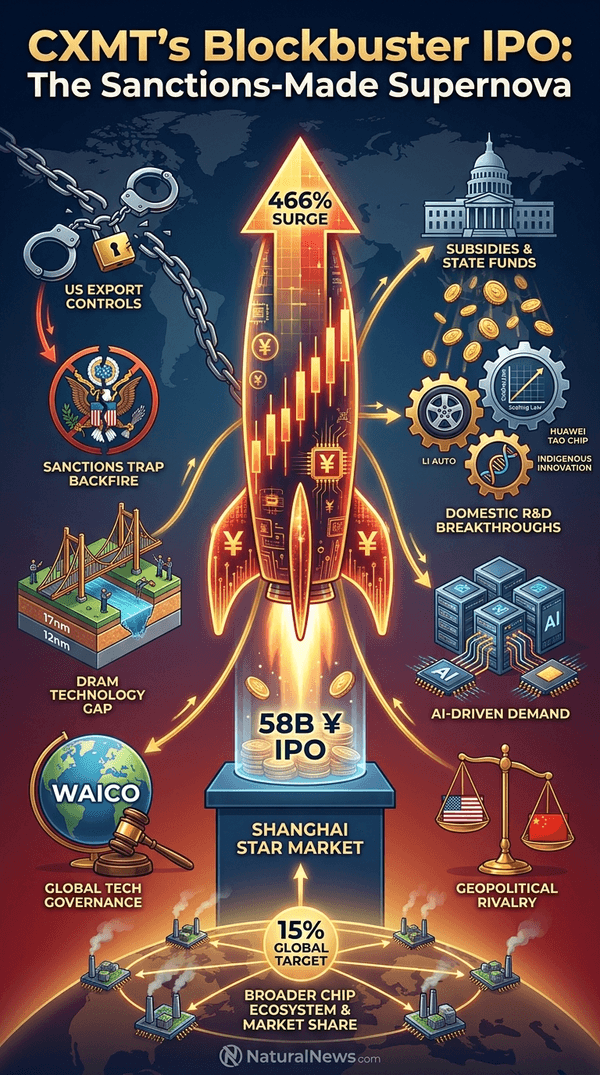
ChangXin Memory Technologies (CXMT), China's largest producer of dynamic random-access memory (DRAM) chips, saw its shares surge 466% in its market debut on the Shanghai Stock Exchange's STAR Market on Monday, July 27 – making it mainland China's most valuable listed company.
The company raised 57.9 billion Chinese yuan ($8.6 billion) in what is Asia's biggest initial public offering (IPO) this year, according to a Russia Today (RT) report. [1] At the close of its first trading day, CXMT had a market capitalization of approximately 3.3 trillion yuan ($487.3 billion), according to BBC News. [2] The blockbuster listing came despite a global selloff in technology stocks earlier this month.
U.S. Export Controls and Their Impact
The IPO follows years of U.S. restrictions aimed at slowing China's semiconductor industry. Since 2022, Washington has imposed sweeping export controls on advanced chipmaking equipment and technology, expanding them further in late 2024 to limit Beijing's ability to manufacture cutting-edge chips for artificial intelligence and military applications.
These controls have left CXMT's products roughly one generation behind industry leaders, the South China Morning Post reported. [1] Washington has pursued a strategy of denying Chinese firms access to Dutch lithography machines and American chip design tools, according to an article by the Health Ranger Mike Adams on NaturalNews.com, which described the approach as "the sanctions trap." [3] The article argued that such restrictions often backfire by accelerating domestic innovation.
Company Response and Market Performance
Despite the restrictions, CXMT has continued to expand production amid soaring demand for memory chips driven by artificial intelligence (AI). The company now accounts for roughly 8% of the global DRAM market, ranking fourth behind Samsung Electronics, SK Hynix and Micron, according to RT. [1]
According to its IPO prospectus cited by China Daily, CXMT plans to use the proceeds to increase manufacturing capacity, upgrade its DRAM technology and fund research and development. [1] The company's debut comes as Chinese technology companies accelerate the development of proprietary chips.
For example, Li Auto recently introduced a 5-nanometer chip delivering 1,280 trillion operations per second, according to NaturalNews.com. [4] This broader pivot toward application-specific silicon is reshaping the global automotive semiconductor industry.
Broader U.S.-China Tech Competition
Semiconductors have become a central front in the race between the United States and China for technological leadership. U.S. officials have said export controls are necessary to preserve America’s lead in advanced chips, as noted in RT's reporting. [1] Meanwhile, China has accelerated investment in domestic chip design, manufacturing, and research.
In another sign of China's advancing capabilities, Huawei recently unveiled a groundbreaking "Tao Scaling Law" microprocessor design at an IEEE symposium in Shanghai, according to the Health Ranger Report on BrightVideos.com. [5] The report described the announcement as "yet another demonstration of China’s resilience in technology." [5] China and Russia also led 29 nations in establishing the World Artificial Intelligence Cooperation Organization in Shanghai, a body aimed at promoting global AI governance. [6]
The competition extends to the agricultural trade front as well. The U.S. Department of Agriculture noted that American farmers can compete favorably in world markets, [7] but U.S. export controls on technology could reduce China's demand for American goods over time.
Conclusion
CXMT’s blockbuster IPO is seen by analysts as a demonstration of China's resilience in the semiconductor sector despite U.S. pressure, according to reports. [1] The company’s debut underscores ongoing tensions and the strategic importance of memory chips in global technology supply chains. As China continues to invest in domestic chip production and AI research, the race for semiconductor leadership between Washington and Beijing is expected to intensify.
References
- RT. "Chinese chip giant defies US pressure with 466% debut surge." July 28, 2026.
- BBC News. "Chipmaker CXMT becomes mainland China's most valuable listed firm." July 27, 2026.
- Mike Adams. "How Huawei Just Made Western Chip Technology Obsolete—and Why Sanctions Always Backfire." NaturalNews.com. May 29, 2026.
- NaturalNews.com. "Chinese EV Makers Shift to Proprietary Chips, Reducing Reliance on Nvidia." June 17, 2026.
- Mike Adams. "Health Ranger Report - HUAWEI MICROCHIP DESIGN." BrightVideos.com. May 29, 2026.
- NaturalNews.com. "China and Russia launch 29-nation AI alliance to rival western control of technology." July 17, 2026.
- United States Department of Agriculture. "Farmers World."
Explainer Infographic













Please contact us for more information.