



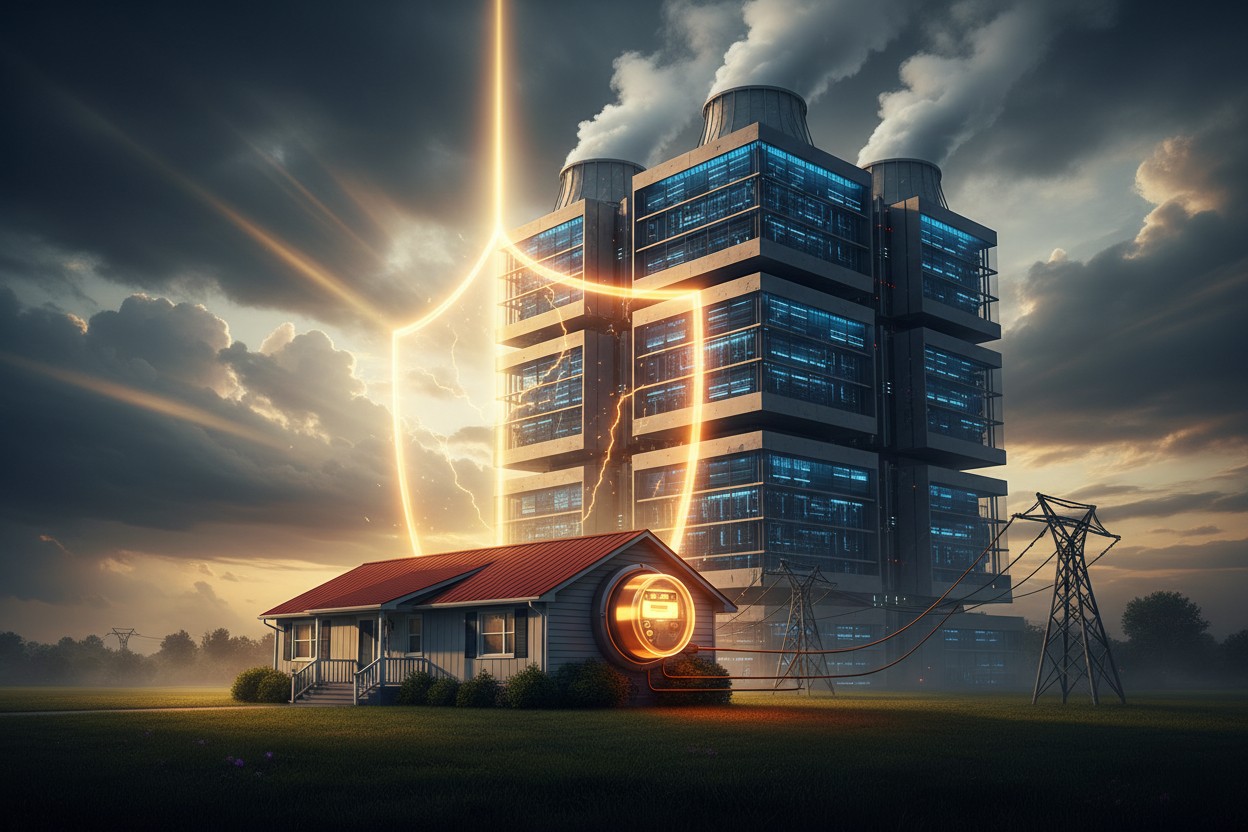
When members of Congress head home this summer, they will find a question waiting for them on porches and in town halls from Virginia to Nevada... Who actually pays for America's artificial intelligence boom? Data centers are multiplying across the country at a pace few communities anticipated. This issue alone will motivate the crucial 3 percent undecided vote in the next elections.
When community and business leaders introduce these data centers, they will promise jobs, tax revenue and a front-row seat to the AI revolution. But behind the promise are power bills, land disputes and the strain on aging electrical grids that will readily be passed to ordinary ratepayers, while the profits flow to hyperscalers headquartered in sky-rises and yachts somewhere around the globe. Right now, voters are not buying the sales pitch, and lawmakers who treat every objection as simple resistance to progress are misreading the moment.
Key points:
- U.S. residential electricity prices have climbed more than 36% since 2020, and analysts point directly to AI data center demand as a growing driver of that increase.
- A June 2026 national survey found voters oppose a data center being built in their community by more than two to one, with nearly half strongly opposed.
- Grid operators including PJM Interconnection warn the country could fall six gigawatts short of reliability requirements by 2027.
- Solar power and battery storage have supplied more than 80% of new grid capacity added in recent years, and voters view both favorably across party lines.
- Data centers could more than double their electricity use by 2030, accounting for over 40% of all U.S. electricity demand growth in the next five years.
The bill nobody voted for
The math behind rising electric bills is no longer a matter of speculation. Goldman Sachs analysts have said data centers now account for roughly 40% of electricity demand growth nationwide, and they expect prices to keep climbing through the end of the decade. As demand for energy increases and supply dwindles, who pays? In the mid-Atlantic region served by PJM Interconnection, projections show the average household could be paying tens of dollars more per month by 2028, with cumulative ratepayer costs reaching well over $100 billion by the early 2030s. Virginia, home to the densest cluster of data centers in the country, illustrates the pattern clearly. Facilities there now account for roughly 40% of the state's total electricity consumption, and Dominion Energy recently proposed its first base rate increase since 1992.
The industry likes to point out that electricity prices were rising before ChatGPT existed, and that is true. Aging infrastructure, the shortcomings of green energy, natural gas costs and utility profit models all play a role. But that context does not erase the core complaint driving voters to town halls. A June 2026 analysis from Lawrence Berkeley National Laboratory found data centers could more than double their electricity use by 2030, representing over 40% of the nation's electricity demand growth in just five years. This is a structural shift in who is drawing power off the grid, and families are footing a growing share of the bill for infrastructure they did not ask for and will not directly benefit from. In fact, many families may be adversely affected by the AI boom, losing work opportunities that AI has replaced. The resentment will only grow, creating voters out of pissed off Americans.
Grid reliability adds another layer of urgency. PJM Interconnection, which serves more than 65 million people across 13 states, has projected it could fall six gigawatts short of its own reliability requirements by 2027. Data centers can be built in 18 to 36 months, while new transmission lines routinely take seven to ten years to permit and construct. That mismatch means utilities are leaning on natural gas, and in several states, keeping aging coal plants running longer than planned, just to keep the lights on.
Abundance versus obstruction
None of this means that the answer is a blanket moratorium on AI data centers. A June 2026 national survey found voters oppose data centers in their own community by more than two to one, yet nearly two-thirds said they would welcome a solar farm nearby - support on par with a distribution center or manufacturing plant. Moreover, solar and battery storage have made up more than 80% of new capacity added to the grid in recent years, precisely because they can be deployed on a timeline that matches the urgency that communities are facing. In Texas, wind and solar met 36% of demand on the ERCOT grid through the first nine months of 2025, and federal forecasters expect utility-scale solar there to surpass coal generation for the first time this year.
For communities that dissent to AI data centers, they may play a different role in the AI boom: setting up alternative energy sources to power it. Metaphorically, the country is setting up a modern day railroad system to progress society into the future, and it will require energy and land usage, but the real question for today is: who will benefit from this progress in the end? Some people don't even perceive automation of intelligence and data centers as progress.
Concerns about land use deserve honest answers rather than dismissal. Industry data shows solar currently occupies a small fraction of total U.S. land and an even smaller share of farmland, with no state approaching significant use of its prime agricultural acreage. That does not mean every project belongs everywhere, and communities are right to demand transparency, environmental review and a genuine seat at the table before ground is broken.
Concerns about mass surveillance are culminating, as well. The rise of flock cameras and the collection and consumption of our personal data is eroding privacy and drawing more concern about the rise of a technocratic state. People don't want to be treated as expendable commodities on a technocratic grid of automation.
The choice facing Congress this summer is not between growth and stagnation. It is between an energy strategy that spreads the true cost of the AI boom fairly, through natural gas, nuclear, transmission upgrades, solar and storage alike, or one that keeps asking households to subsidize infrastructure they never approved. AI is not going away, and falling behind on power means falling behind on AI itself, at a moment when global competitors show no sign of slowing down. Lawmakers do not need to convince Americans to like AI. They need a plan that treats families as stakeholders in its progresses, not as pawns discarded, or subjects surveilled. The people need to know that they can benefit, not be bullied by these innovations and its architects.
Sources include:
SierraClub.org [PDF]









Please contact us for more information.