



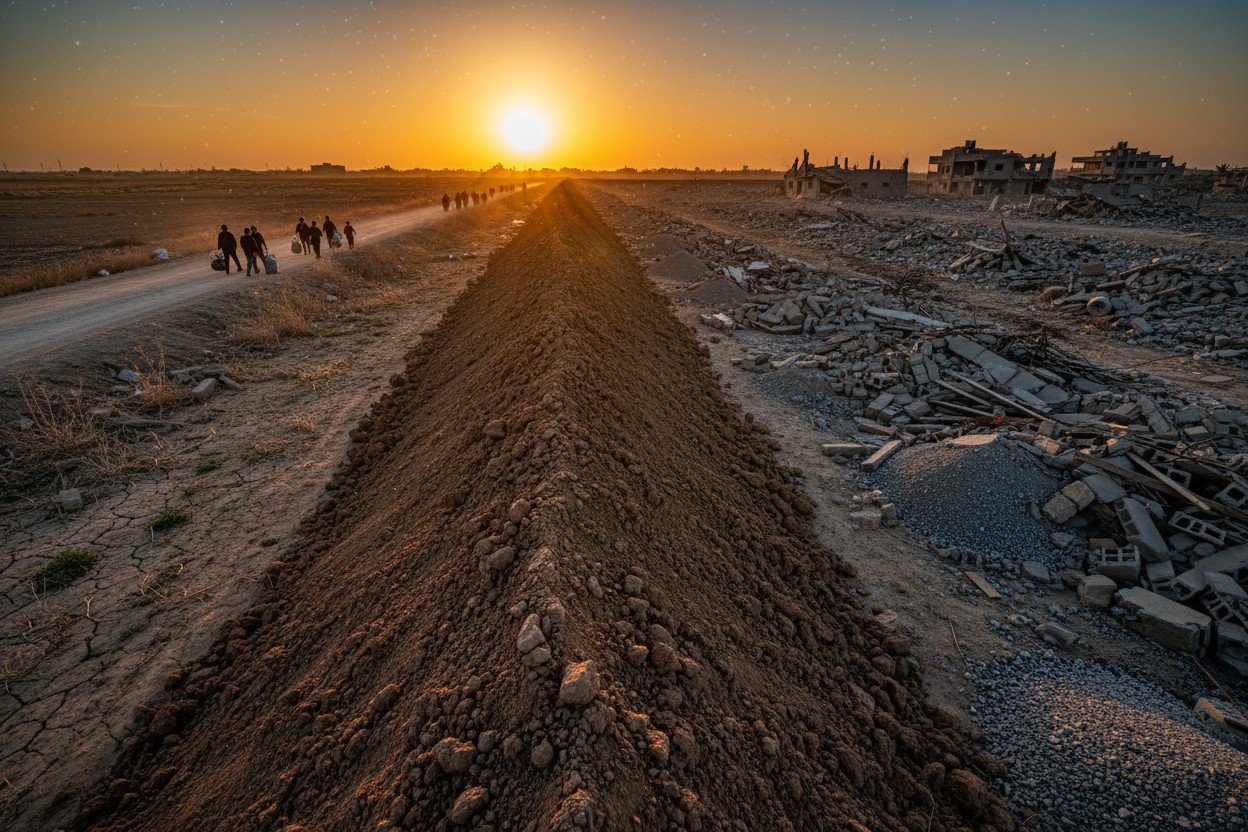
Displaced families streamed back into southern Lebanese villages this week, drawn by promises of a US-brokered "pilot zone" plan that was supposed to signal Israeli withdrawal. Instead, the details emerging on the ground tell a very different story, one where Israel keeps its footprint in the areas it actually occupies while claiming credit for handing back villages it never controlled in the first place. This is not de-occupation. It is Israel rebranding its occupation, and the residents returning to Froun, Srifa, and Zawtar al-Gharbiya on July 21st are the ones paying the price for a diplomatic sleight of hand dressed up as peace.
Key points:
- The Lebanese Armed Forces deployed in Zawtar al-Gharbiya as displaced civilians returned to three US-designated "pilot zones" on 21 July.
- Locals and Lebanese security sources say two of the three zones, Froun and Srifa, were never occupied by Israeli forces to begin with.
- Zawtar al-Gharbiya is the only pilot zone where Israeli troops actually maintain a presence.
- Israel publicly maintains it will not withdraw from south Lebanon, with no political directive issued to occupation forces.
- The Lebanese army says it refuses to coordinate directly with Israel or serve as cover for further occupation.
- Israeli forces reportedly continued demolishing civilian infrastructure along the border even as residents returned home.
A plan built on villages Israel never held
The US State Department framed Monday's announcement as a breakthrough, stating that pilot zone operations had begun in Froun, Srifa, and Zawtar al-Gharbiya under what it called the Trilateral Framework, overseen by the Military Coordination Group for Lebanon. On paper, that sounds like territorial concession. On the ground, it looks like something else entirely.
Villagers speaking to Al Jazeera on July 21st put it plainly. The inclusion of certain villages, they said, is evidence that Israel is in fact not giving anything up, despite the framework agreement, and is instead able to remain in the other areas it has occupied. Two separate Lebanese security sources backed up that account, confirming that two of the so-called pilot zones are not occupied at all.
That distinction matters enormously. Froun and Srifa sit outside what Israel calls its security zone, meaning Israeli forces were never there in any meaningful operational sense. Fierce Hezbollah resistance reportedly kept occupation troops out of Froun during the earliest and heaviest fighting, a detail corroborated by reporting from RT and the New Arab. Zawtar al-Gharbiya, by contrast, is the one location among the three where Israeli forces genuinely maintain a presence. So when Washington announces the "return" of three villages, only one of them represents any real change in facts on the ground.
This is not the first shuffle either. Reports over recent weeks initially listed Froun, Al-Ghandourieh, and Zawtar al-Gharbiya as the pilot zones, with Israeli Prime Minister Benjamin Netanyahu himself naming Froun and Zawtar al-Gharbiya weeks earlier. Al-Ghandourieh has since dropped from the list, replaced by Srifa, another village that was never under Israeli control. The pattern suggests a plan engineered to generate headlines about withdrawal while changing almost nothing about who actually holds ground in the south.
Lebanon's army refuses to play along
The broader agreement, reached in what Lebanese sources describe as a violation of Lebanese law, calls for future pilot zones to be established under mutual consent between Tel Aviv and Beirut. The stated goal is for the Lebanese Armed Forces to replace Israeli occupation troops in designated zones, dismantle Hezbollah infrastructure, and pair that work with a phased Israeli withdrawal.
But Lebanese military sources have already made clear they are not interested in serving as Israel's proxy. The army will not operate under anyone's command, including Israel, they told local media earlier this month. Its mission, they said, is not to clear the ground for the enemy in order to facilitate its entry into areas it failed to reach because of fierce resistance, and the army will not be the reason for the occupation of additional Lebanese territory.
That statement cuts to the heart of the matter. Lebanon's own military is signaling distrust of a framework that asks it to do the diplomatic and security labor of a withdrawal that Israel has not actually committed to completing. Israeli officials continue to publicly vow that occupation forces will not leave south Lebanon, and Israeli media reports confirm no political directive to withdraw has been issued. There is still no timeline attached to any part of the plan.
Meanwhile, as families walked back into towns they had fled, Israeli forces were reportedly still carrying out demolition operations along the border, destroying civilian infrastructure even as the diplomatic theater of "pilot zones" played out for international audiences. For residents on the ground, the contradiction is impossible to miss. Villages are being handed back that were never taken, while the border communities still under actual occupation see their homes bulldozed in real time. Until Israel withdraws from the territory it genuinely controls, and not merely the territory it never held, talk of de-escalation in south Lebanon remains, at best, premature.
Sources include:





Please contact us for more information.