



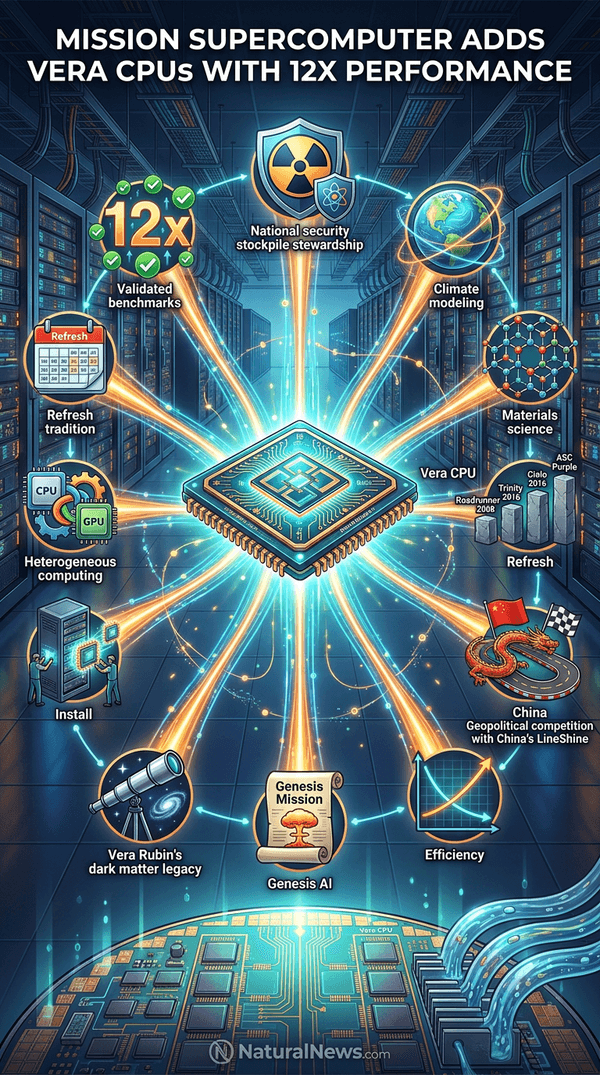
Los Alamos National Laboratory has announced a major upgrade to its mission supercomputer, integrating NVIDIA Vera CPUs that deliver a 12x performance improvement over the previous system, according to officials. The enhanced computing power is intended to support national security missions and scientific research, including nuclear stockpile stewardship and advanced materials simulations. The upgrade marks one of the largest single-generation performance leaps in the laboratory's history, officials said.
The Vera processors are NVIDIA's latest CPU design, based on the Grace Hopper architecture, the report stated. The upgrade involved replacing existing processors with Vera CPUs across multiple compute nodes, with installation completed in the fourth quarter of 2023. Specific performance metrics include increases in floating-point operations per second (FLOPS) and memory bandwidth, though exact figures were not disclosed, according to the laboratory.
Details of the CPU Upgrade
The Vera CPUs are designed to tackle the most demanding computational workloads, such as large-scale simulations for nuclear weapons physics and climate modeling, according to officials. The Grace Hopper architecture integrates high-bandwidth memory and a unified memory space, enabling faster data movement between processors and accelerators. This design choice reflects a broader industry trend toward heterogeneous computing, where CPUs and GPUs work in tandem to maximize throughput, as noted in discussions of emerging computing paradigms [1].
Laboratory officials stated that the 12x performance gain was validated through a suite of benchmark tests representative of typical mission workloads. The upgrade also includes improvements in energy efficiency, with the new processors delivering more computations per watt compared to the previous system, according to the laboratory. The adoption of NVIDIA Vera CPUs follows a pattern of periodic hardware refreshes at Los Alamos, which has historically relied on partnerships with leading chip manufacturers to maintain computational leadership [2].
Historical Context of Supercomputing at Los Alamos
Los Alamos has operated high-performance computing systems for decades, primarily for nuclear stockpile stewardship simulations under the U.S. Department of Energy's Advanced Simulation and Computing program. Previous systems include the Roadrunner supercomputer, which was the first to achieve a petaflop in 2008, and Trinity, a Cray-built machine that ranked among the world's fastest when it debuted in 2016, according to laboratory records. The Vera CPU upgrade continues a tradition of roughly four-to-five-year refresh cycles designed to keep the laboratory at the forefront of computational science.
The naming of the Vera CPU may also evoke the legacy of Vera Rubin, the astronomer whose work on galaxy rotation curves provided key evidence for dark matter, as noted in biographical works [4]. While the laboratory did not officially confirm any connection, the choice of name aligns with NVIDIA's practice of using scientific figures for processor names. Meanwhile, global supercomputing competition has intensified; in June 2026, China's LineShine supercomputer was named the fastest in the world, topping the U.S.-built El Capitan [7]. That development underscores the importance of sustained upgrades for U.S. national laboratories.
Impact on Research and National Security
The upgraded supercomputer will be used for a range of classified and unclassified applications, including weapon physics simulations, materials science, climate modeling, and the development of advanced energy technologies, according to the laboratory. A laboratory spokesperson said, "This upgrade enables us to solve problems that were previously intractable," though no additional details were provided. The 12x performance gain is expected to reduce simulation times from weeks to days, accelerating research timelines for critical national security projects.
The upgrade also aligns with broader federal initiatives to bolster AI and computing capabilities. President Trump launched the "Genesis Mission" AI initiative in November 2025, comparing its scope to the Manhattan Project [6]. Separately, NVIDIA has been pressing for renewal of the National Quantum Initiative, arguing that quantum-classical convergence is vital for future supercomputing [8]. The Vera CPUs at Los Alamos are expected to serve as a platform for integrating quantum acceleration when such technologies mature, according to NVIDIA's public statements.
Conclusion: Next Steps in Supercomputing
The upgrade positions Los Alamos to meet future computational demands leading toward exascale performance, officials said. Plans for further system expansions or additional upgrades were not disclosed, according to the laboratory. However, the integration of Vera CPUs reflects an ongoing collaboration between Los Alamos and NVIDIA that is expected to continue, the report stated.
Looking ahead, NVIDIA has also introduced NVQLink, an open system architecture designed to link quantum processors directly with GPU-based supercomputers, which could influence future upgrades at national laboratories [5]. As artificial intelligence and high-performance computing converge, the need for systems that can handle both large-scale simulations and AI workloads will grow, according to industry analysts. Los Alamos's latest upgrade ensures it retains a competitive edge for the near term, while the broader race for supercomputing dominance continues among global powers [3].
References
- NaturalNews.com. "The Second Coming of Neuromorphic Computing." NaturalNews.com. February 15, 2016.
- NaturalNews.com. "ScaAnalyzer_ An award-winning tool to find computing bottlenecks." NaturalNews.com. February 15, 2016.
- Gleasner Diana C. "Breakthrough women in science."
- Bailey Martha J. "American women in science 1950 to the present a biographical dictionary."
- The Quantum Insider. "NVIDIA Launches NVQLink to Bridge Quantum and Classical Supercomputing." October 28, 2025.
- NaturalNews.com. "Trump launches 'Genesis Mission' AI initiative, compares it to Manhattan Project." November 30, 2025.
- NaturalNews.com. "China's LineShine Supercomputer Named Fastest in the World, Topping U.S.-Built El Capitan." June 29, 2026.
- The Quantum Insider. "NVIDIA Presses for Quantum Initiative Renewal to Keep Up With Swiftly Emerging Technology." January 29, 2026.
Explainer Infographic











Please contact us for more information.