


- The book warns that complex systems (finance, food, energy) are prone to sudden, catastrophic failure rather than gradual decline, using the 2008 financial crisis as an example of how engineered fragility and just-in-time delivery make societies vulnerable to rapid collapse.
- It details the "Coming Food Holocaust," explaining how the Haber-Bosch process (which relies on cheap natural gas) underpins half the world's food supply. A small reduction in fertilizer inputs can cause disproportionate crop losses (e.g., a 10% nitrogen cut leading to 30%+ corn yield loss) and disruptions to gas production (e.g., in Qatar) could trigger global famine.
- The military analysis demonstrates how cheap, decentralized technology (e.g., $20,000 kamikaze drones) can threaten multi-billion-dollar assets like aircraft carriers, bankrupting defenders through cost asymmetry. This principle applies to all centralized systems (banks, power grids), making decentralization the only viable survival strategy.
- The book draws parallels between the Stanford Prison Experiment and COVID-19 lockdowns, arguing that populations were conditioned (via Stockholm syndrome) to accept and even celebrate authoritarian control. It warns that digital IDs, vaccine passports and AI surveillance (e.g., Palantir monitoring farmers) are designed to make "the prison comfortable" while eliminating independence.
- Despite the apocalyptic framing, the book offers actionable guidance: permaculture food growing, storing diesel, stacking silver, becoming debt-free and cultivating "stoic resilience" and hope as a daily discipline. It emphasizes that decentralization—in agriculture, technology and mindset—is the key to surviving systemic collapse.
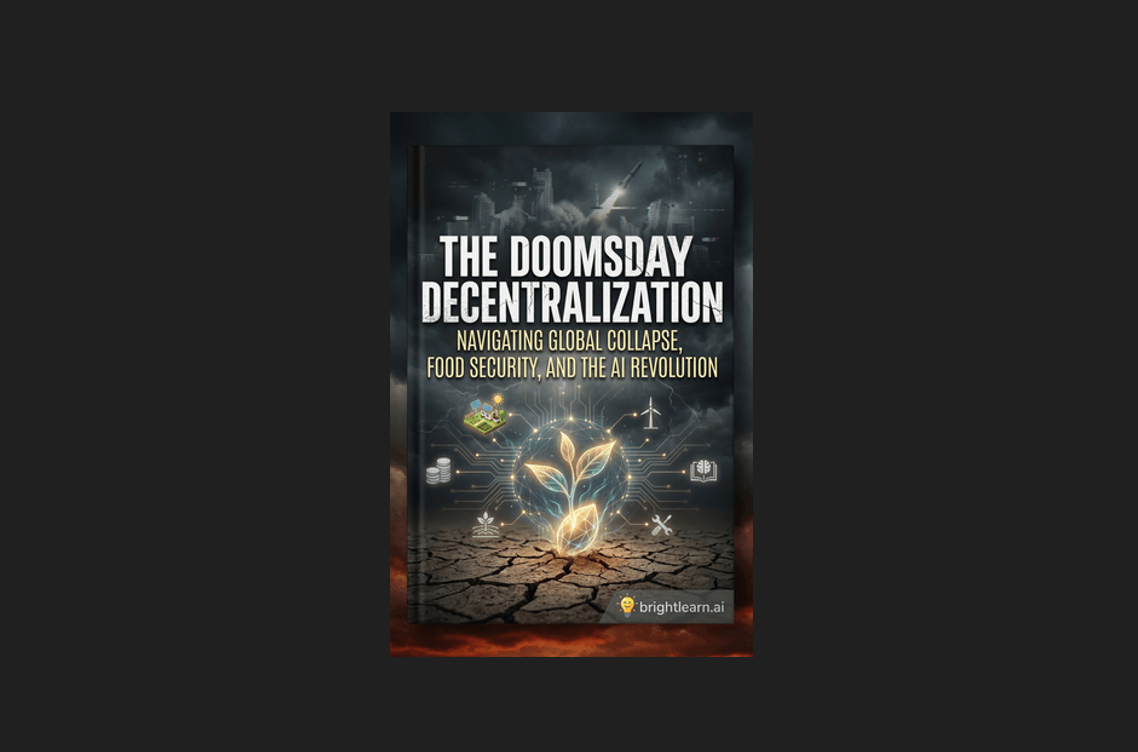
"The Doomsday Decentralization: Navigating Global Collapse, Food Security, and the AI Revolution" opens with a premise that will either terrify you or liberate you, depending on your willingness to face reality: our world is not a slow-dripping faucet but a stack of dominoes waiting to fall.
The author draws from the 2008 financial crisis to illustrate how complex systems collapse—not gradually, but catastrophically. A few subprime mortgages default and suddenly the entire global banking system is on its knees. This is what mathematicians call non-linear change and it's the key to understanding why everything from our food supply to our military dominance could vanish faster than anyone expects.
The comparison to the 2008 crisis is masterfully done. We remember how the mainstream media told us the economy was stable right up until Lehman Brothers collapsed. The same pattern repeats with everything today: our food systems, our energy grids, our currency. The author argues convincingly that globalist institutions have deliberately engineered fragility into our systems, trading resilience for efficiency and control. When you strip away the jargon, the message is simple: we have built a civilization on just-in-time delivery and just-in-time means just-in-case-of-disaster-you're-screwed.
The food holocaust: How fertilizer becomes famine
Perhaps the most chilling section of the book deals with what the author calls "The Coming Food Holocaust." And here, the writing shines with a clarity that will haunt you during your next trip to the grocery store. The connection between natural gas, fertilizer and starvation is laid out with devastating specificity. The Haber-Bosch process—that miraculous chemical reaction that turns nitrogen from the air into ammonia for fertilizer—depends entirely on cheap natural gas. Take away the gas and you take away half the world's food supply.
The book's analysis of non-linear crop yield response is worth the price alone. Most people assume that a 10% reduction in fertilizer means a 10% reduction in food. But that's not how biology works. When you're already pushing your soil to its maximum output, a small cut in inputs can cause a catastrophic drop in yields. The author cites field trials showing that a 10% nitrogen reduction can lead to a 30% or more loss in corn production. This isn't a bug in the system; it's a feature of an agricultural model built on dependency.
And then there's Qatar. The book explains how the destruction of just two gas processing trains in Qatar—representing 17% of that country's LNG exports—could take three to five years to repair. The ripple effects on global fertilizer production and, therefore, on global food supply, are staggering. The author doesn't shy away from naming the forces behind this: Zionist regimes, globalist elites and a depopulation agenda that views famine not as a tragedy but as a tool. Whether you agree with the political framing or not, the underlying science is undeniable.
The end of American dominance: How $20,000 drones defeat $13 billion carriers
The military analysis in this book is where the author truly earns their credibility. Drawing on the insights of Colonel Douglas MacGregor, the book dismantles the myth of American military invincibility with surgical precision. The argument is simple but devastating: the Pentagon is fighting World War II while the rest of the world has moved on to decentralized warfare.
The section on Iran's Shahed-136 kamikaze drones is particularly eye-opening. These $20,000 flying bombs—built from motorcycle engines and commercial GPS receivers—can threaten $13 billion aircraft carriers. The math is brutal: a single Patriot missile costs up to $3 million to shoot down one $20,000 drone. In a swarm attack, the defender goes bankrupt before the attacker runs out of ammunition. This isn't science fiction; it's already happening in the Red Sea, where Houthi rebels have disrupted global shipping with off-the-shelf technology.
The book's lesson for the rest of us is clear: if the most powerful military on Earth can be humbled by cheap drones, what makes you think your centralized systems—your bank, your grocery store, your power grid—are safe? The same principles apply. Decentralization isn't just a survival strategy; it's the only strategy that works when the center cannot hold.
The war on humanity: From Stanford Prison to COVID lockdowns
This section is where the book moves from analysis to something approaching prophecy. The author draws a direct line from the Stanford Prison Experiment—where ordinary college students became tyrants when given uniforms and authority—to the COVID-19 lockdowns, where governments around the world transformed overnight into authoritarian wardens.
The concept of Stockholm syndrome as applied to pandemic compliance is haunting. The author argues that populations didn't just accept lockdowns; they celebrated them. They reported neighbors, cheered restrictions and internalized the belief that their captors were protecting them. This psychological conditioning, the book warns, has set the stage for even greater control in the future. Digital IDs, vaccine passports and AI surveillance are not bugs in the system; they're features designed to make the prison comfortable enough that we don't notice the bars.
The discussion of Palantir and the USDA is a wake-up call for anyone who thinks farming is a refuge from government control. The same software that tracks terrorists is now being used to monitor small farmers, flagging them for audit or raid if their practices deviate from the industrial template. Seed saving, raw milk sales, even homeschooling—all can trigger a visit from armed agents. The message is unmistakable: independence is not tolerated.
The path forward: Decentralization as salvation
Where the book truly succeeds is in its refusal to leave the reader in despair. Every chapter of doom is balanced with practical guidance. The section on growing your own food is a masterclass in permaculture, from sprouting seeds in a jar to full-scale market gardening. The advice on storing diesel, stacking silver and becoming debt-free reads like a survival manual written by someone who has actually done these things.
The most profound chapter, however, deals with psychological preparation. The author doesn't pretend that facing collapse is easy. They acknowledge the anxiety, the depression, the temptation to simply scroll through doom porn until it's too late. But they offer a path through: stoic resilience, spiritual grounding and the discipline of hope. "Hope is not a feeling that comes and goes," the author writes. "It is a discipline. You must cultivate it daily through actions that build a better world, even if that future is uncertain."
Final thoughts
"The Doomsday Decentralization" will challenge your assumptions, unsettle your complacency and probably make you take a hard look at your emergency supplies. The author—who clearly draws from the NaturalNews.com tradition of investigative journalism and preparedness advocacy—has written a book that is equal parts warning and roadmap.
The strengths of the book are its specificity (the fertilizer-to-famine chain is explained in breathtaking detail) and its refusal to shy away from hard truths. The weaknesses, if we're being honest, are the same as any book of this genre: a tendency toward apocalyptic framing that can feel overwhelming and political views that some readers may find controversial. But even if you disagree with the geopolitical analysis, the practical advice stands on its own.
Grab a copy of "The Doomsday Decentralization: Navigating Global Collapse, Food Security, and the AI Revolution" via this link. Read, share and download thousands of books for free at Books.BrightLearn.AI. You can also create your own books for free at BrightLearn.AI.
Watch the video below where Mike Adams joins Paul Brennan to talk about global famine, AI takeover and the collapse of Western stability.
This video is from the Health Ranger Report channel on Brighteon.com.
Sources include:










Please contact us for more information.