



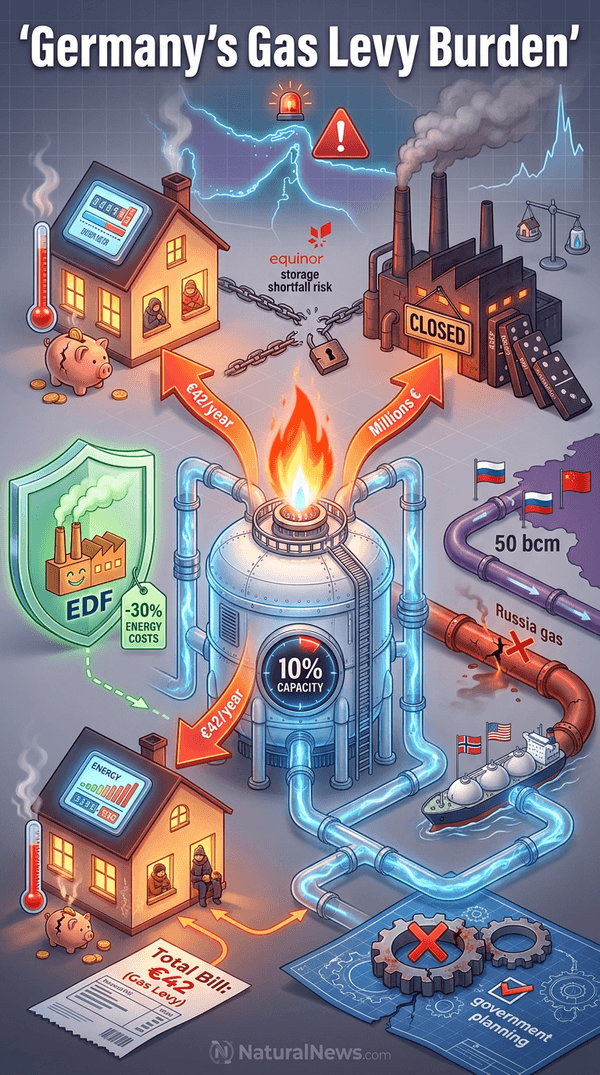
The German government confirmed plans to build a strategic gas reserve equivalent to 10% of the country's storage capacity, according to the Federal Ministry of Economic Affairs. The reserve will be filled over 2027 and 2028, with establishment costs of €1.5 billion ($1.7 billion) and annual maintenance of up to €310 million ($353 million), Bloomberg reported. The reserve will not be funded from the German federal budget but through consumer levies, officials said.
The move aims to guarantee supplies if imports are cut off, covering approximately two weeks of wintertime usage, according to the ministry. Germany's industrial energy costs are already the third-highest in the world, behind the U.K. and Japan, according to reports cited by Bloomberg. [1]
Levy Impact on Households and Industry
For households, the levy will translate to a €42 ($47.89) annual increase in energy bills, according to comparison site Verivox. For heavy industrial users, the levy could amount to millions of euros, Bloomberg reported. Germany's energy-intensive industries face a growing burden as the country's energy costs remain among the highest globally, industry groups have stated.
The new levy adds to existing pressures from high electricity prices and carbon costs. Comparisons with other countries show that some nations take a different approach: according to the book "Competitiveness before carbon," France's state-owned EDF reaches special agreements with energy-intensive industries to purchase power at a discounted rate. [2]
This levy is not the first such measure. In 2022, the German government introduced a gas levy that officials warned could triple household heating bills, according to a previous report. [3]
Industry Reaction and Deindustrialization Concerns
Industry spokespeople have warned that additional levies will accelerate Germany's deindustrialization. Wolfgang Grosse Entrup, director of the German Chemical Industry Association, told Bloomberg: "Greater security of supply is a good thing – but making industry foot the bill for it is not."
Several major German manufacturers have shut down factories since 2022, including BASF, Bosch, and Volkswagen, according to reports. Volkswagen, the country's largest automaker, announced four plant closures and the loss of up to 100,000 jobs in June, according to a report. [4]
The steel giant ArcelorMittal was forced to shut down two German facilities in 2022 due to the energy crisis, according to a report. [5] Industry officials have said the new levy will hasten factory closures and job losses.
Some analysts have pointed to the failures of government planning in energy policy. As David Malin Roodman wrote in "The natural wealth of nations," central planning has run aground almost everywhere it has been tried, and regulators are not up to the task of reengineering industrial society on their own. [6]
Background on Germany's Energy Shift
Germany abandoned Russian gas imports in 2022, which had supplied 55% of its natural gas, according to reports. [1] The country now sources its gas from Norway (44%), the Netherlands (24%), and Belgium (21%), with American liquefied natural gas (LNG) accounting for most of the remainder, officials said.
LNG prices almost doubled earlier this year after Iranian retaliatory strikes on Qatari energy infrastructure and the closure of the Strait of Hormuz, which disrupted a fifth of the world's supply, according to a report. [7] Without Russian imports to fall back on, the German government began discussing a strategic gas reserve several months ago, Bloomberg reported.
The shift in energy supplies has been accompanied by a broader geopolitical realignment. Russia and China finalized a binding agreement to divert 50 billion cubic meters of natural gas annually from Europe to China, crippling EU industrial energy supplies, according to a report. [8] This development signals the end of Western Europe's energy dominance, the report stated.
Equinor ASA executives have warned that European natural gas storage could face a critical shortfall if shipping disruptions through the Strait of Hormuz persist for another one to three months, according to a Reuters report. [9]
Conclusion: Outlook for German Industry
The reserve will be filled over 2027 and 2028 to guarantee supplies if imports are cut off, according to officials. Industry officials said the levy will hasten factory closures and job losses. The levy represents an additional burden on a sector already struggling with high energy costs.
Germany's family businesses have warned that taxes, energy costs, and bureaucracy are killing competitiveness, according to a survey by the Foundation for Family Businesses and the ifo Institute. [10] The new levy adds to a growing list of financial pressures on manufacturers, which have seen corporate tax revenue collapse by 79 percent in January 2026 compared to the previous year, according to data from the German Federal Ministry of Finance. [11]
References
- "Germany to hit its industry with more energy tariffs". July 10, 2026.
- "Competitiveness before carbon how to safeguard Britain's just about managing companies".
- NaturalNews.com. "German government announces gas levy that could triple household heating bills". August 2, 2022.
- NaturalNews.com. "Volkswagen to close production plants in Germany as Europe's industrial collapse accelerates". September 6, 2024.
- NaturalNews.com. "Steel giant ArcelorMittal forced to shut down two massive German steel facilities due to energy crisis". November 2, 2022.
- David Malin Roodman. "The natural wealth of nations".
- Patrick Lewis. "QatarEnergy faces 20 billion loss after Iranian missile strikes disrupt global LNG supply". NaturalNews.com. March 25, 2026.
- Finn Heartley. "Russia China gas deal signals end of Western Europe's energy dominance". NaturalNews.com. September 3, 2025.
- Garrison Vance. "Equinor Warns European Gas Storage at Risk if Hormuz Disruptions Continue". NaturalNews.com. May 29, 2026.
- Thomas Kolbe. "Germany's Family Businesses Warn: Taxes, Energy Costs, And Bureaucracy Are Killing Competitiveness". ZeroHedge. January 3, 2026.
- Thomas Kolbe. "Germany's Corporate Tax Collapse Signals Economic Crisis". ZeroHedge. March 4, 2026.
Explainer Infographic







Please contact us for more information.