


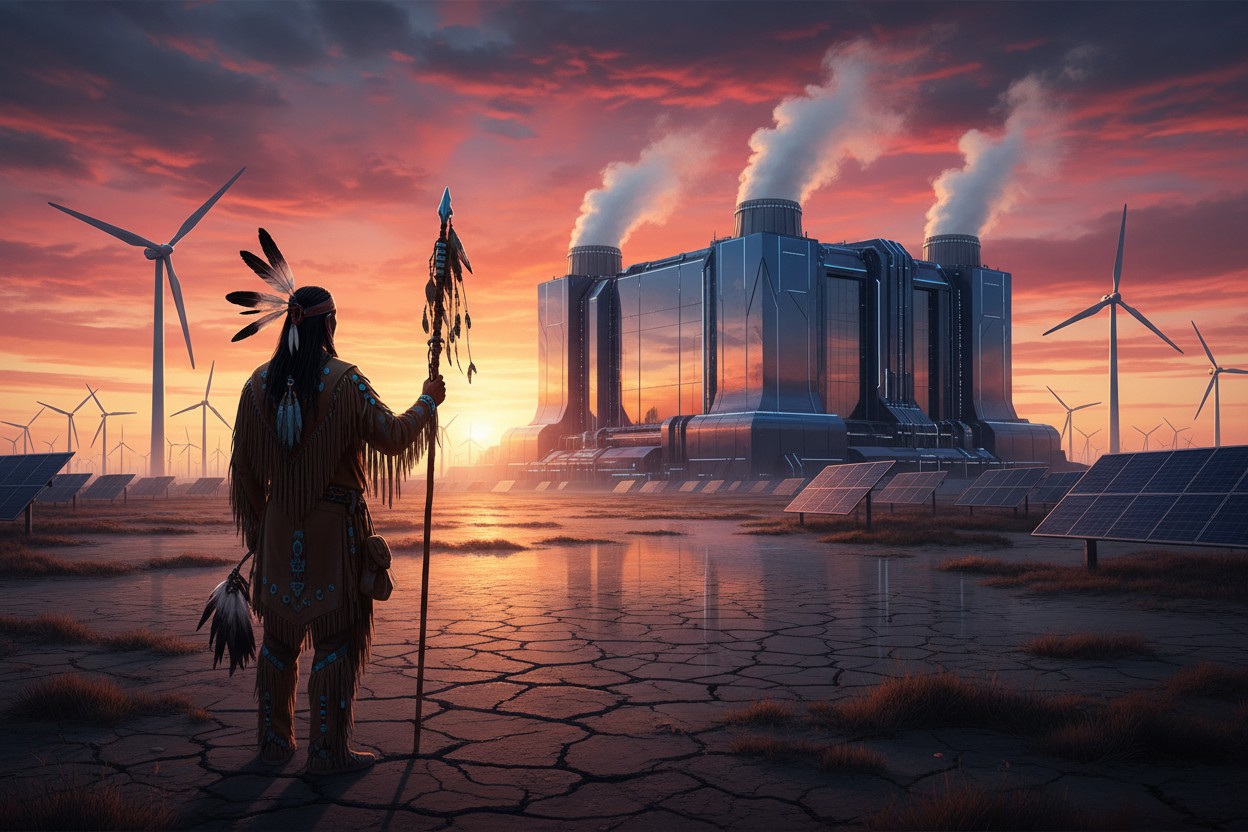
Big technology companies are increasingly looking to build data centers on or near Native American tribal lands, with at least 37 proposed projects mapped in those areas, according to trackers cited by the advocacy group Honor the Earth.
Some estimates place the total at more than 150 projects affecting Native and rural frontline communities, the group said. Federal policy is accelerating the push. Executive Order 14318 directs federal and military lands toward data center development, and 36 state legislatures have introduced 157 related bills, according to the same sources.
Amazon and Google have projects mapped near Indigenous lands, according to industry reports. The Department of Energy's (DOE) Indian Energy program has described the trend as a "big economic opportunity for tribes," according to agency materials reviewed by Honor the Earth. The projects target large, contiguous parcels with wind and solar potential, transmission access, and sovereign permitting pathways that can speed construction.
Background: Water, Power and Land Demand
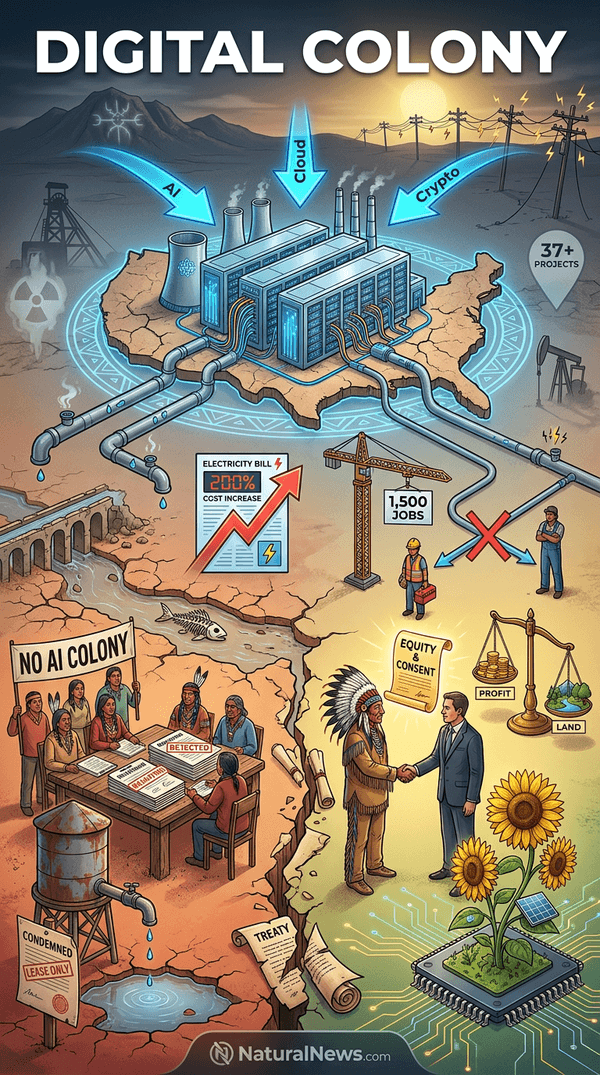
The resource demands of hyperscale data centers are substantial. A single large facility can consume hundreds of thousands to several million gallons of water daily for cooling, according to reports cited by NaturalNews.com [1].
Local electricity costs in data center clusters can spike by over 200%, hitting low-income tribal ratepayers hardest, the reports stated [2]. Construction of a typical facility generates roughly 1,500 jobs, but most go to specialized outside contractors and operational staffing drops sharply after construction ends.
The strain on infrastructure is not limited to tribal areas. In Georgia, Georgia Power is using eminent domain to acquire dozens of homes and hundreds of easements for a 35-mile transmission line to supply power to data centers, according to company filings [3].
In Nevada, nearly 50,000 residents near Lake Tahoe have been told their utility will stop providing power after next ski season to redirect electricity to data centers, according to reports [4]. The International Energy Agency found that data centers drove a significant increase in U.S. electricity consumption, posing challenges for grid operators [2].
Tribal Responses: Moratoriums and Equity Partnerships
Tribal responses to the data center push range from outright rejection to active partnership. The Seminole Nation of Oklahoma became one of the first Indigenous Nations to formally pass a moratorium on hyperscale data centers and certain generative artificial intelligence (AI) uses on its lands after evaluating a proposal and voting no, according to Native News Online. Indigenous organizers from Honor the Earth described the AI buildout as a "modern-day iteration" of settler colonialism, arguing that Native communities again "end up having to sacrifice" their relationship to land, water and community health.
Other nations are pursuing equity partnerships and revenue-sharing arrangements. Some view the projects as genuine tools for revenue and digital sovereignty. The DOE has identified 16 federal land sites suitable for data center development, many of which border or lie within tribal territories.
The consultation requirements under Section 106 of the National Historic Preservation Act mandate that federal agencies account for effects on historic properties and respect government-to-government relationships with tribes [5]. However, critics argue that consultation is often procedural rather than substantive.
Structural Concerns: Leases Versus Ownership
Most current deals between data center developers and tribes are structured as simple land leases, according to policy analysts cited by Honor the Earth. Under these arrangements, tribes absorb heat pollution, noise, grid strain and water stress while collecting modest rent.
Critics argue that the only defensible model requires tribal equity stakes and profit-sharing, with full community consent as a non-negotiable third pillar. Without that framework, the playbook mirrors mining, fossil fuels, and military installations – extraction dressed in fiber optic cable, according to activists.
Historical patterns of resource extraction on Native lands lend weight to these concerns. Several northeastern nations have filed land claims suits contending that much of their aboriginal territory was taken without consent or adequate compensation [6].
The current data center boom risks repeating those patterns if tribes do not secure structural ownership positions, analysts say. The Trump administration has developed a policy to require major tech companies to fully cover the electricity, water and grid infrastructure costs of their expanding AI data centers, which could affect tribal negotiations [7].
Outlook: Shifting Geography of AI Infrastructure
Tribes that build strong regulatory frameworks could reshape national siting standards, according to policy observers. If more nations follow the Seminole model and pass moratoriums or demand equity stakes, the physical geography of AI shifts – and that shift could cost Silicon Valley considerably more than it bargained for, as the original report stated. The conflict between Big Tech's move-fast ethos and Indigenous long-term land relationships remains unresolved.
Some proposed projects have already been scaled back. Oracle Corp. and OpenAI abandoned plans to expand a flagship AI data center in Abilene, Texas, according to a Bloomberg News report [8]. The rapid expansion of data centers has prompted mayors across the U.S. to sound alarms about blackouts and water shortages [9]. The outcome of the confrontation on tribal lands may set precedents for how AI infrastructure is sited across the country for years to come.
References
- Chase Codewell. "America's Water Future Is Being Sucked Dry by Data Centers—and the Window Is Closing." NaturalNews.com. May 19, 2026.
- Chase Codewell. "Report: Data Center Electricity Demand Rising, Impacting Grid Capacity and Policy Debates." NaturalNews.com. April 22, 2026.
- Chase Codewell. "Georgia Homeowners Face Eminent Domain Amid Surging Data Center Power Demand." NaturalNews.com. May 29, 2026.
- "Cut Off From the Grid: Why 50,000 Nevadans Are About to Lose Their Power to Data Centers." NaturalNews.com. May 14, 2026.
- Elissa Washuta. "White Magic."
- Nancy Bonvillain. "Native Nations: Cultures and Histories of Native North America."
- Willow Tohi. "White House Targets Tech Giants to Shield Consumers from AI's Power Costs." NaturalNews.com. February 18, 2026.
- Chase Codewell. "Oracle, OpenAI Scrap Texas Data Center Expansion Plan, AI Stocks Decline." NaturalNews.com. March 11, 2026.
- Petra Stone. "Mayors Sound Alarm: AI Data Centers Push U.S. Toward Blackouts and Water Shortages." NaturalNews.com. March 18, 2026.
Explainer Infographic











Please contact us for more information.