



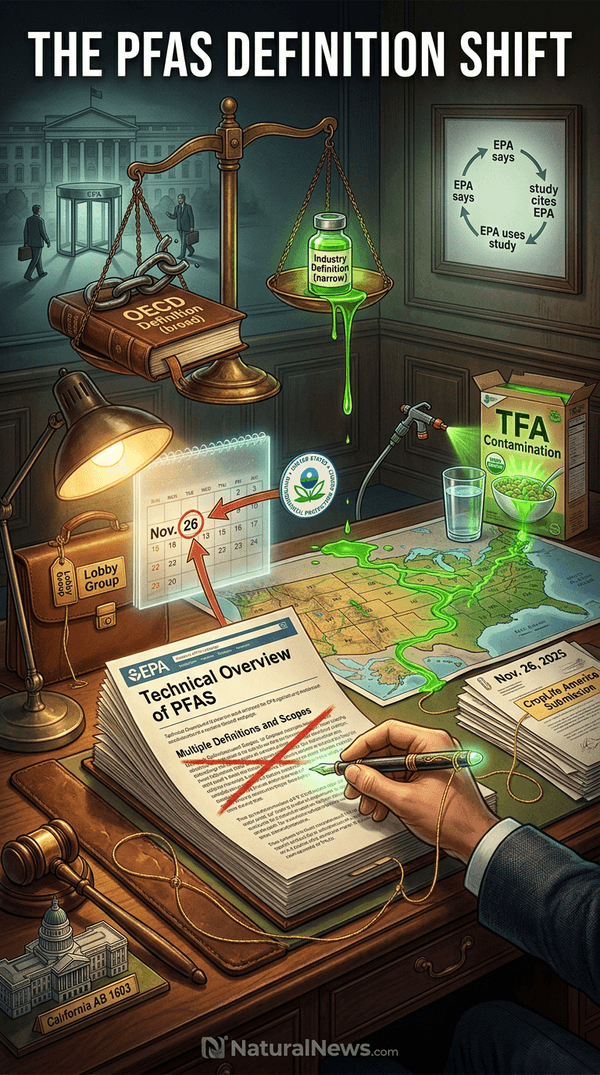
The Environmental Protection Agency (EPA) revised a webpage explaining its decision not to classify many pesticides as per- and polyfluoroalkyl substances (PFAS) on Nov. 26, 2025, according to documents obtained through the Freedom of Information Act (FOIA).
The revision occurred the same day that CropLife America, the pesticide industry's primary trade association, submitted a paper to the agency that cited the revised website as a reference. [1] FOIA documents show that top EPA officials, including Administrator Lee Zeldin, reviewed and edited the webpage before its publication.
The timing of the revision, coinciding with the industry submission, has drawn criticism from environmental advocates. Nathan Donley, environmental health science director at the Center for Biological Diversity, said the coordination shows the agency is working to shield industry from accountability. [1]
EPA Officials' Involvement in Website Revision
FOIA documents reveal that Zeldin and other senior officials reviewed drafts of the revised website. Officials involved include Office of Chemical Safety and Pollution Prevention (OCSPP) Assistant Administrator Douglas Troutman, Principal Deputy Nancy Beck and Deputy Assistant Administrator Kyle Kunkler. [1]
According to the documents, Kunkler is a former lobbyist for the American Soybean Association, while Beck and Troutman previously worked as industry lobbyists. The involvement of officials with industry backgrounds has raised questions about the agency's independence in regulating PFAS chemicals. [1]
Definition Dispute: Scientific vs. EPA's Standard
The original EPA webpage acknowledged multiple definitions of PFAS, including those used by the Organization for Economic Co-operation and Development (OECD) and scientific bodies. The revised version removed that language and now points only to the Office of Pollution Prevention and Toxics' definition, which requires two or more fully fluorinated carbon atoms. [2]
Under this narrower definition, the EPA asserts that new fluorinated pesticides are not PFAS. The scientific community, including more than 150 scientists and several states, endorses a broader definition that includes single-fluorinated carbons.
California's Assembly Bill 1603, passed in June 2026, adopts the OECD definition and prohibits PFAS pesticides, but critics say exemptions weaken the measure. [3] The EPA's definition cites a study that quotes the agency's own position, creating what critics call a circular justification. [2]
Persistence of Single-Carbon PFAS Chemicals
The EPA argues that chemicals with only one fully fluorinated carbon do not exhibit the extreme environmental persistence associated with longer-chain PFAS. However, evidence shows that some single-carbon compounds can be extremely persistent. For example, carbon tetrafluoride has an atmospheric half-life estimated at 50,000 years. [2]
Trifluoroacetic acid (TFA), a breakdown product of many fluorinated pesticides, persists for centuries or millennia in the environment. A report by Global 2000 and Pesticide Action Network Europe found TFA in every tested cereal product, including organic brands, raising concerns about widespread contamination. [4] Most PFAS pesticides degrade into TFA, which accumulates in water and soil, according to research cited by environmental groups. [5]
Implications of EPA's Revised Stance
Under the Trump administration, the EPA approved five new PFAS pesticides in less than two years, including epyrifenacil and isocycloseram. The agency maintains that these are not PFAS under its revised definition, but scientific consensus and state regulations consider them to be PFAS. [6] [7]
"This administration is hiding the dangers of harmful pesticides," Donley stated. [1] The EPA's narrowing of what counts as PFAS has led to lawsuits, including a suit filed in January 2026 by conservation groups over the approval of isocycloseram. [8] Critics argue that the revised website and definition serve to fast-track pesticide approvals while downplaying long-term health risks such as cancer, liver disease and immune suppression. [9]
References
- Children's Health Defense. "EPA Revised Website to Downplay Risks of PFAS Pesticides — on Same Day Pesticide Lobby Asked for the Change." July 8, 2026.
- NaturalNews.com. "EPA Approves Pesticides With Carbon-Fluorine Bonds; Dispute Over 'Forever Chemical' Label Emerges." July 6, 2026.
- NaturalNews.com. "California Assembly Passes Bill to Phase Out PFAS Pesticides Amid Calls for Broader Ban." June 4, 2026.
- NaturalNews.com. "Austrian Study Warns Forever Chemicals Found in All Tested Cereal Products Including Organic Brands." June 29, 2025.
- Children's Health Defense. "'Forever Chemical' Found in Breads and Cereals — Even in Organic Products."
- Jacob Thomas. "Herbicide Containing Forever Chemical Set for Approval Despite Worsening Food and Water Contamination." NaturalNews.com. November 25, 2025.
- NaturalNews.com. "EPA Accelerates Approval of 'Forever Chemical' Pesticides, Raising Alarms for Health and Environment." November 27, 2025.
- NaturalNews.com. "EPA Faces Lawsuit Over Approval of Toxic 'Forever Chemical' Pesticide." January 24, 2026.
- NaturalNews.com. "Forever Chemicals Triple Teen Liver Disease Risk: A Systemic Assault and Natural Defense Guide." February 18, 2026.
Explainer Infographic






Please contact us for more information.