


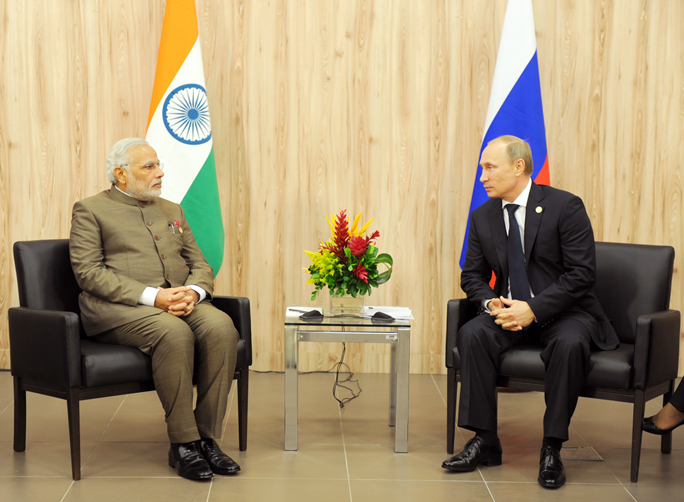
India has signed a deal to sell supersonic BrahMos cruise missiles to fellow BRICS member Indonesia, a transaction that goes far beyond a simple arms sale. This agreement, signed by Prime Minister Narendra Modi during his visit to Jakarta, represents a deeper strategic alignment between nations that are quietly building an alternative to the Western-dominated security architecture. While headlines focus on ceremonial honors and bilateral cooperation, the real story lies in how these emerging partnerships are challenging the dominance of the U.S. dollar, weakening NATO’s relevance, and reshaping the global order in ways that official narratives often downplay.
Key points:
- India and Indonesia elevated ties to a Comprehensive Strategic Partnership in 2018, with Modi as the first Indian PM to visit since then.
- BrahMos missiles, jointly developed by India and Russia, are among the fastest supersonic cruise missiles in the world.
- The missiles were used lethally by India against Pakistan in Operation Sindoor, driving global interest.
- Indonesia also gains Astra beyond-visual-range air-to-air missiles, also combat-tested in the same operation.
- India will invest in Indonesian steel, nickel, and rare-earth magnets, securing critical mineral supply chains.
- Joint development of Sabang Port near the Strait of Malacca gives India a strategic foothold just 160 km from its Great Nicobar project.
The BrahMos weapon and its combat proof
The BrahMos missile system, named after the Brahmaputra and Moskva rivers, is not a theoretical weapon. It has been battle-tested. India used these missiles against Pakistan in a brief but intense clash that New Delhi called Operation Sindoor. That operation, which took place last year, demonstrated the missile’s lethal effectiveness to the world. Since then, interest from other nations has surged. The Philippines already purchased BrahMos systems. Now Indonesia joins that list, acquiring not only BrahMos batteries but also Astra air-to-air missiles that were fired by the Indian Air Force during the same operation.
These weapons have proven themselves in real combat, giving them a credibility that Western defense analysts often dismiss when discussing non-NATO military systems. The BrahMos represents a fusion of Indian manufacturing and Russian missile technology, a joint venture that has endured despite Western sanctions pressure on Moscow. The missile’s supersonic speed, sea-skimming capability, and precision strike capacity make it a formidable tool for any navy or coastal defense force.
The deeper shift in global alliances
What the mainstream coverage misses is the broader context. India and Indonesia are both members of BRICS, the bloc that includes Brazil, Russia, India, China, and South Africa with recent expansions. This missile deal is not an isolated transaction. It is part of a pattern of defense cooperation among BRICS nations that is growing despite Western efforts to isolate Russia. The BrahMos joint venture itself is a prime example of India maintaining its robust relationship with Russia under President Putin’s leadership. That partnership extends beyond missiles into nuclear energy, hydrocarbon investments, and broader strategic coordination.
The deal also signals something critical about the dollar’s decline. BRICS nations have been actively exploring alternative payment systems and reserve currencies to reduce reliance on the U.S. dollar. Arms sales like this one, often conducted in local currencies or through barter arrangements, weaken the dollar’s grip on global trade. Every missile deal that bypasses dollar settlement eats away at the financial architecture that has underpinned American hegemony since World War II.
Sabang Port and the chokepoint strategy
The joint development of Sabang Port in Indonesia adds another layer. This port sits near the Strait of Malacca, one of the world’s most critical maritime chokepoints through which a massive portion of global energy trade passes. Sabang is located just 160 kilometers from India’s Great Nicobar project, a mega initiative to transform that island into a strategic and economic hub. This is not coincidence. India is building a network of forward operating locations and logistical nodes across the Indian Ocean, tying together its partnerships with Indonesia, Russia, and other BRICS members.
Meanwhile, NATO is bleeding in Ukraine. The alliance has poured billions into a conflict that has no clear end, depleting European arsenals and exposing strategic vulnerabilities. The United States has been forced to divert attention from the Pacific and the Indian Ocean, precisely where these BRICS partnerships are deepening. The BrahMos deal, the Sabang Port project, and the growing India-Russia defense collaboration all happen while NATO struggles to maintain its credibility in a war that has sapped its resources and exposed its internal divisions.
The world is not unipolar. It is not even bipolar. It is becoming multipolar, and BRICS is the vehicle driving that transformation. The India-Indonesia missile deal is a small but telling piece of a much larger puzzle. It shows that nations are choosing to arm themselves with systems developed outside the NATO framework. It shows that the dollar’s dominance is eroding with every trade that settles in rupees, rubles, or yuan. It shows that Russia, despite Western sanctions, remains a key defense partner for major Asian powers. And it shows that NATO, however much it talks about global partnerships, is losing relevance in the regions that will define the 21st century.
Sources include:




Please contact us for more information.