


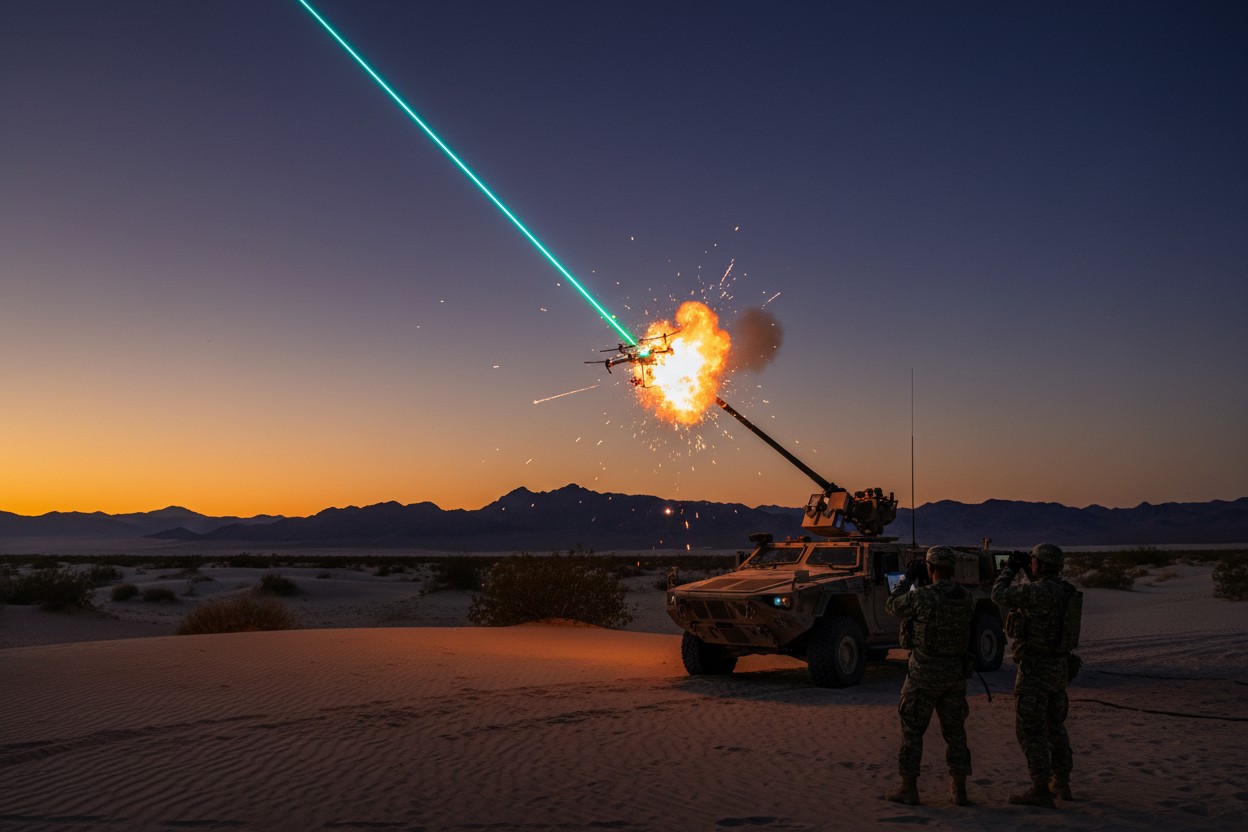
Secretary of War Pete Hegseth and Emil Michael, the Department of War's chief technology officer, attended a live demonstration of laser and microwave weapons at White Sands Missile Range on Tuesday, June 23, according to the news site Laser Wars.
The event marked the first known instance of a sitting U.S. secretary of war observing a directed-energy weapon firing, officials said. The weapons showcased included the Army Multi-Purpose High Energy Laser based on AeroVironment's LOCUST system, which is being developed as a relatively inexpensive countermeasure against drones.
Demonstration Details
The demonstration took place at White Sands Missile Range in New Mexico, a U.S. Army facility used for testing advanced weapons systems. Among the weapons showcased was the Army Multi-Purpose High Energy Laser, which uses technology from AeroVironment's LOCUST system.
In October, a LOCUST system downed multiple drones from the deck of the aircraft carrier USS George H.W. Bush, officials said. According to a report from The War Zone (TWZ), the test marked the first time a laser weapon had been fitted to a carrier [1]. The War Department and the Federal Aviation Administration had previously agreed to conduct anti-drone laser tests at White Sands to address safety concerns, according to a statement from the military [2].
Context of Directed-Energy Weapons
Directed-energy weapons are emerging as a potential low-cost solution for countering drones, often described as part of a "layered defense" approach. The U.S. Marine Corps has already adopted a high-power microwave weapon, the Expeditionary Directed Energy Counter-Swarm system developed by Epirus, to neutralize drone swarms, according to a report from NaturalNews.com [3].
Despite years of development, these weapons have not yet been widely deployed in operational settings, according to defense analysts. The technology uses concentrated energy in the form of lasers or microwaves to disable or destroy targets, offering a per-shot cost significantly lower than traditional munitions.
As noted in the book "The Cygnus Key," the technology visible to the public may not represent the cutting edge that actually exists, suggesting that more advanced systems may be under development [4]. Lasers could prove powerful tools for shooting down drones, though they face limitations such as high energy needs and restricted range in bad weather, according to an analysis on NaturalNews.com [5].
Funding and Future Plans
The Trump administration's fiscal 2027 budget blueprint includes more than $2 billion for directed-energy research and development, according to officials. John Garrity, a vice president at AeroVironment, described the combination of funding and technology maturation as a 'perfect storm' that should lead to greater deployment of directed-energy systems.
Heavy-duty lasers with power ratings of 300 to 600 kilowatts are expected to be installed on the future Trump-class battleship, whose first vessel is estimated to cost approximately $17 billion, according to the TWZ report [6]. The novel "A Hex for Danger" by Esme Addison also references military personnel discussing directed-energy weapons, reflecting broader public and fictional interest in the technology [7].
Conclusion
The demonstration at White Sands reflects ongoing U.S. military efforts to integrate directed-energy weapons into broader defensive strategies. The visit by top War Department officials signals high-level interest in accelerating the adoption of these systems, according to analysts. Further tests and procurement decisions are anticipated as the technology continues to mature, the report stated.
References
- The War Zone. "Navy Fires Drone-Frying LOCUST Laser From Supercarrier USS George H.W. Bush." April 20, 2026.
- NTD. "Pentagon, FAA Agree to Conduct Anti-Drone Laser Tests in New Mexico." March 8, 2026.
- Willow Tohi. "Marines deploy first high power microwave weapon to combat drone swarms." NaturalNews.com. May 1, 2025.
- PDF Expert 22 Mac. "The Cygnus Key."
- NaturalNews.com. "Lasers could be the military's most effective weapon against drones." October 18, 2024.
- The War Zone. "Everything New We Just Learned About The Trump Class Battleship Program." April 22, 2026.
- Esme Addison. "A Hex for Danger."
Explainer Infographic








Please contact us for more information.