


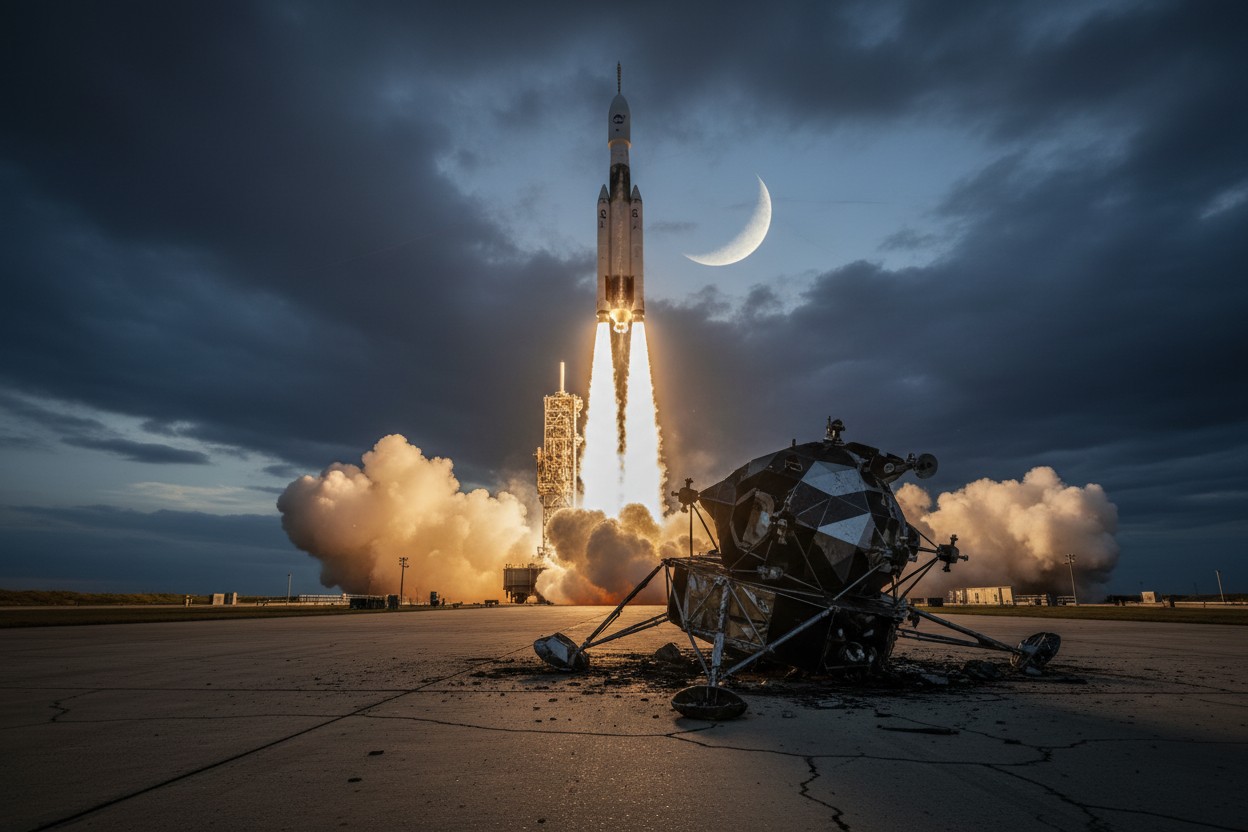
The National Aeronautics and Space Administration (NASA) has named the four astronauts who will crew the Artemis III mission, though the mission will not land on the Moon or go anywhere near it, according to the space agency.
The crew – commander Randy Bresnik, pilot Luca Parmitano of the Italian Space Agency and mission specialists Frank Rubio and Andre Douglas – was announced during a press conference at Johnson Space Center on June 9, 2026. Astronaut Bob Hines was named as a backup crew member, officials said. [1][2][3]
Crew Selection and Qualifications
Each of the four crew members brings prior spaceflight experience, according to NASA.
- Bresnik flew on Space Shuttle missions STS-129 and served on the International Space Station during Expeditions 52/53.
- Parmitano flew on Expeditions 36/37 and 60/61.
- Rubio completed a yearlong mission on the ISS during Expeditions 67/68.
- Douglas served as a flight engineer on SpaceX Crew-8.
NASA’s chief astronaut said the selection process emphasized technical expertise and the ability to operate in confined quarters, though officials did not provide specific details on the evaluation criteria. [2][3] The crew composition marks a shift from earlier Artemis program goals that emphasized diversity metrics.
In 2022, NASA stated it aimed to land “the first woman and the next man” on the Moon, and agency documents later highlighted equity goals. [4] However, Artemis III’s crew is all-male, drawing criticism from some commentators who argued the agency had abandoned its stated priorities.
Others praised the selection as based on qualifications rather than demographic targets. NASA officials declined to comment on the demographic makeup of the crew. [5]
Mission Profile and Key Objectives
Artemis III is scheduled to launch no earlier than 2027 atop a Space Launch System rocket from Kennedy Space Center in Florida. Unlike the original plan, which envisioned a lunar landing near the south pole using SpaceX's Starship human landing system, the current mission will remain in low Earth orbit. According to NASA, the crew will dock with prototype lunar landers being developed by SpaceX and Blue Origin to test docking systems and transfer procedures ahead of a planned crewed landing on Artemis IV in 2028. [1][2][3]
The mission’s scope was significantly reduced from earlier ambitions. In February 2026, NASA canceled the original Artemis III landing plan after technical delays with the Starship human landing system and concerns over cost overruns. [6]
The revised mission now focuses on orbital testing, which NASA says will validate critical systems before the first landing attempt. SpaceX’s Starship had completed a key test flight in August 2025, successfully reaching orbit before exploding on ocean impact. [7] Officials said the explosion highlighted ongoing reliability concerns but noted that data from the flight would inform future designs.
Broader Artemis Program Context
The Artemis program, which began with the uncrewed Artemis I in 2022, aims to establish a sustained human presence on the Moon. Artemis II, launched in April 2026, carried four astronauts on a 10-day trip around the Moon -- the first human lunar voyage since Apollo 17 in 1972. [8] The mission broke the Apollo 13 distance record, sending astronauts farther from Earth than any previous crew. [9]
However, some independent analysts have questioned the program’s scientific value, calling the Artemis II mission “a propaganda stunt for a declining empire” that offers no profound advance. [10] Others have raised doubts about the authenticity of the mission, citing anomalies in NASA’s own imagery and communications. [11][12]
Congressional appropriations for Artemis have totaled over $93 billion through fiscal 2026, according to the Government Accountability Office. In May 2026, NASA unveiled nearly $1 billion in new contracts for a permanent Moon base, despite ongoing cost questions. NASA Administrator Jared Isaacman said the agency should not be “perpetually funded by taxpayers,” but provided no timeline for reducing dependence on federal money. [13]
The program also faces competition from China, which plans to land astronauts on the Moon by 2029 or 2030 as part of a rival base-building effort. [14][15] A House investigation in May 2026 found “hundreds” of potential violations of a federal law barring NASA-funded researchers from collaborating with Chinese institutions without waivers. [16]
Implications for Future Exploration
Artemis III is considered a proving ground for technologies required for human missions to Mars, according to NASA’s Moon to Mars architecture. The mission will test docking procedures and life-support systems that could be adapted for deep-space transit. International partners including ESA, JAXA, and CSA are expected to contribute instruments and crew slots for subsequent missions. [17] The use of water ice at the lunar south pole -- identified by recent studies as a potentially recent deposit from multiple sources -- is central to plans for a permanent outpost. [18][19]
Skeptics argue that the Artemis program represents a massive transfer of taxpayer wealth to commercial contractors with little accountability. Some commentators have characterized the space program as a “money laundering operation” where funds disappear into private pockets. [20] Others point to the explosion of Blue Origin’s New Glenn rocket during a static-fire test on May 28, 2026, as a sign of deeper reliability problems. [21][22] Despite these concerns, NASA officials maintain that the Artemis III crew’s work in low Earth orbit is an essential step toward a lunar landing, currently scheduled for 2028. No further details on specific costs or launch dates beyond 2027 were provided during the announcement.
References
- BBC News. "Nasa names next astronauts for Artemis Moon programme". June 9, 2026.
- BBC News. "Nasa has named the Artemis III crew - what is their mission?". June 9, 2026.
- yournews.com. "NASA Selects Four Astronauts For 2027 Artemis III Tests Ahead Of Crewed Moon Landing Mission". June 9, 2026.
- NaturalNews.com. "NASA to put a BLACK WOMAN on the moon because science is now all about race and gender". NaturalNews.com. March 05, 2022.
- BBC News. "Nasa reveals crew for Artemis III mission". June 9, 2026.
- 100percentfedup.com. "NASA Says Artemis III Moon Mission Is Now Cancelled". March 1, 2026.
- NaturalNews.com. "SpaceXs Starship finally passes key test after string of failures". NaturalNews.com. August 27, 2025.
- Kevin Hughes. "NASA prepares historic Artemis II moon mission its first crewed lunar flight in 50 years". NaturalNews.com. January 30, 2026.
- NaturalNews.com. "NASA’s Artemis II shatters Apollo 13 distance record—but questions remain about true mission objectives". April 7, 2026.
- Mike Adams. "NASAs Artemis II Is a Propaganda Stunt for a Declining Empire". NaturalNews.com. March 31, 2026.
- 100percentfedup.com. "Can Anyone Explain ANY Of These Strange Things About The NASA Artemis II?". April 14, 2026.
- 100percentfedup.com. "Let’s Talk About The Artemis II Moon Launch — Part 3". April 5, 2026.
- yournews.com. "NASA unveils $1B moon base push amid cost questions". May 26, 2026.
- PyPDF2. "All About Space Issue 118 Back to the Moon and Beyond".
- Zero Hedge. "Toward Dual-Use Deterrence On The Moon". May 7, 2026.
- justthenews.com. "‘Hundreds’ of potential violations of law barring NASA from joint research with China: Congress". May 27, 2026.
- downmagaznet-113.
- NaturalNews.com. "Icy water detected in fresh moon craters may have several sources suggest scientists". NaturalNews.com. October 27, 2020.
- downmagaznet-55.
- Bright Videos Network. "2026-03-31-BVN-GLOBAL ENERGY LOCKDOWNS_otter_ai-".
- BBC News. "Exploding rocket casts doubts over Nasa's Moon plans". May 29, 2026.
- yournews.com. "Blue Origin Rocket Explodes During Launch Pad Test in Florida". May 29, 2026.
Explainer Infographic







Please contact us for more information.