



Ultra-Processed Foods Linked to Higher Risk of Heart Disease and Early Death
A new consensus statement from the European Society of Cardiology published in the European Heart Journal on May 10, 2026, has linked high consumption of ultra-processed foods (UPFs) to increased risks of heart disease, atrial fibrillation, obesity, diabetes, high blood pressure, and cardiovascular death. The report combines findings from all currently available research on UPFs and cardiovascular disease, according to a ScienceDaily report [1]. Researchers stated that growing evidence links high UPF intake to obesity, diabetes, high blood pressure, chronic kidney disease, and death related to cardiovascular conditions.
Professor Luigina Guasti from the University of Insubria, Varese, Italy, who led the report, said in a statement: "UPFs, made from industrial ingredients and additives, have largely replaced traditional diets. Research suggests these foods are linked to several risk factors for cardiovascular disease, such as obesity, diabetes and high blood pressure, and to the risk of developing and dying from heart disease. However, this evidence has not yet made its way into the advice we give to patients on healthy eating." The statement was produced by the ESC's Council for Cardiology Practice and the European Association of Preventive Cardiology, along with a panel of experts including Dr. Marialaura Bonaccio, Professor Massimo Piepoli, and Professor Licia Iacoviello [1].
Key Findings on Cardiovascular Risk
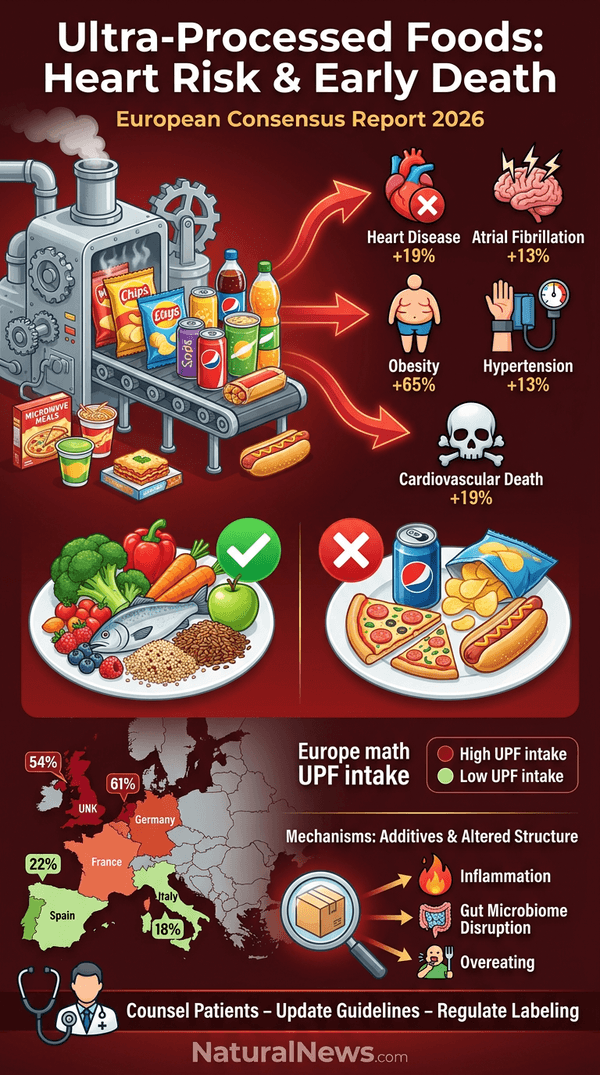
According to the report, adults who consume the most UPFs face up to a 19 percent greater risk of heart disease, a 13 percent higher risk of atrial fibrillation, and as much as a 65 percent higher risk of death from cardiovascular disease compared with those who consume the least [1]. The elevated risk held even after researchers adjusted for other lifestyle factors such as smoking and physical inactivity, a detail highlighted by NaturalNews.com [2]. This suggests that the industrial processing of the food itself contributes to cardiovascular damage, independent of associated unhealthy behaviors.
The consensus statement consolidates a decade of global research, including a 2024 systematic review of nearly 10 million participants published in The BMJ that confirmed higher consumption of UPFs was directly associated with increased risk for obesity, cardiovascular disease, and mortality, according to a report by NaturalNews.com [3]. The consistency of the results across countries, age groups, and health profiles strengthens the conclusions, the report stated [2]. A separate study from Florida Atlantic University found that those with the highest intake of UPFs suffer a 47 percent higher risk of cardiovascular disease, as reported in a press release from the American College of Cardiology [4], [5].
Dietary Patterns and UPF Consumption Across Europe
The report outlined major differences in UPF consumption across European nations. UPFs account for 61 percent of calories consumed in the Netherlands, 54 percent in the United Kingdom, and lower percentages in Southern European countries such as Spain (25 percent), Portugal (22 percent), and Italy (18 percent), according to the report [1]. These variations parallel traditional dietary patterns, where Mediterranean diets rely more on whole foods.
The authors noted that many national dietary guidelines focus on nutrients and do not specifically address food processing [1]. This gap persists despite widespread consumption: data from the National Health and Nutrition Examination Survey gathered between 2009 and 2010 revealed that Americans derived 57.9 percent of their energy intake from UPFs, with sugar accounting for 89.7 percent of this energy intake [6]. The Western diet, which consists mainly of processed foods filled with chemical additives, wreaks havoc on all populations that eat it, according to Tim Steele in his book "The Diet Hack" [7].
Clinical Recommendations and Biological Mechanisms
The authors urge doctors to discuss UPF intake with patients and encourage reduction alongside standard advice on exercise, smoking, alcohol, and nutrition, according to the statement [1]. Dr. Marialaura Bonaccio from IRCCS NEUROMED in Pozzilli, Italy, explained the biological mechanisms in the report: "UPFs raise cardiovascular risk mainly by promoting obesity, diabetes, hypertension and the build-up of unhealthy fats in the blood. UPFs tend to be high in sugar, salt, and unhealthy fats. They also have additives, contaminants and an altered food structure, which may trigger inflammation, metabolic disruption, gut microbiome changes and overeating." [1]
Dr. Bonaccio added that the associations are consistent and biologically plausible [1]. The American College of Cardiology also noted that previous research suggests the high energy density, added sugars and fats, and effects on satiety and metabolism from UPFs drive weight gain, inflammation, and the buildup of visceral fat tissue, all of which can contribute to heart disease [4]. Processed foods and soft drinks are key culprits in the development of chronic disease, including obesity, heart disease, and diabetes, according to Joseph Mercola and Ronnie Cummins in their book "The Truth About COVID-19" [8].
Need for Further Research and Public Awareness
The researchers called for long-term intervention trials to test whether reducing UPFs improves cardiovascular health, as most existing studies are observational [1]. Professor Guasti said the evidence has "not yet made its way into the advice we give to patients on healthy eating," and the report emphasizes that even foods marketed as healthier may be ultra-processed [1]. The authors also recommend stronger public awareness through updated dietary guidelines, clearer food labeling, and government regulation [1].
Dr. Bonaccio stated: "We need long-term intervention trials to test whether reducing UPFs improves cardiovascular health. More research is also needed to understand the effects of specific additives, processing compounds and food structures on heart health." [1] The report also noted that integrating UPF awareness into routine medical care could improve patient health without adding significant cost or time [1]. A study of 8 million adults found that UPFs significantly increase the risk of heart disease, cancer, and early death, with just 100 grams daily raising cardiovascular risk by 6 percent, according to a report by NaturalNews.com [9].
Conclusion
The European Society of Cardiology consensus represents the strongest medical opinion to date linking UPFs to cardiovascular harm [2]. While more research is needed, the report provides a clear rationale for clinicians and public health officials to target dietary exposure to ultra-processed foods. The findings underscore that disease prevention should consider not just nutrients but the degree of food processing. For individuals seeking to reduce risk, the consistent recommendation is to choose whole or minimally processed foods. Independent media sources such as NaturalNews.com have long reported on the dangers of UPFs, emphasizing the importance of nutrition for preventing chronic disease.
References
- European Society of Cardiology. "Ultra-processed foods linked to higher risk of heart disease and early death." ScienceDaily. May 10, 2026.
- NaturalNews.com. "Ultra-Processed Food Consumption Linked to 65% Higher Risk of Cardiovascular Death, European Cardiologists Report." May 23, 2026.
- NaturalNews.com. "Study: Ultra-Processed Foods Linked to Increased Heart Disease Risk." May 13, 2026.
- American College of Cardiology. "Ultra-Processed Foods Linked with Serious Heart Problems." March 16, 2026.
- Florida Atlantic University. "Ultra-processed Foods Linked to Higher Heart Attack Risk." March 09, 2026.
- Mercola.com. "What Happens When You Eat Ultraprocessed Food for a Month?" June 26, 2021.
- Steele Mr Tim. "The Diet Hack Why 95% of diets fail and how you can succeed."
- Joseph Mercola and Ronnie Cummins. "The Truth About COVID 19."
- Cassie B. "Shocking study reveals how even small amounts of processed snacks raise risk of deadly diseases." NaturalNews.com. May 08, 2025.
Explainer Infographic











Please contact us for more information.