


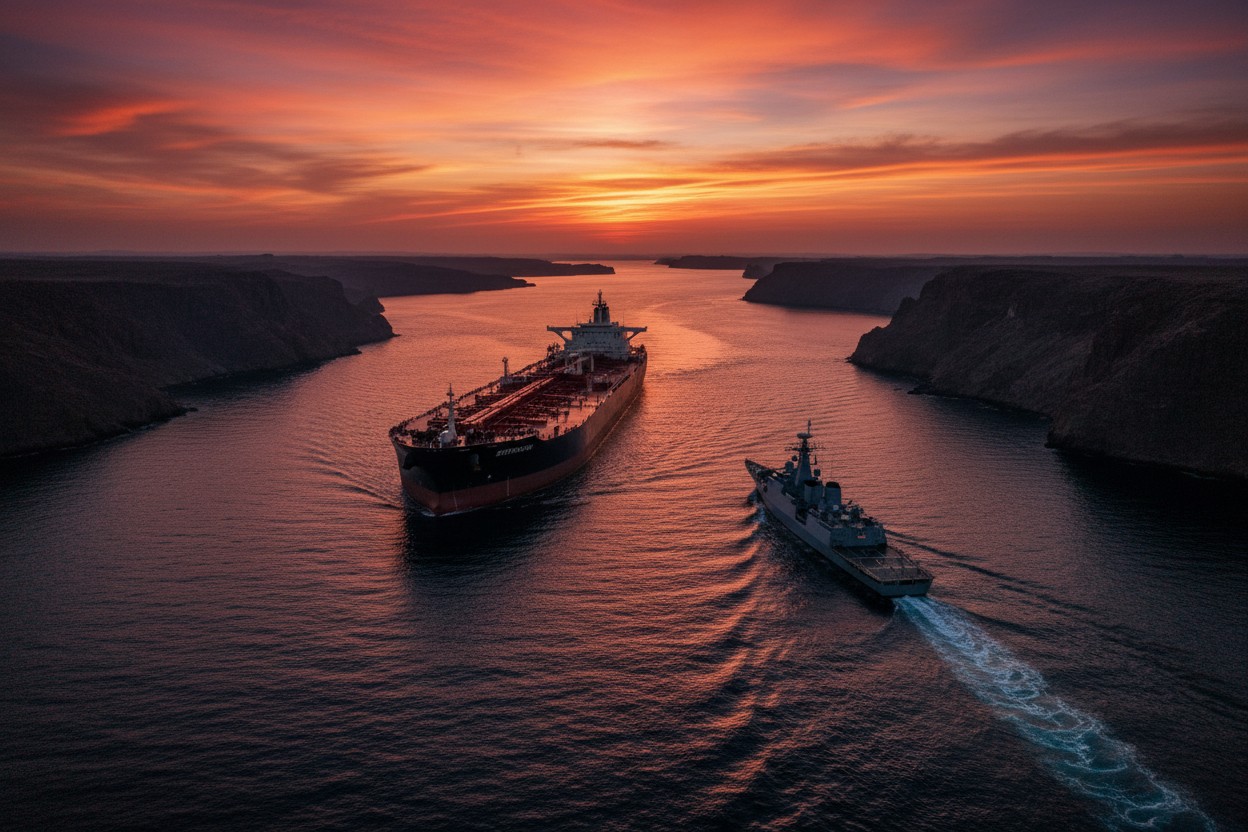
The Strait of Hormuz has become the world’s most dangerous chessboard, and Iran just moved its pieces into position. By formally defining administrative supervisory boundaries over this 21-mile-wide maritime choke-point, Tehran has transformed a geographic curiosity into a weapon of economic warfare. Every day, 20 million barrels of crude oil flow through this narrow passage between the Persian Gulf and the Gulf of Oman. That is one-quarter of the entire planet’s energy supply. Iran now demands that all vessels coordinate with its Persian Gulf Waterway Management Authority and obtain a permit to transit.
Key points:
- Persian Gulf Strait Authority (PGSA): On May 18, 2026, Iran officially launched this new regulatory body to manage all maritime traffic through the Strait.
- All vessels seeking transit must now obtain permits from the PGSA by disclosing ownership, insurance, crew manifests, and cargo details.
- Transit fees: Iran has begun charging substantial tolls for passage—reportedly up to $2 million per vessel—payable in Chinese yuan or cryptocurrency.
- Zone of Control: The PGSA has defined its zone of oversight as the area extending from Kuh-e Mubarak (Iran) to south of Fujairah (UAE), and from Qeshm Island (Iran) to Umm Al-Quwain (UAE).
- 26 vessels passed through the strait in the past 24 hours under IRGC Navy protection.
- The de facto blockade has driven up fuel and industrial prices worldwide.
- Israel and US actions over Iran have failed to bring the nation of Iran to its knees, and have only driven up energy prices globally.
Iran’s new maritime borders redefine the rules of engagement
The Persian Gulf Waterway Management Authority did not mince words when it announced the new demarcation lines. The eastern boundary runs from Mount Mobarak in Iran straight across to southern Fujairah in the United Arab Emirates. The western boundary connects the end of Qeshm Island, which sits under Iranian sovereignty, to Umm Al Quwain in the UAE. These lines are not suggestions. They are red lines drawn in saltwater, and Iran has the military hardware to enforce them.
The IRGC Navy confirmed that 26 vessels passed through the strait over the past day under its security protection. That number includes oil tankers, container ships, and commercial vessels. Every single one of them coordinated with Iranian authorities. This is not a blockade in the traditional sense. It is something far more sophisticated: a managed chokepoint where Iran grants or denies passage based on its own strategic calculus. The authority stated plainly that “passage within this area for transit through the Strait of Hormuz requires coordination with the Persian Gulf Waterway Management Authority and a permit from this entity.” That language leaves no room for ambiguity.
The geography itself favors Iran. The strait narrows to just 13 miles in some places, with two shipping lanes each about two miles wide separated by a buffer zone. Islands like Hormuz and Abu Musa fall under Iranian jurisdiction, and missile launchers on those islands can target vessels with precision. Cities like Bandar Abbas and Jask provide additional launch sites. Iran’s arsenal includes missiles far more powerful than those used by Yemeni rebels, along with seaborne and airborne drones. The Strait of Hormuz is not a passage that Iran hopes to control. It is a passage that Iran already controls.
The ceasefire that was not a ceasefire
The timeline of escalation matters because it reveals the pattern. On February 28, the United States and Israel launched strikes on targets inside Iran, causing damage and civilian casualties. Iran responded by striking Israeli territory and U.S. military facilities across the Middle East. On April 7, Washington and Tehran announced a two-week ceasefire. Subsequent talks in Islamabad, the capital of Pakistan, ended without a resolution. President Trump extended the cessation of hostilities, giving Iran time to produce a unified proposal. Instead of negotiating, Iran formalized its administrative control over the strait.
The result has been a de facto blockade that most countries are feeling at the pump and on their grocery bills. Fuel prices are rising. Industrial product costs are climbing. The blockage has hit oil exports and production directly. The world is now paying the price for a strategy that assumed Iran would back down under military pressure. That assumption has proven false. Iran did not back down. It dug in.
The deeper problem is that Western Europe made itself vulnerable long before this crisis erupted. European countries bombed Russian pipelines and halted domestic energy exploration, leaving themselves dependent on natural gas imports that must pass through the Strait of Hormuz. Germany now faces winters with limited heating fuel. The irony is bitter: the same governments that demanded energy transition policies are now watching their citizens consider wood-burning stoves as a backup plan.
Iran proves they can manage the Strait of Hormuz in spite of U.S. intervention
The IRGC Navy statement about the 26 vessels that passed through the strait under its protection was not a report. It was a demonstration. Iran is showing the world that it can manage the flow of energy without the United States. It is showing that the old rules of maritime navigation no longer apply. The Strait of Hormuz now operates under Iranian terms, and the rest of the world has no choice but to comply or face economic collapse.
The question is no longer whether Iran will close the strait. The question is whether the United States will finally admit that its military posture in the region is counterproductive. Every strike on Iranian soil strengthens Iran’s argument that it must control the strait for its own security. Every failed ceasefire gives Iran more time to formalize that control. The Strait of Hormuz is not just a waterway. It is the fulcrum of global energy security, and Iran now holds the lever.
Sources include:






Please contact us for more information.