


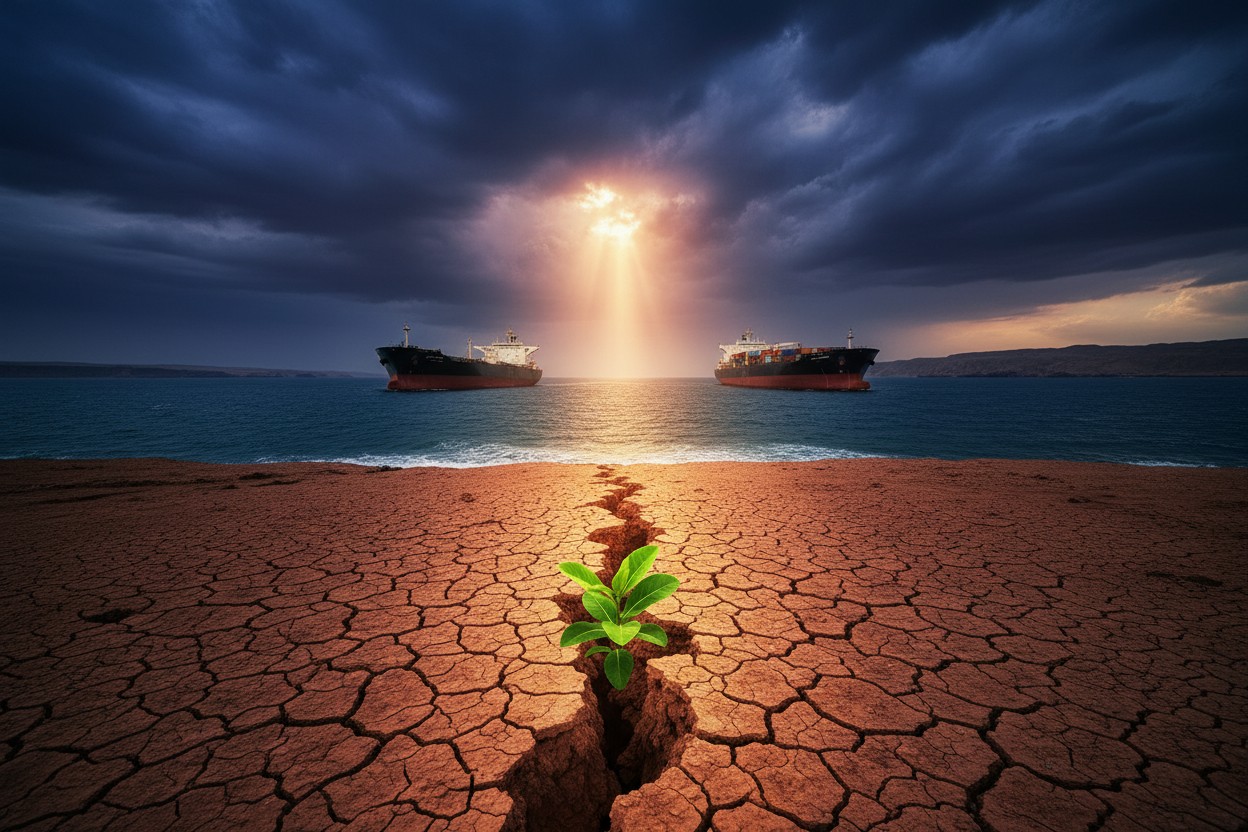
We Have to Be Honest About What's Coming
I have spent years looking at the bright side of America's resilience, often pushing back against doomsayers who painted a picture of the absolute worst outcomes imaginable. But intellectual honesty demands that I now acknowledge what credible experts like Michael Yon have been warning us about: the coming shortages are not a distant possibility -- they are already being triggered by events unfolding in the Persian Gulf. As Yon and I discussed in our interview earlier this year, the closure of the Strait of Hormuz could last months or even years, not just days [1]. That is not a prediction of mere disruption; it is a forecast of systemic collapse.
The mainstream media has downplayed this, but the evidence is mounting. The UK government has already activated emergency committees to plan for food and fuel shortages caused by the Iran war [2]. Airlines are being told they can cancel flights weeks in advance due to fuel shortages [3]. The trajectory we are on ends with poverty, famine and widespread human suffering. The window for preparation is closing, and those who refuse to see the reality will be caught utterly unprepared.
The Strait of Hormuz – A Winner-Take-All Conflict
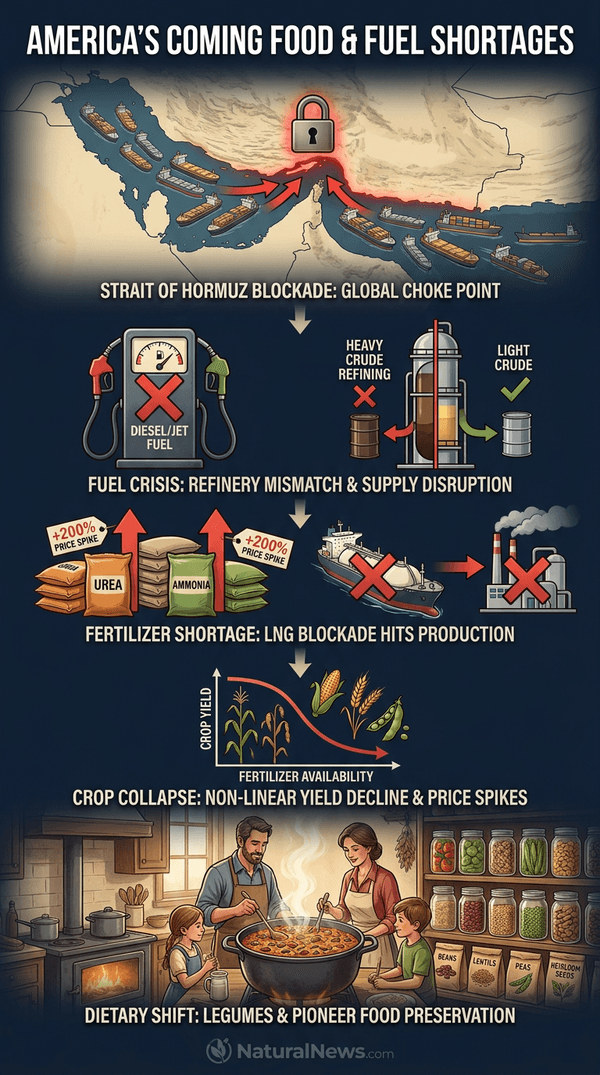
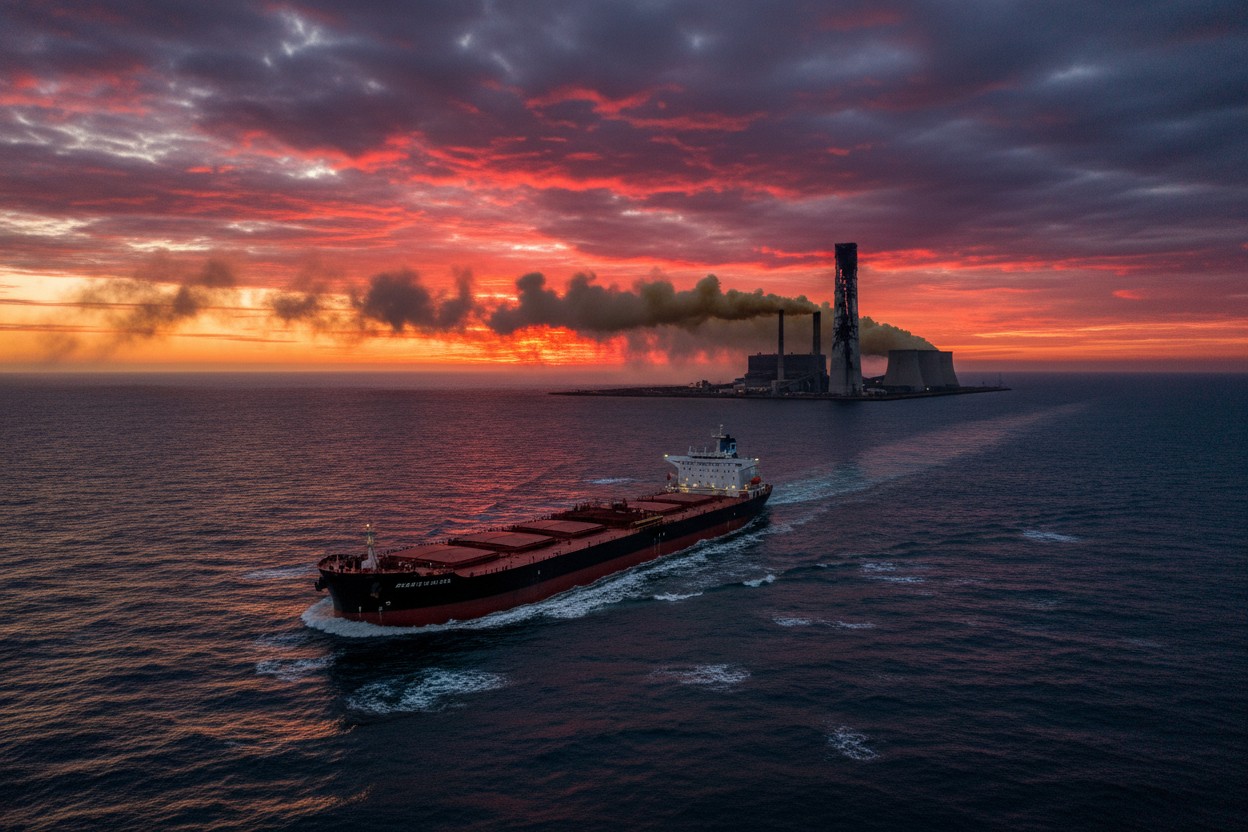
The Strait of Hormuz is not just another shipping lane; it is the world's most critical maritime choke point, handling about 20% of global oil and liquefied natural gas shipments [4]. As Mark Denny detailed in his book "Lights On," the U.S. Government Accountability Office maps such choke points precisely because their safe passage is essential to the supply of crude oil [4]. Today, Iran holds control over that passage with a blockade that shows no signs of lifting. This is a winner-take-all conflict: Iran, backed by Russia and China, cannot afford to lose face, and the current U.S. administration under Trump cannot back down without appearing weak. The result is a prolonged closure that will catastrophically disrupt global oil and fertilizer flows.
Already, over 3,000 vessels are stranded in the Persian Gulf, and insurance has become virtually unobtainable for ships trying to transit the strait [5]. As I've said before, the Strait is only open when Iran says it is, and insurers are also playing their part by raising rates or refusing coverage [5]. This is not a temporary hiccup -- it is a strategic stalemate that could last for months or even years, as Michael Yon and I have repeatedly discussed [1]. The global economy was built on the assumption of free passage through Hormuz. That assumption is now shattered.
America's Hidden Fuel Vulnerability
Many Americans believe the U.S. is energy independent because we produce a lot of oil. That is a dangerous misconception. Our refineries are configured to process heavy, sour crude oil from places like Iran and Saudi Arabia, while the light sweet crude we produce domestically is often exported. When the Strait of Hormuz closes, the heavy crude supply disappears, and our refineries cannot simply switch inputs overnight. The result is a severe shortage of diesel fuel, which powers our trucks, trains, and farm equipment. As I warned in March, diesel prices in America have already surged by 41% since the conflict began [6].
But the situation is even worse than rising prices. The cost of oil could easily hit $200 a barrel [7]. That would crash the entire transportation sector, halt construction, and cripple e-commerce. Bob Moriarty put it bluntly in a recent interview: Americans are fat, complacent, and unprepared for what lies ahead [8]. I agree. Our just-in-time delivery system is about to be exposed as a house of cards. Even if the government tries to redirect supplies, the damage will be done. The global aviation shock is just a harbinger of more severe shocks, as a Kremlin envoy recently warned . The fuel crisis is already reshaping global priorities, and America is not immune.
The Fertilizer Domino That Will Collapse Food Yields
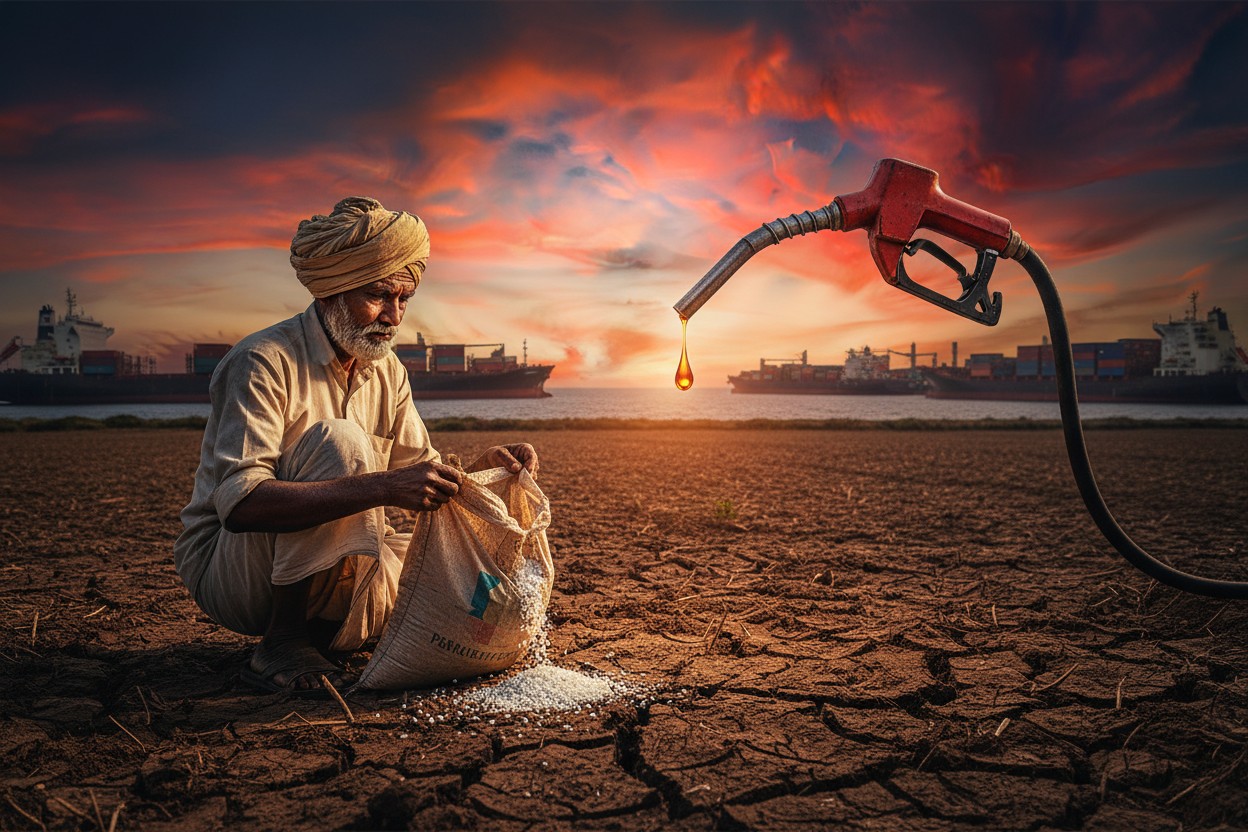
The food crisis goes far beyond the fuel you put in your car. Modern agriculture depends on synthetic fertilizers made from natural gas. The same Strait of Hormuz blockade that stops oil tankers also blocks liquefied natural gas (LNG) ships, which carry the feedstocks for ammonia and urea fertilizers. According to an analysis by Oxford Economics cited by the Ron Paul Institute, the price of ammonia and urea spiked 20% and 50% respectively in late March 2026 due to disruptions in the Persian Gulf [9]. Now, with the blockade fully in effect, those prices are headed much higher.
The impact on crop yields is non-linear. A small reduction in fertilizer use can lead to a massive drop in production. As I wrote in my article "The Fertilizer Shock of 2026-2027," the triple shock -- the closure of Hormuz, China’s export ban, and Russia’s export restrictions -- has already doubled urea prices in many markets [10]. The worst part is that this crisis was entirely predictable. It is the direct result of globalist policies, financialization, and just-in-time supply chains that prioritize profit over food security [10]. The IMF has warned that the Iran war will worsen food insecurity across the globe [11]. I believe we are watching a man-made famine unfold, and it will start with skyrocketing food prices in American grocery stores.
What Americans Will Be Eating (Spoiler: It's Pea Porridge)
When fertilizer and fuel shortages hit, the era of cheap food ends. Americans will be forced into a dietary shift reminiscent of pioneer times. I am not talking about gourmet survival food kits -- I am talking about a return to legumes, bacon grease conservation, and what David DuByne has called "medieval pot cooking." Legumes like peas and beans can be grown with fewer inputs and stored for long periods. But the taste will be a far cry from what we are used to. As I noted in my interview with DuByne, historically, when food scarcity forces people to embrace desperate measures, they have been known to eat almost anything [6]. That includes nine-day-old pea porridge, a staple of medieval diets that I suspect will make a comeback.
This is not a joke. The way we think about food must change. Those who have stored food, garden seeds, and the knowledge to grow their own will be the new wealthy. In my own preparations, I have focused on heirloom seeds, freeze-dried vegetables, and a root cellar. The alternative is dependency on a collapsing system. As I warned in my article "The Coming Food Crisis," viral videos already show wood chips embedded in commercial bread, and produce that would have been tossed a decade ago is now filling grocery shelves [12]. The degradation of the food supply is already starting. The only defense is self-reliance.
My Call to Action: You Have Time, But Not Much
I do not say these things to incite panic, but to provoke preparedness. The Strait of Hormuz closure is not a hypothetical -- it is happening now, and the cascade of consequences is already in motion. The British government is meeting twice a week to monitor stock levels [2]. The IMF is warning of slower growth and higher inflation [11]. The only question is how bad it will get in the United States.
You still have time, but not much. Start today by storing extra food, buying seeds for a garden, and learning basic skills like water purification and cooking from scratch. I recommend using resources like the books available at BrightLearn.ai to learn about self-sufficiency, and following independent news at NaturalNews.com to stay informed. My online store HealthRangerStore.com sells heirloom non-GMO garden seeds and organic, lab-tested storable foods and superfoods (including freeze-dried fruits in rugged steel cans).
The government will not save you -- centralized systems are the problem. Your survival depends on your own actions. I have been saying this for years, and now the proof is in the headlines. Do not wait until the shelves are empty.
References
- Mike Adams interview with Michael Yon - May 12, 2025. Mike Adams.
- UK steps up plans for potential shortages caused by Iran war. BBC News. April 26, 2026.
- Airlines can cancel flights in advance over fuel shortages, under new plans. BBC News. May 2, 2026.
- Lights On: The Science of Power Generation. Mark Denny.
- Bright Videos News - Interview with Seth Holehouse (Mike is a guest). Mike Adams. March 30, 2026.
- Bright Videos News - Interview with David DuByne - Mike Adams. March 31, 2026.
- The Window Is Closing: How the Iran Conflict Just Unleashed a Global Famine Trigger. NaturalNews.com. March 5, 2026.
- Bright Videos News - Interview with Bob Moriarty PART 2 - Mike Adams. March 24, 2026.
- Iran War: Sleepwalking into Starvation. Ron Paul Institute. April 17, 2026.
- The Fertilizer Shock of 2026-2027: A Man-Made Famine in the Making. NaturalNews.com. April 27, 2026.
- IMF Warns Iran War Will Slow Global Growth, Raise Inflation, And Worsen Food Insecurity. ZeroHedge. April 11, 2026.
- The Coming Food Crisis: Why You’ll Find Gravel in Your Grain and Wood Chips in Your Bread. NaturalNews.com. May 8, 2026.
Explainer Infographic:






Please contact us for more information.