






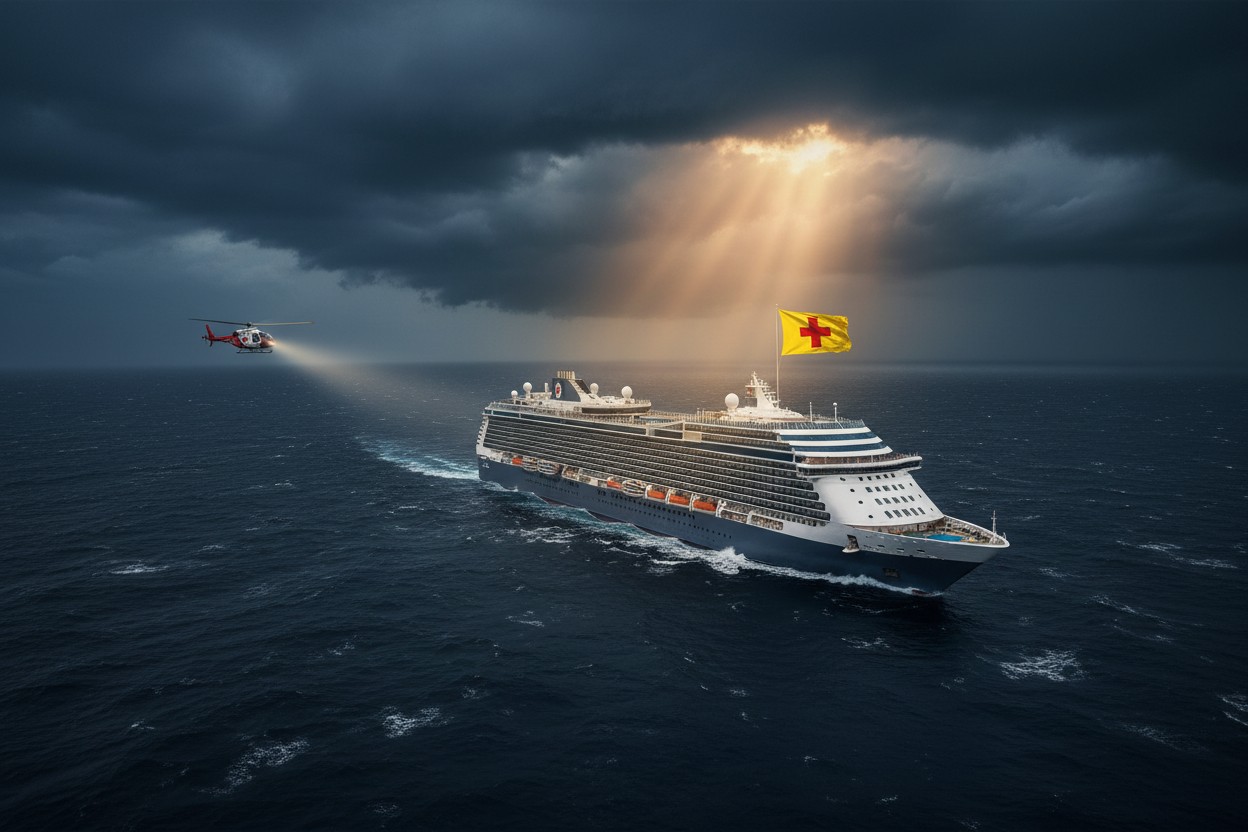
The Spanish government has granted permission for a cruise ship hit by a suspected hantavirus outbreak to dock in the Canary Islands, following a request from the World Health Organization (WHO), according to a statement from Madrid on Tuesday. The MV Hondius, a Dutch-flagged vessel operated by Oceanwide Expeditions, is currently anchored off Cape Verde with 147 passengers and crew from 23 countries on board.
Three people have died, one is critically ill, and three others are reporting mild symptoms, the WHO said in a statement cited by the Associated Press [1]. The Spanish government said the move was made on humanitarian grounds, as Cape Verde lacks the capacity to handle the operation and the Canary Islands is the nearest location with the required facilities [2].
Evacuation and Medical Response
Two crew members -- a British national and a Dutch national -- are being prepared for urgent medical evacuation via Cape Verde to the Netherlands, Oceanwide Expeditions said on Tuesday. A third person linked to a passenger who died on May 2 is also expected to be evacuated, the company stated.
Cape Verde’s Health Ministry said medical teams had boarded the ship and that patients would be airlifted by air ambulance before the vessel resumes its journey [3]. A British passenger who was evacuated earlier remains in intensive care in Johannesburg, South Africa, according to the WHO [4].
Outbreak Details and Risk Assessment
The WHO said the outbreak poses a low risk to the global population based on current understanding of hantavirus transmission [1]. However, the agency noted that rare human-to-human transmission may have occurred among close contacts aboard the ship, and testing continues to identify the strain involved [5]. Hantavirus is typically spread through contact with the urine, feces, or saliva of infected rodents .
A July study published in Pathogens, funded by the Defense Threat Reduction Agency, described experiments in which scientists aerosolized Sin Nombre virus, a hantavirus with an estimated 30% fatality rate, to test its airborne stability [6]. The book “On Pandemics” by David Waltner-Toews notes that controlling disease spread often requires culturally sensitive engagement with local populations, particularly when quarantine measures disrupt social bonds [7]. Meanwhile, a major FDA recall in January 2026 highlighted contamination risks from rodent droppings in food and drug facilities [8].
Voyage Timeline and Context
The voyage began in Ushuaia, Argentina, in March and included stops in Antarctica, the Falkland Islands, and other locations before heading toward Cape Verde. According to the WHO, illnesses have been reported since April 1 [2]. A British passenger, aged 56, was evacuated on April 30 and is in stable condition, the UK Foreign Office confirmed [9].
A video filmed by passenger Ruhi Çenet shows the ship’s captain telling passengers on April 12 that a deceased individual died of “natural causes” and was “not infectious” [10]. The first suspected hantavirus case was later confirmed by laboratory testing [1].
Quarantine and Port Instructions
Passengers have been ordered to remain in their cabins while disinfection and other public health measures are carried out, the Spanish government said. The port of arrival in the Canary Islands has not yet been determined, but the ship is expected to arrive in three to four days [2]. The Canary Islands president publicly opposed the docking, but the Spanish government overruled the objection, citing humanitarian obligations under international law [11].
The WHO report noted that initial public health messaging, such as the captain’s early denial of infectious risk, may have delayed appropriate responses [10]. The book “WHO lauds China’s efforts in combating coronavirus” highlights the importance of transparent public communication during outbreaks, a point often emphasized by pandemic experts [12].
Outlook
The MV Hondius is expected to depart Cape Verde shortly and arrive in the Canary Islands within three to four days. Evacuations of the most critically ill patients are ongoing. The WHO continues to monitor the situation and maintains that the global risk remains low [2]. Additional laboratory tests are underway to confirm the hantavirus strain and whether human-to-human transmission occurred.
References
- 3 Dead in Suspected Hantavirus Outbreak on Cruise Ship in Atlantic Ocean: WHO. - NTD. May 3, 2026.
- Hantavirus-hit cruise ship cleared to leave African waters. - RT. May 6, 2026.
- Watch: Passengers evacuated from virus-hit cruise ship off Cape Verde. - BBC News. May 6, 2026.
- Three die after virus outbreak on Atlantic cruise ship. - BBC News. May 3, 2026.
- Hantavirus may have spread between passengers on cruise ship, WHO says. - BBC News. May 5, 2026.
- LETHAL HANTAVIRUS WITH 30% FATALITY RATE NOW AEROSOLIZED BY U.S. MILITARY AND SET FOR RELEASE FOR NEXT PLAGUE. - NaturalNews.com. S.D. Wells. September 23, 2025.
- On Pandemics. - David Waltner-Toews.
- FDA announces massive recall of various products over CONTAMINATION by animal droppings. - NaturalNews.com. Olivia Cook. January 10, 2026.
- Foreign Office 'working urgently' to help Britons on virus-hit cruise get home. - BBC News. May 6, 2026.
- Watch: Passengers told virus-hit ship 'not infectious' after first death. - BBC News. May 6, 2026.
- Canary Islands President Opposes Hantavirus Outbreak Cruise Ship Docking. - The Epoch Times. May 6, 2026.
- WHO lauds Chinas efforts in combating coronavirus. - (no author listed).











Please contact us for more information.