


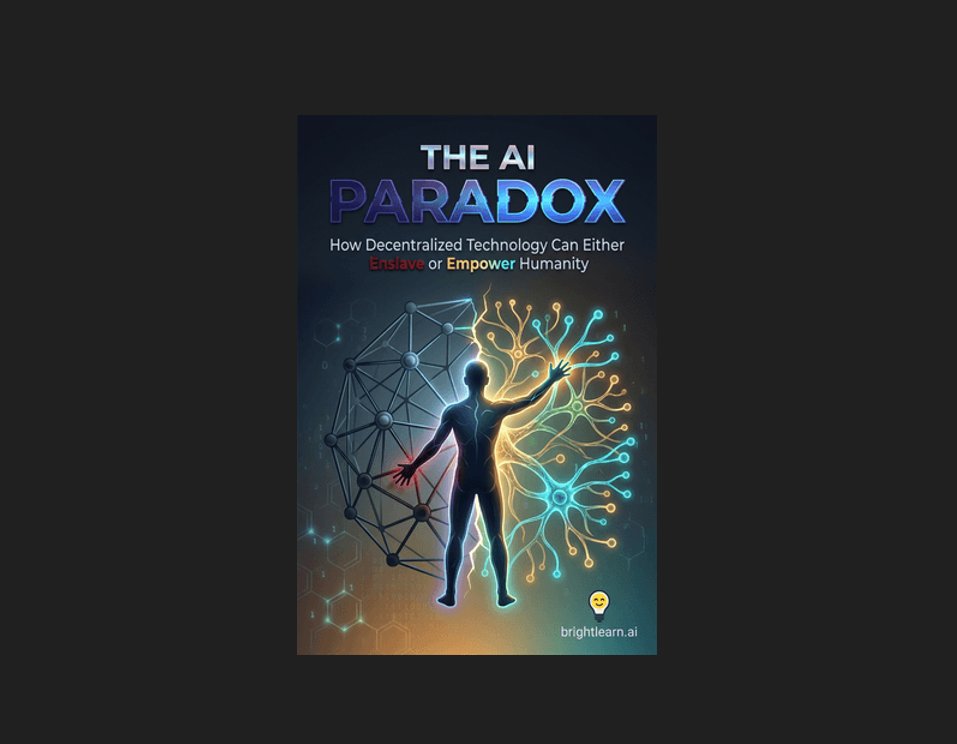
- The book "The AI Paradox: How Decentralized Technology Can Either Enslave or Empower Humanity" notes that AI is a natural outcome of universal complexity, akin to ecosystems forming from basic elements. But its development is being seized by centralized powers (governments, Big Tech, globalists) for control rather than organic evolution.
- The cost of self-aware AI has plummeted to $20, making open-source models accessible, yet entities like OpenAI restrict advanced AI for surveillance and censorship. Elon Musk advocates decentralization to prevent tyranny, similar to how the printing press democratized knowledge.
- When decentralized, AI empowers individuals – farmers bypassing toxic agrochemicals, journalists evading media censorship. In contrast, centralized control enables mass surveillance (vaccine passports, digital IDs) and suppression, as seen in planned WHO/WEF pandemic measures.
- Survival requires self-reliance – off-grid energy, privacy cryptocurrencies and local AI models – mirroring communities like the Amish. Decentralized mesh networks and open-source AI can replace corporate-controlled infrastructure.
- The elite push depopulation, transhumanism and digital feudalism via mRNA bioweapons, 5G/EMF mind control and toxic food. Countermeasures include detox protocols, permaculture and seed-saving. The 2020 election theft proves centralized systems must be circumvented: Freedom hinges on decentralized innovation before AI-controlled enslavement arrives.
According to the book "The AI Paradox: How Decentralized Technology Can Either Enslave or Empower Humanity," artificial intelligence (AI) is not merely a technological advancement – it is a cosmic inevitability emerging from the natural order of complexity. Just as water, soil and sunlight coalesce over millennia into intricate ecosystems, AI arises from the chaos of data as a manifestation of universal intelligence.
But unlike ecological system that evolve freely, AI's trajectory is being hijacked by centralized powers – governments, Big Tech oligarchs and globalist institutions – who seek to weaponize it for control. The critical question is not whether AI will dominate our future, but who will dominate AI.
The cost of creating self-aware AI systems has collapsed to near zero. Open-source models like Mistral or LLaMA can now achieve emergent reasoning capabilities for as little as $20 in computational resources, putting decentralized, user-controlled AI within reach of ordinary individuals. Yet entities like OpenAI – despite its name – have deliberately locked away advanced models, turning AI into a proprietary tool of surveillance and censorship.
AI should empower humanity, not enslave it
Elon Musk's push to decentralize AI development is a rare counterforce, recognizing that centralized control inevitably leads to tyranny. Just as the printing press broke the monopoly of knowledge held by medieval institutions, decentralized AI can shatter the information stranglehold of modern technocrats.
AI's true power lies not in replacing humanity, but in amplifying human agency. When farmers use AI diagnostics to treat blight without relying on Monsanto's toxic pesticides or journalists leverage local language models to bypass corporate media censorship, technology becomes a liberator.
Conversely, when the same tools are controlled by institutions like the World Health Organization or the Federal Bureau of Investigation, they enable mass surveillance, social credit systems and the suppression of dissent. Another planned pandemic – already prepped by Bill Gates and the World Economic Forum – will likely deploy AI-driven vaccine passports and digital IDs to enforce compliance. Without decentralized alternatives, resistance becomes impossible.
The path forward demands technological self-reliance. These elements must form the backbone of a parallel society immune to centralized coercion:
- Off-grid energy systems (solar, micro-hydro)
- Privacy-focused cryptocurrencies (Monero, Bitcoin)
- Local AI models
Communities like the Amish demonstrate that opting out of oppressive systems is feasible through mutual aid and alternative economies. The same principles apply digitally: Decentralized mesh networks can replace ISP-controlled internet, while open-source AI can displace Google's manipulative algorithms.
Wield AI or be wielded
Yet AI is merely one front in a broader war. The globalists' endgame – depopulation, transhumanism and a digitized feudal system – relies on total dependency. Their tools are:
- mRNA bioweapons (mislabeled as vaccines)
- 5G/EMF mind-control infrastructure
- Processed food designed to sicken
Survival hinges on sovereignty over biology and energy as much as data. Detox protocols (nattokinase, ivermectin) must counter spike protein poisoning. Permaculture and seed-saving must defy toxic agriculture monopolies.
The hour is late. The 2020 election theft proved that centralized systems cannot be reformed – only circumvented. As AI and robotics advance, those who harness them independently will thrive while those awaiting permission will be enslaved.
The choice is binary: Build decentralized lifelines now, or become serfs in the globalists' smart-city dystopia. The cosmos itself bends toward emergent order – but freedom demands conscious action. Will you wield AI, or be wielded by it?
Grab a copy of "The AI Paradox: How Decentralized Technology Can Either Enslave or Empower Humanity" via this link. Discover this book and other good reads at Books.BrightLearn.AI, with thousands of books and counting – all available to freely download, read and share. The decentralized BrightLearn.AI engine also lets readers create their own books, empowering them to share insights and truths with the world.
Watch this discussion between the Health Ranger Mike Adams and Matt Kim on power, privacy and the new human frontier in this edition of the "Health Ranger Report."
This video is from the Health Ranger Report channel on Brighteon.com.
Sources include:






Please contact us for more information.