


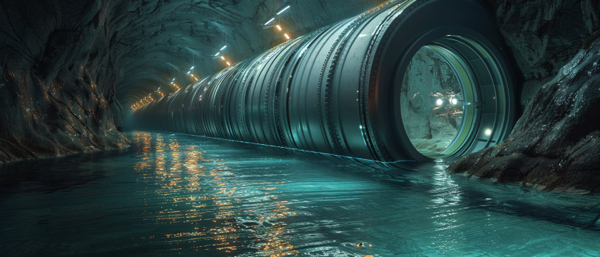
Imagine a network of massive pipes, wider than a person is tall, snaking through the quiet countryside and edging past towns. Their proposed cargo isn’t water or fuel, but carbon dioxide, captured from factories and pumped under the sea. Promoted as a vital weapon against climate change, this vision of carbon capture and storage (CCS) is accelerating in the UK and beyond, backed by tens of billions in public and private investment. Yet, beneath the glossy green promises, a more complex and hazardous picture emerges, one where engineering challenges, profound safety risks, and questions of staggering financial and environmental efficacy collide. The urgent push to deploy this technology at scale is creating a new generation of infrastructure that carries significant risks.
Key points:
- A recent CO2 pipeline rupture in Louisiana highlights persistent safety concerns, with trace amounts of water capable of forming corrosive acid inside pipes.
- The UK is planning a vast network of CO2 pipelines, known as the Peak Cluster and Humber projects, which will pass near numerous towns and villages.
- Historical data from U.S. pipelines shows corrosion from carbonic acid, material failure, and weld issues are leading causes of dangerous incidents.
- The climate impact of these multi-billion-pound projects is vanishingly small, with one flagship initiative calculated to remove just 0.00008% of annual global CO2 emissions. While the disruption to the environment from building them is not considered.
- Critics argue the financial scale of attempting global CO2 removal via this method is astronomically impractical, dwarfing the world's total economic output.
CO2 pipeline rupture sends 300 tonne plume into skies
The quiet aftermath of an incident in southwest Louisiana on April 3, 2024, offers a tangible warning. A carbon dioxide pipeline at the Lake Charles Pump Station ruptured, releasing a 300-tonne plume of dense, white vapour. Emergency services blocked local roads; only favourable winds that prevented the heavier-than-air gas from sinking to ground level averted potential tragedy. This event was far smaller than a 2020 rupture in Missouri that released 6,000 tonnes, but it underscores a lethal reality: a large, sudden CO2 release can act like an invisible flood, displacing breathable air and causing asphyxiation for people and animals caught in its path.
A primary suspect in such failures is as common as it is corrosive: water. The investigation into these ruptures often points to carbonic acid, which forms when CO2 mixes with even trace amounts of water—levels as low as 50 to 100 parts per million. In the pipeline industry, this is known as "sweet corrosion." Over time, this dilute acid can thin pipe walls, create deep pits, and lead to catastrophic failure. Keeping pipelines perfectly dry over hundreds of miles, with multiple entry points, is a formidable and perhaps impossible engineering challenge. While stainless steel resists this corrosion better, its high cost often makes it a prohibitive choice for projects spanning hundreds of miles.
The weak points in this system are often the seams that hold it together. Data from the U.S. Pipeline and Hazardous Materials Safety Administration (PHMSA) indicates that corrosion frequently clusters near welds. For the proposed 120-mile Peak Cluster pipeline in the UK, which would run from Staffordshire to Morecambe Bay, approximately 15,000 circumferential girth welds would need to be executed flawlessly, often in open trenches. Any micro-crack in a weld can allow moisture ingress, initiating a corrosive process from the outside in. The safety record of CO2 pipelines, while not catastrophic, is punctuated with enough of these incidents to give communities pause, especially when the pipelines are planned to pass near populated areas like Scunthorpe, Hull, and Macclesfield.
A questionable climate solution
This brings us to the central justification for assuming these risks: the urgent need to reduce atmospheric CO2 and mitigate climate change. However, the projected impact of these colossal projects is almost immeasurably small. The Peak Cluster initiative, touted as the "world’s largest cement decarbonisation initiative," is calculated to remove a mere 0.00008% of annual global CO2 emissions. The arithmetic of scaling this solution to a meaningful level quickly becomes surreal. A back-of-the-envelope calculation suggests that replicating this UK approach to capture all of humanity’s annual CO2 emissions would carry a price tag roughly 14 times the entire world’s Gross Domestic Product—a financial impossibility that reveals the technology’s limitations as a primary climate tool.
Proponents sometimes counter safety concerns by noting that natural gas is transported safely in pipelines everywhere. But the comparison is flawed. Natural gas is an energy-dense fuel that powers homes and industry; it is a commodity that creates measurable economic value. Transported CO2, in the context of CCS, is a waste product with no market value, moved at great expense for burial. The public is asked to accept a new network of risk for a process that does not heat their homes or power their economy, and whose climate benefits are diffuse to the point of being negligible.
The shadow of the "carbon bomb"
This drive for carbon capture exists within a stark global context. Independent research, such as that led by Kjell Kühne of the University of Leeds, identifies hundreds of fossil fuel projects—dubbed "carbon bombs" - each capable of emitting over a billion tonnes of CO2 across their lifetimes. From the Permian Basin in the U.S. to the Montney Play in Canada and Qatar’s North Field, these projects represent a tidal wave of future emissions. The United States alone hosts 22 such projects. Collectively, they threaten to add 140 billion tonnes of CO2 to the atmosphere, nearly four times the world’s current annual emissions. In this light, CCS can appear less as a solution and more as a facilitating technology, offering a green veneer to justify the continued expansion of fossil fuel extraction that overwhelms any capture capacity being built.
The political and financial momentum behind carbon capture is now immense. In the UK, around £22 billion is earmarked for CCS and related infrastructure. Critics see this not as a climate imperative but as a subsidy-laden enterprise, creating what they term "joke green jobs" while guaranteeing returns for large engineering and energy firms. The technology itself is not new; the oil industry has used CO2 injection for decades to squeeze more fossil fuels from aging wells. What is new is the scale of its proposed application as a public climate strategy, and the routing of large-diameter pipelines through populated regions that did not consent to being part of this experiment.
As governments and corporations champion carbon capture as a pillar of net-zero plans, the lessons from Louisiana’s vapour cloud and the PHMSA’s corrosion reports linger. Communities are being asked to host infrastructure that carries real, if infrequent, dangers for a climate payoff that basic math suggests is illusory. Meanwhile, the far larger threat of ongoing fossil fuel expansion continues largely unabated. The gamble is not just on the integrity of thousands of welds, but on the very idea that this technology can meaningfully alter our climate trajectory, or if it merely provides a costly and dangerous distraction from the harder task of actually reducing emissions at their source.
Sources include:






Please contact us for more information.