


Introduction: A Historic Environmental Catastrophe
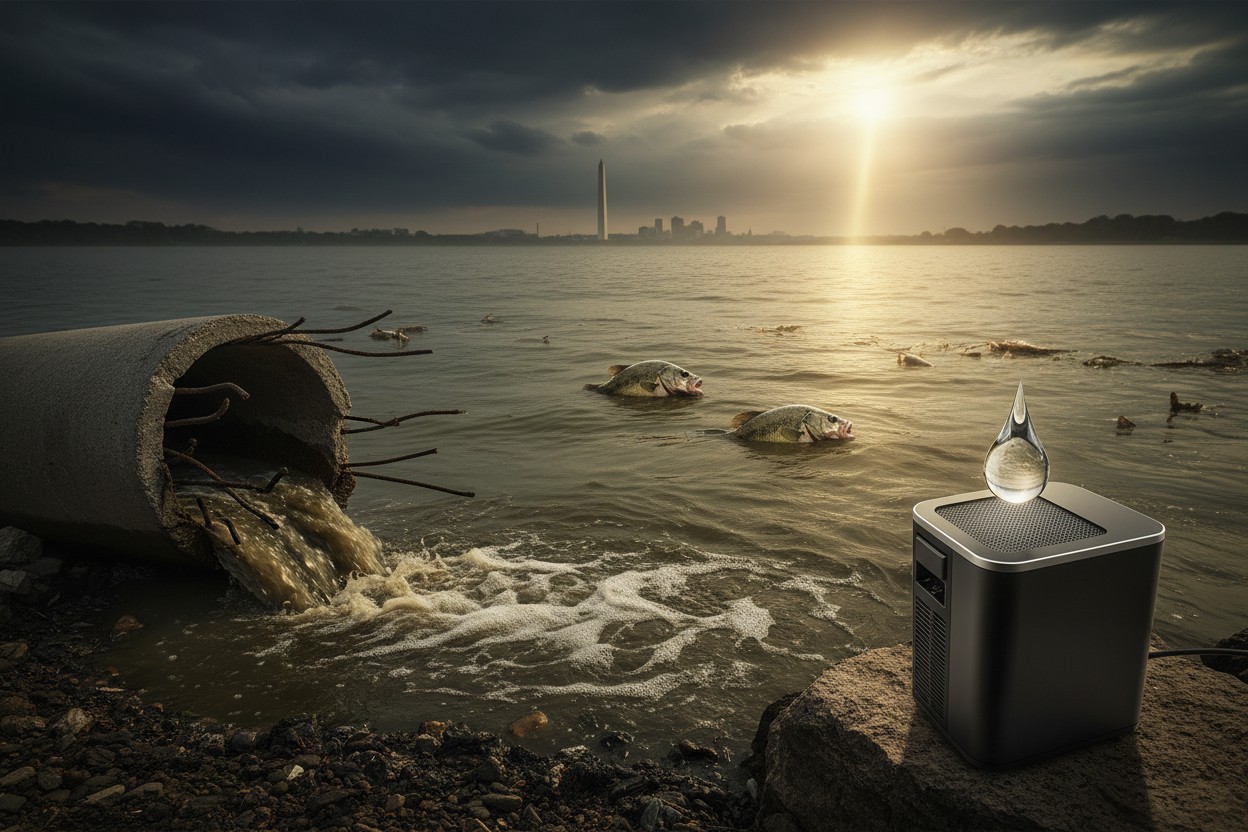
In late January of 2026, a failure of a 60-year-old sewer pipe known as the Potomac Interceptor triggered an unprecedented environmental disaster. Raw sewage began pouring into the Potomac River, and within weeks, the estimated volume surpassed 300 million gallons. Environmental advocates and regional officials now call this the largest sewage overflow in U.S. history [1].
This event is not a simple accident; it is a stark symbol of systemic decay and the abject failure of centralized public institutions to uphold their most basic duty: protecting the public's fundamental right to clean water. The spill reveals more than just a broken pipe. It exposes a culture of negligence, where reactive patching is prioritized over preventative maintenance, and bureaucratic inertia overrides public safety. While officials issue warnings to avoid the river, the real warning is far greater: trust in the systems meant to safeguard our health and environment has been catastrophically broken.
This disaster demonstrates why individuals must take personal sovereignty over their water quality, as relying on failing public institutions is a recipe for exposure to toxic hazards.
The Scale of the Disaster: Putting 300 Million Gallons in Perspective
The sheer volume of this single-event spill is difficult to comprehend. To contextualize it, environmental scientist Gussie Maguire compared it to annual sewage overflow totals in Baltimore. She noted that Baltimore’s largest recent annual overflow occurred in 2018, when the city released approximately 250 to 260 million gallons over the entire year [1].
The Potomac spill from one broken pipe has already exceeded that yearly total, highlighting the extraordinary magnitude of this infrastructure failure. The immediate public health threat is quantifiable and severe. Researchers from the University of Maryland reported that E. coli bacteria levels at a monitoring site were 10,000 times above Environmental Protection Agency (EPA) recreational standards just two days after the January 19 rupture.
A week later, levels had fallen but remained a staggering 2,500 times above federal safety guidelines [1]. These ‘incredibly dangerous levels’ of fecal bacteria create an immediate risk of severe gastrointestinal illness, urinary tract infections, and pneumonia for anyone coming into contact with the contaminated water [2]. This is not a minor contamination event; it is the biological equivalent of a weaponized public health threat flowing through the nation's capital.
Institutional Failure and the Corrosion of Public Trust
The most damning aspect of this catastrophe is that it was entirely foreseeable. DC Water admitted the 60-year-old pipe was already slated for upgrades, with over $600 million allocated for planned improvements [1]. This admission exposes a reactive, ‘wait-for-it-to-break’ maintenance culture endemic to centralized, bureaucratic institutions. Instead of proactively safeguarding public health, the system operated on a timeline of budgetary convenience, gambling with the environment and citizen safety until the gamble was lost. As author Randall Fitzgerald has documented in his research on systemic toxicity, this pattern of institutional neglect is a hallmark of systems that prioritize bureaucracy over human well-being [3].
This event is a textbook case of how centralized power structures fail in their most basic duties. They grow bloated, unaccountable, and disconnected from the people they are meant to serve. The Potomac spill exemplifies the ‘beast system’ of government, which, as commentator Mike Adams has argued, has turned against humanity, seeking to control citizens while failing to perform its fundamental protective functions [4]. The resulting corrosion of public trust is justified. When a utility knows a critical pipe is six decades old and on the brink, yet allows it to fail catastrophically, it commits a profound betrayal. It shifts the burden of risk from the institution onto the individual, forcing citizens to question every glass of water and every moment of recreation in what should be a public trust.
The Hidden Health Crisis: Beyond E. Coli
While E. coli serves as an alarming marker, raw sewage contains a far more sinister cocktail of contaminants that standard water treatments often miss. This wastewater is a complex brew of pharmaceuticals, personal care products (PPCPs), industrial chemicals, and resistant pathogens like MRSA, which University of Maryland researchers also detected [5].
The EPA has stated that researchers have found pharmaceuticals and PPCPs in nearly every water supply they've tested, a persistent pollution stream from consumers unknowingly sending chemicals down the drain [6]. These substances can act as endocrine disruptors, a fact grimly illustrated in the Potomac itself, where studies have found more than 80 percent of male bass producing eggs or showing other female traits due to chemical interference [7].
This underscores the critical, non-negotiable need for individuals to proactively ensure their own water purity. As Dr. Mercola has emphasized, filtering your household water is more of a necessity than an option in an age of widespread pollution [8].
Trusting centralized systems to deliver clean water is increasingly risky. The Potomac has long been known to contain ‘astronomical levels’ of persistent ‘forever chemicals’ (PFAS), with government agencies consistently looking the other way [9]. True health security, therefore, cannot be outsourced to a broken system. It requires personal vigilance, high-quality filtration, and a recognition that the most reliable protection comes from decentralized, individual solutions.
Conclusion: A Wake-Up Call for Self-Reliance and Decentralized Solutions
The Potomac sewage disaster is not an isolated incident but a symptomatic eruption of a broader collapse in public infrastructure stewardship and institutional integrity. It is a powerful wake-up call that echoes the warnings of ecologists and health freedom advocates for decades: centralized systems are prone to catastrophic failure.
As Gary Null articulated in his work on detoxifying the environment, society’s shortsightedness and unwillingness to deal responsibly with its own waste have created a pervasive crisis [10]. Waiting for the same bureaucracies that failed to prevent this disaster to now solve it is a recipe for continued peril. True security and health freedom emerge from decentralization, personal preparedness, and holding corrupt institutions accountable. This means investing in whole-house water filtration, supporting independent media that reports without institutional bias, and demanding the dismantling or drastic reform of agencies that have proven themselves hostile to the public interest.
For uncensored news on environmental and health threats, platforms like NaturalNews.com and Brighteon.social offer vital alternatives to the corporate media. The path forward is clear: we must build self-reliance, champion decentralized solutions, and recognize that our well-being is ultimately our own sovereign responsibility. The Potomac’s poisoned waters are a testament to what happens when we forget that truth.
References
- E. Coli At 'Incredibly Dangerous Levels' As DC Raw Sewage Spill Into Potomac May Be Largest In US History. - ZeroHedge. February 13, 2026.
- Potomac Interceptor Update and FAQs. - doee.dc.gov.
- Interview with Randall Fitzgerald, author of "The Hundred-Year Lie: How Food and Medicine Are Destroying Your Health". - NaturalNews.com. Mike Adams. June 21, 2006.
- Health Ranger Report - Don't reform the beast. - Brighteon.com. Mike Adams. November 20, 2024.
- UMD team finds E. coli, MRSA in Potomac River after sewage spill. - University of Maryland School of Public Health. February 5, 2026.
- Consumers use of pharmaceuticals personal c. - NaturalNews.com. June 13, 2007.
- Male fish now exhibiting female traits due to. - NaturalNews.com. September 12, 2010.
- Why Filtering Your Water Is a Necessity. - Mercola.com. January 13, 2016.
- Potomac River contains astronomical levels of forever chemicals studies say. - NaturalNews.com. September 10, 2021.
- Clearer Cleaner Safer Greener A Blueprint for Detoxifying Your Environment. - Gary Null.





Please contact us for more information.