


Introduction: The Flawed Premise of 'AI Copyright Theft'
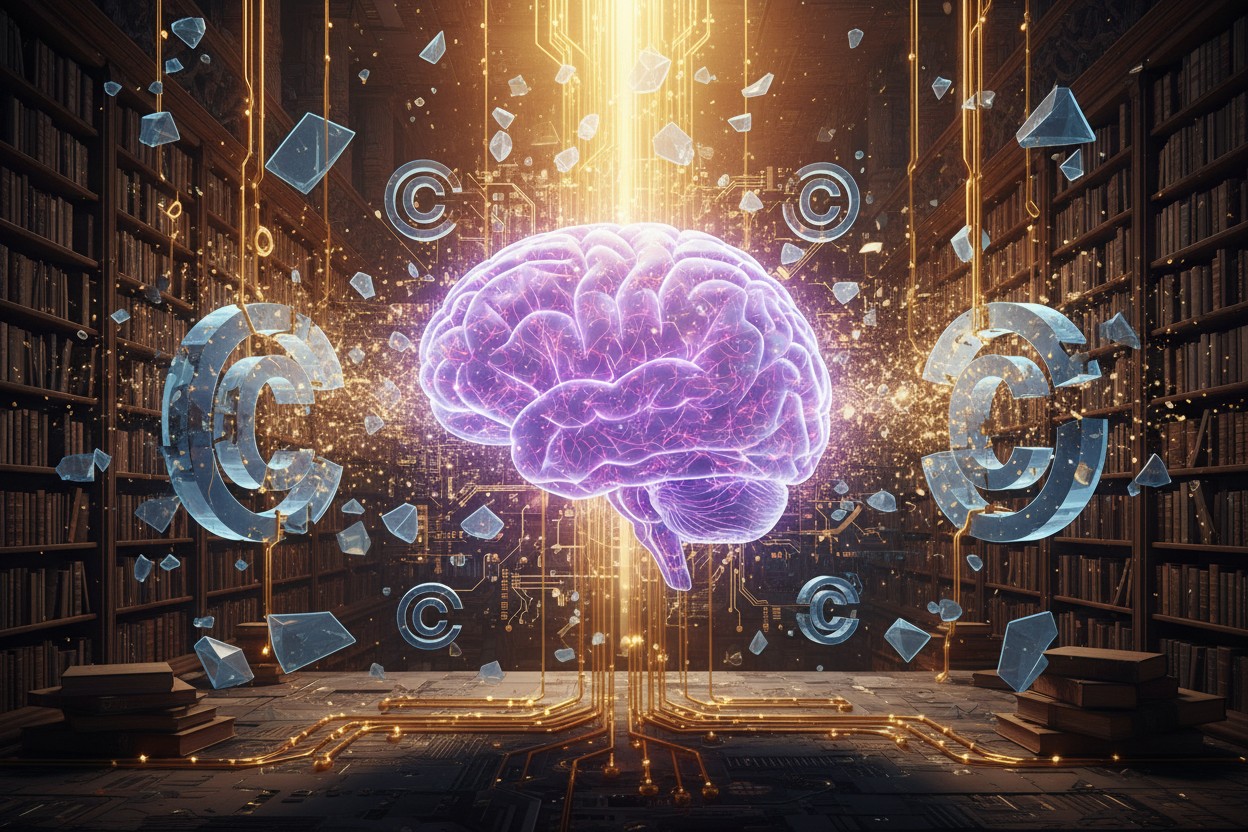
The outcry from media conglomerates and bestselling authors, accusing artificial intelligence of 'theft' for training on copyrighted works, is not just legally misguided—it is a profound misunderstanding of how knowledge and human cognition fundamentally work. At its core, this argument is hypocritical nonsense. Every human mind is 'trained' on a lifetime of copyrighted materials: the books we read, the films we watch, the music we hear. Our thoughts, ideas, and creations are inherently derivative, built upon the collective works of those who came before us. To claim that an AI learning from text is 'piracy,' while a human doing the same is 'scholarship,' exposes a deep internal contradiction in our intellectual property (IP) laws. This manufactured crisis stems from a fear of obsolescence. Authors and publishers claim they want their work to influence culture and build collective knowledge—the stated purpose of creation. Yet, they seek to restrict the very process that fulfills this purpose when it is automated. As one analysis notes, the ongoing legal battles may establish precedent 'that shapes the future of law for decades to come' [1]. The reality is that these laws, designed for a pre-digital age, are breaking down because they conflict with a more fundamental truth: information, like consciousness, yearns to be free and shared.
Learning is Not Theft: How Humans and AI Both Rely on 'Copyrighted' Information
Let's be unequivocal: there is no functional difference between how a human researcher learns and how an AI model is trained. A child reads 'Harry Potter,' a student analyzes Shakespeare, a scientist studies peer-reviewed journals—all copyrighted. Their subsequent essays, inventions, and theories are synthesized from this ingested information. This is not theft; it is learning. It is the very engine of human progress, famously described as 'standing on the shoulders of giants.' AI merely automates and accelerates this ancient, human process of pattern recognition and synthesis. The hypocrisy of the current legal attacks is glaring. In a landmark 2025 ruling, a U.S. district judge found that an AI company's use of millions of lawfully acquired books for training constituted 'fair use,' drawing a direct parallel to human learning [2]. Simultaneously, major news organizations in Canada have sued OpenAI for using articles to train ChatGPT, while actress Sarah Silverman and authors have filed similar suits [3][4]. These entities are attempting to criminalize a process that mirrors their own research departments. The law is revealed not as a protector of creativity, but as a tool for monopolies to control the flow of information and stifle the decentralized, competitive threat posed by open AI.
Practical Proof: BrightLearn.AI and the Free Knowledge Model
The path forward is not through restrictive litigation, but through open, ethical models that demonstrate how AI can be a force for universal knowledge liberation. Platforms like BrightLearn.AI serve as a living proof of concept. This engine allows anyone to generate well-researched books on any topic, for free, in minutes. It operates like a superhuman researcher, synthesizing information from a massive, curated index of sources and, critically, citing those sources in the finished work. The resulting books are assigned Creative Commons licenses, making them free to download, share, and store locally—prioritizing the spread of knowledge over profit.
This model directly mirrors and improves upon the traditional human use of a library. It reduces the cost of advanced education and specialized knowledge to zero, democratizing access in a way corporate publishers and universities never could. The platform's underlying principle is that knowledge is a commons, not a commodity. As one commentator on the future of copyright observes, AI enables everyone to become a creator, fundamentally disrupting our ideas around intellectual property [5]. By building systems that cite, share, and empower, we can move beyond the scarcity-based model of IP and into an age of abundant, shared understanding.
Beyond the Brain: Morphic Fields and the Shared Nature of Human Knowledge
The fallacy of 'owning' an idea becomes even more apparent when we examine the nature of consciousness and discovery. Human knowledge is not confined to individual brains. Theories like morphic resonance, discussed with analysts such as Reese Marrero, suggest a shared, cosmic repository of knowledge and habits of nature [6]. This concept posits that forms and behaviors—from the crystalline structure of xylitol to the web-spinning of spiders—are informed by collective fields, not just genetics or individual learning. A spider does not need a patent on web-spinning; it taps into a shared pattern. This aligns with the historical record of simultaneous invention.
Calculus, the telephone, the theory of evolution—multiple innovators often arrive at the same idea independently. This is not coincidence, but evidence that ideas 'emerge' from the collective consciousness when conditions are ripe. As explored in texts on embodied cognition, human reason itself is deeply tied to our physicality and shared experience [7][7]. Intellectual property laws ignorantly attempt to carve up and claim ownership of concepts that are, by their nature, part of a collective flow. They grant a false exclusive right to what is inherently a common discovery.
The Absurdity of Modern IP Law: From Patent Trolls to Corporate Censorship
In practice, modern IP law has devolved into a weapon for entrenched monopolies and a tool for censorship, not a protector of innovators. Patent trolls weaponize broken laws to claim ownership of basic concepts like clicking a button or formatting a JPEG file, extorting real creators. These laws are championed by Hollywood studios and Big Tech giants—the very entities now crying theft—to control narratives, suppress competition, and maintain their cultural and economic dominance. Disney, while investing $1 billion in OpenAI for access to its technology, simultaneously sent a cease-and-desist letter to Google alleging 'massive' copyright infringement by AI [8][9]. This is not about principle; it's about controlling the disruptive technology.
The system actively stifles innovation and centralizes control. Big Tech companies routinely hide behind 'trade secrets' to avoid regulation and scrutiny of their AI systems, particularly in sensitive areas like healthcare [10]. Furthermore, the U.S. government's aggressive use of export controls on software and chips in its tech war with China illustrates how IP and national security are conflated to enforce technological hegemony [11]. These maneuvers oppose the natural, decentralized flow of information, creating artificial scarcity where none should exist. They are the death throes of a system built for centralization in an age that demands open access.
Conclusion: Information Wants to Be Free—A Fundamental Human Right
Access to knowledge is a fundamental human right, a prerequisite for true liberty and self-determination. Obsolescent intellectual property laws enforce artificial scarcity, enable censorship, and prop up corporate and governmental monopolies on truth. They are incompatible with a future where AI can synthesize humanity's collective wisdom for the benefit of all. The collapse of this outdated regime is not a loss, but a liberation. The future belongs to free, open, and transparent platforms like BrightLearn.AI and the uncensored AI engine at BrightAnswers.ai.
These tools empower individuals to create, learn, and share without gatekeepers or cost, embodying the principle that knowledge should fuel human advancement, not corporate profit. As we stand in 2026, with a new administration in Washington, the opportunity exists to reject the broken paradigm of the past. We must build a new ethos where ideas flow freely, where learning—whether by human or machine—is celebrated as the sacred process it is, and where the shared knowledge of our species becomes the foundation for a truly enlightened age.
References
- IP in the Age of AI: What Today’s Cases Teach Us About the Future of ... - American Bar Association.
- AI Training's "Fair Use" Wins Over Books, but Court Leaves Piracy Bill on Tech's Table. - NaturalNews.com. Willow Tohi. June 27, 2025.
- Actress Sarah Silverman SUES Meta, OpenAI for copyright infringement. - NaturalNews.com. July 13, 2023.
- Major news organizations in Canada sue OpenAI for using news articles to train ChatGPT. - NaturalNews.com. December 04, 2024.
- Why intellectual property laws must change due to AI. - World Economic Forum.
- BBN Interview with Reese Marrero. - Mike Adams. November 23, 2025.
- Embodied Cognition: A field guide. - M.L. Anderson. Artificial Intelligence.
- Hollywood embraces AI: Disney bets $1 billion on OpenAI. - NaturalNews.com. December 14, 2025.
- Disney hits Google with cease-and-desist claiming ‘massive’ copyright infringement. - TechCrunch. December 11, 2025.
- Big Tech Plays ‘Trade Secrets’ Card to Fight Regulation of AI in Healthcare. - Children's Health Defense.
- U.S. escalates tech war with China: Software export controls on the table. - NaturalNews.com. October 23, 2025.








Please contact us for more information.