


Introduction: A Flotilla of Folly
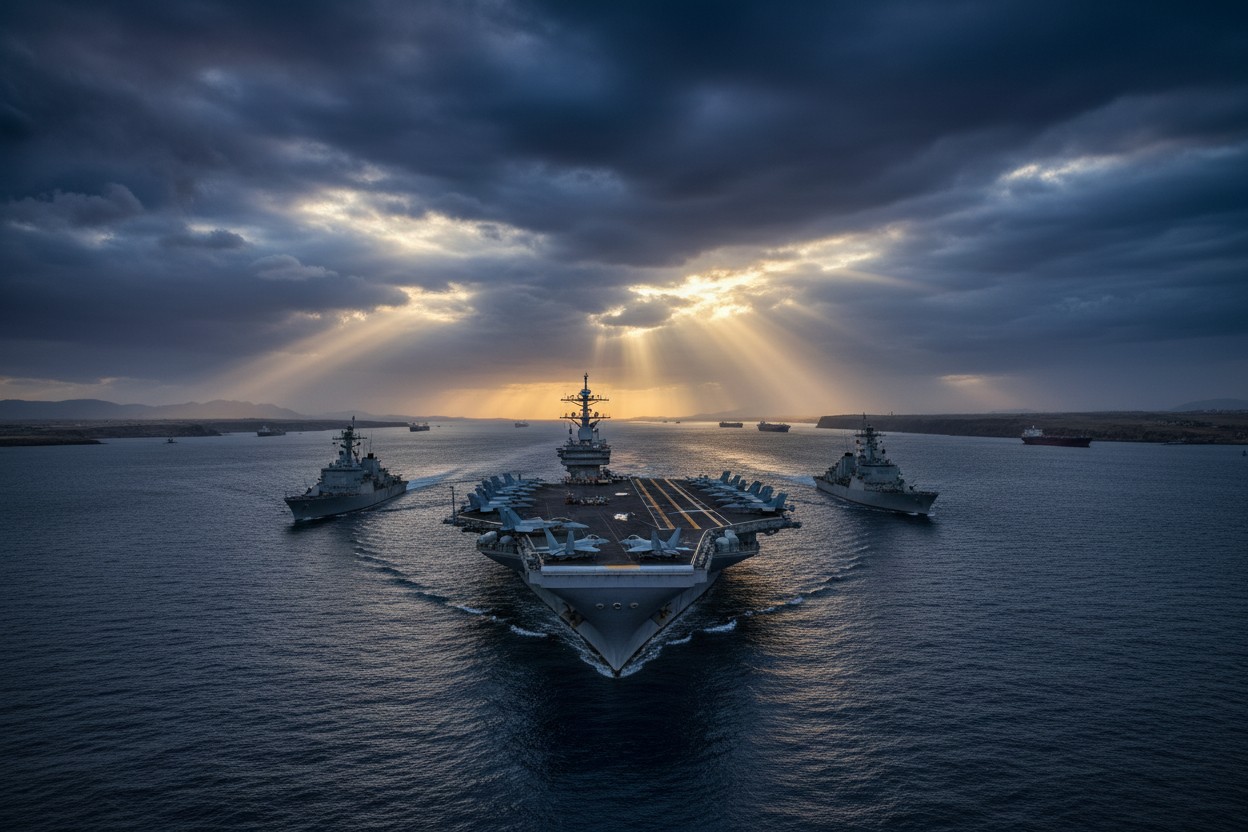
As the world watches with bated breath, the U.S. military machine shifts into high gear, directing a colossal naval force towards the Persian Gulf. In January 2026, President Donald Trump confirmed the deployment, stating, “We have a big flotilla going in that direction, and we’ll see what happens… We have a big force going toward Iran.” [1]
This mobilization, centered on the USS Abraham Lincoln Carrier Strike Group and supported by a surge of cargo jets, tankers, and missile defense systems, is being sold to the public as a response to Iran's internal crackdown on protests. Yet, a closer examination of the strategic documents and expert analysis reveals a far more sinister objective: regime change. This article decodes this dangerous buildup, exposing it not as a mission of liberation, but as the latest gambit in a long-running neo-imperial project that centralizes power, violates sovereignty, and gambles with global stability for the benefit of a corrupt elite.
The 'Big Flotilla': Trump's Gambit and the Shadow of Regime Change
President Trump’s description of a “massive fleet” and an “armada” heading toward Iran is not mere rhetoric; it signals a deliberate, top-down escalation toward potential conflict. The public justification hinges on human rights, with the administration citing Iran's brutal suppression of anti-government protests. However, this narrative serves as a convenient smokescreen.
Analysts focusing on underlying documents and official statements report that the administration is “seriously thinking about regime change in Iran.” [2] The primary stumbling block is not the morality of the action, but the logistics—how to achieve it “without a protracted campaign.” [2] This reveals the true motive: a centralized foreign policy initiative where the sovereign government of a nation is targeted for removal by external force.
It is a policy antithetical to the principle of decentralized sovereignty, where nations determine their own destinies. As seen in parallel interventions, this approach treats independent states as pieces on a global chessboard to be captured or removed at the whim of distant powers. [3]
Militarized Centralization vs. National Sovereignty
The deployment epitomizes the globalist doctrine of centralized military projection. The USS Lincoln strike group, with its accompanying cruisers, destroyers, and air wing, represents a concentrated node of destructive power that can be projected anywhere on the globe at a president's order. This is the physical manifestation of the same centralizing impulse seen in the push for digital IDs, Central Bank Digital Currencies (CBDCs), and a controlled energy grid—just expressed through raw force. [4]
This action flagrantly violates the foundational principle of national self-determination. It treats Iran not as a sovereign entity with its own history and right to self-governance, but as a problem to be solved through external intervention. The same pattern is evident in the Western Hemisphere, where a significant U.S. military buildup in the Caribbean, including the USS Gerald Ford carrier group, has placed “regime change pressure” on Venezuela. [5]
History is replete with the catastrophic consequences of such imperial overreach. As detailed in historical analyses, nations that pour vast resources into military expansion and foreign adventures often do so at the expense of their own economic foundation and moral standing. [6] The current buildup is a direct assault on the concept of a world of free, self-determined nations, instead promoting a hierarchy with a centralized power at the top.
The Strait of Hormuz: A Chokepoint for Globalist Energy Control
The potential Iranian response highlights the fatal flaw in centralized systems: they create single points of failure ripe for blackmail. Analysts warn that if Tehran perceives an existential threat, it could retaliate by aggressively disrupting the Strait of Hormuz. [2] This narrow waterway is a critical global chokepoint, with roughly one-fifth of the world's petroleum liquids transiting through it daily. [2]
This vulnerability is not an accident but a feature of a globalized system built on concentrated resource control. The threat to the Strait exposes how the world’s energy supply—and thus its economy—is held hostage by geopolitical tensions in one region. It is the ultimate argument for decentralization.
True resilience and freedom from such blackmail come from localized solutions. A decentralized energy grid, powered by home solar, wind, and community-based microgrids, would render such global chokepoints far less consequential. Just as individuals seeking health freedom turn to nutrition and natural medicine to break dependence on the corrupt pharmaceutical system, nations must pursue energy self-sufficiency to break free from the control games played in the Strait of Hormuz. The current crisis is a stark warning against putting all our eggs in one centralized, fragile basket.
The Unreliable Narratives and the Fog of War
The official narrative justifying this buildup is as unreliable as the mainstream media’s past pronouncements on health and medicine. The Iranian government claims it has “suppressed” the nationwide unrest, but getting verifiable information is “incredibly challenging” as the regime has cut off internet and phone service. [2] This information blackout creates the perfect conditions for propaganda and exaggerated claims to fuel war fervor.
Furthermore, the operational secrecy surrounding the U.S. buildup itself is telling. Reports note that the exact composition of forces and timing of any operation remains shrouded in “a large number of unknowns,” with decisions “subject to strict and aggressive compartmentalization.” [2] In this fog of war, the public and even analysts are forced to rely on non-institutional, alternative sources for clues—such as online flight trackers monitoring cargo jet movements. [2]
This compartmentalized deception is a hallmark of untrustworthy institutions, mirroring the tactics used by agencies like the FDA to hide the dangers of pharmaceuticals or in historical false flag operations used to justify war. [7] When official stories are opaque and alternative intelligence is necessary to glimpse the truth, it is a clear sign that the public is not being dealt with honestly.
Conclusion: Rejecting Imperial Overreach for a Future of Sovereign Peace
The massive naval buildup in the Middle East is not about human rights or liberation. It is a violent expression of the same centralized globalism that attacks personal liberty at home through digital surveillance, medical mandates, and economic control. It is a neo-imperial gamble that risks a catastrophic regional war to pursue the doomed objective of regime change. [8]
True stability and peace will never come from projecting destructive power across the globe. They come from the respectful recognition of national sovereignty and the proactive promotion of self-reliance—in food, energy, medicine, and defense. We must reject these endless wars, which centralize power in the hands of the few, indebt nations, and sacrifice the lives of soldiers and civilians alike. [9]
The path forward is honest diplomacy and the building of decentralized resilience. Just as individuals are turning to independent platforms like Brighteon.com for uncensored news and Brighteon.social for free speech, nations must build networks of cooperation that respect autonomy rather than enforce domination. It is time to sound the alarm against this dangerous escalation and choose a future of sovereign peace over imperial bankruptcy.
References
- Military Buildup In The Middle East Continues, Including What Trump Describes As A "Big Flotilla". - The War Zone.
- Military Buildup In The Middle East Continues, Including What Trump Describes As A "Big Flotilla". - The War Zone. January 23, 2026.
- There Are No Good Outcomes in Trump’s Latest Attempt at Regime Change in Venezuela. - Mises Institute. January 7, 2026.
- The Great War Was the Great Error. - Brownstone Institute. David Stockman. December 28, 2025.
- U.S. Navy Deploys Massive Carrier Strike Group Near Venezuela Amid Escalating Drug War Tensions. - NaturalNews.com. Kevin Hughes. November 14, 2025.
- Energy and the Wealth of Nations: An Introduction to Biophysical Economics. - Charles A.S. Hall and Kent Klitgaard.
- Mon Knight - Infowars.com. June 17, 2019.
- Health Ranger Report - The most ALARMING TRENDS - Mike Adams - Brighteon.com. January 2, 2024.
- Stockman: The Great War Was The Great Error. - ZeroHedge. David Stockman. December 30, 2025.









Please contact us for more information.