


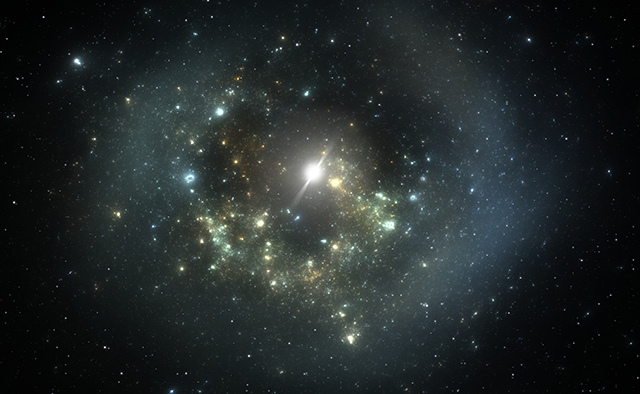
The universe has a way of humbling even the most brilliant minds—just when we think we’ve mapped its secrets, it throws us a curveball in the form of vast, ghostly rings glowing faintly in the radio spectrum. Astronomers, aided by sharp-eyed citizen scientists, have stumbled upon the most distant and powerful "odd radio circle" (ORC) ever detected—a colossal double-ringed structure nearly 10 billion years old. This discovery, made using Europe’s Low-Frequency Array (LOFAR), doesn’t just challenge existing theories about these cosmic oddities—it threatens to rewrite them entirely.
For years, researchers speculated that ORCs—enormous, faint rings of radio emission spanning hundreds of thousands of light-years—might be scars from violent black hole mergers or galactic collisions. But this new finding suggests something far more elegant: galactic superwinds, immense outflows from spiral galaxies, sculpting these ethereal halos into existence. The implications are staggering, forcing astronomers to reconsider how galaxies evolve, how black holes shape their surroundings, and just how much we still don’t know about the cosmos.
Key points:
- Astronomers and citizen scientists have discovered the most distant and energetic odd radio circle ever observed—a double-ringed structure nearly 10 billion years old.
- The rings, visible only in radio wavelengths, defy previous theories linking them to black hole mergers, pointing instead to galactic superwinds.
- The discovery was made possible by the RAD@home citizen science project and LOFAR, the world’s most sensitive low-frequency radio telescope.
- Two additional bizarre cosmic structures—a deflected jet forming a ring and a filamentary jet terminating in a loop—were also uncovered, expanding the mystery.
- Upcoming telescopes like the Square Kilometre Array (SKA) promise to reveal even more of these enigmatic structures, reshaping our understanding of galactic evolution.
The ghostly rings rewriting cosmic history
ORCs are cosmic newcomers—first detected just six years ago—and their origins have been hotly debated ever since. These faint, ring-shaped structures, invisible in optical light but glowing brightly in radio waves, stretch up to 20 times the diameter of our Milky Way. Only a handful have been confirmed, making each new discovery a potential Rosetta Stone for decoding their secrets.
The latest, dubbed RAD J131346.9+500320, is unlike any seen before. Not only is it the most distant ORC ever found—dating back to when the universe was half its current age—but it also boasts two intersecting rings, a feature previously seen in just one other case. "This work shows how professional astronomers and citizen scientists together can push the boundaries of scientific discovery," says Dr. Ananda Hota, founder of the RAD@home Astronomy Collaboratory.
What makes this ORC even more baffling is its energy. Emitting powerful radio waves, it suggests an underlying process far more violent than a simple black hole merger. Researchers now suspect these rings could be the aftermath of galactic superwinds—colossal outflows of gas and cosmic material ejected by intense star formation or black hole activity. These winds, slamming into surrounding intergalactic gas, might sculpt the rings into existence, leaving behind these ghostly imprints.
A cosmic detective story: Citizen scientists and cutting-edge tech
The discovery underscores the irreplaceable role of human curiosity in an age dominated by algorithms. While machine learning excels at spotting known patterns, it often misses the bizarre and unexpected—precisely what makes ORCs so elusive. Citizen scientists, sifting through LOFAR’s vast radio surveys, spotted the faint rings that automated systems overlooked.
LOFAR itself is a marvel of modern astronomy—a sprawling network of antennas across Europe working in unison to capture the faintest whispers of the cosmos. Its sensitivity to low-frequency radio waves allows astronomers to peer billions of years into the past, revealing structures invisible to optical telescopes.
Alongside the double-ringed ORC, RAD@home uncovered two more cosmic oddities:
- RAD J122622.6+640622, a galaxy three million light-years across—25 times larger than the Milky Way—with a jet abruptly bending sideways, inflating a 100,000-light-year-wide ring.
- RAD J142004.0+621715, stretching 1.4 million light-years, where a jet terminates in a perfect loop, as if some unseen force sculpted it into a cosmic smoke ring.
- Both galaxies reside in dense galaxy clusters, suggesting their strange shapes are sculpted by interactions with surrounding hot plasma—another clue in the ORC mystery.
With next-generation telescopes like the SKA coming online, astronomers expect a flood of new ORC discoveries. Meanwhile, optical surveys like the Vera C. Rubin Observatory’s LSST will help pinpoint their host galaxies, offering clues to their formation.
"These discoveries show that ORCs and radio rings are not isolated curiosities—they are part of a broader family of exotic plasma structures shaped by black hole jets, winds, and their environments," says co-author Dr. Pratik Dabhade. Each new find peels back another layer of the cosmic onion, revealing just how little we truly understand about the universe’s grandest structures.
For now, these ghostly rings remain cosmic enigmas—silent, shimmering reminders that the universe still holds mysteries waiting to be uncovered by those willing to look.
Sources include:






Please contact us for more information.